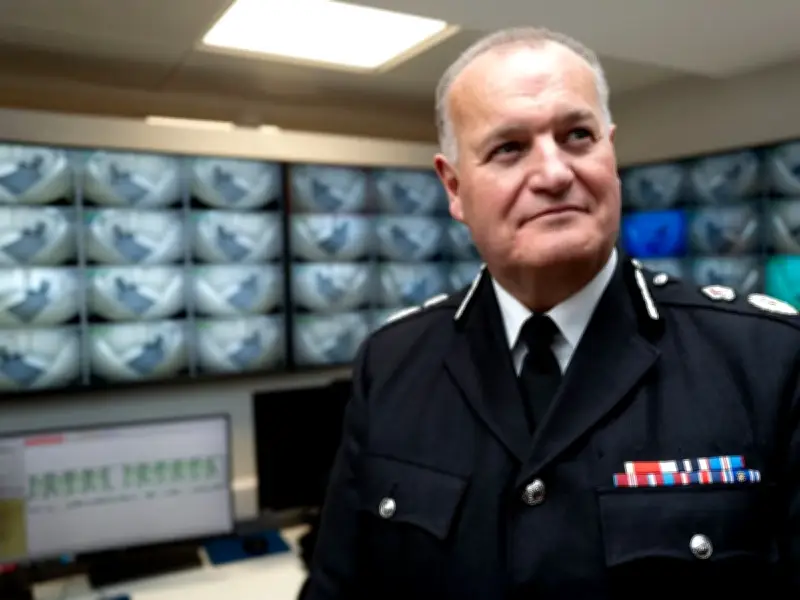
Greater Manchester Police (GMP) would not necessarily be merged with neighbouring forces as part of a radical reform of policing, the force's chief constable has said. Sir Stephen Watson was among speakers at an event in Manchester on Friday, November 6, where the Commissioner of the Metropolitan Police, Sir Mark Rowley, warned UK policing 'will fail' if it doesn't 'urgently reform.'
Call for Restructuring
In a keynote speech, Sir Mark said the country has 43 'overstretched' police forces 'trying to do too much with too little' and needed to drastically reshape its current 'fragmented, bureaucratic, top-heavy spaghetti model.' He said he believed it should be restructured into one national police service and 'eight to ten regional police forces' alongside hundreds of 'local police commands.'
The proposal has faced resistance from some police and crime commissioners and local leaders who fear a restructuring will cost money and weaken ties between senior officers and the communities they serve. However, Sir Mark said that 'scale provides efficiency' and that efficiency savings would 'enable us to put more resources on the frontline.' He said reform would also allow specialist units to tackle organised crime, which some smaller forces struggle to do adequately.
GMP as a Model
Sir Stephen, who has turned the force around to being a top performer after being in special measures, said during a roundtable discussion with other chief officers that GMP is 'a good example of what you can do with scale and what you can do in terms of teaming and laying, and delivering ubiquitously full-spectrum delivery.' He said it was a 'racing certainty' that there 'will not be a slug of general extra money into policing, given the state of public finances' and that 'we have got to use the money already committed to policing better than we do today.'
"It must be an incontrovertible fact that we have tied up in 43 headquarters, 43 chiefs, 43 deputies, 43 IT directors, 43 HR directors, 43 procurement specialists, 43 different IT systems; it must be the case that there is money to be liberated through economies of scale and bringing some rational bringing together of those resources. And the point of that exercise is to bolster that which happens at the local level," he said.
"All we are trying to set out is, there is a way, pragmatically we think, within what we've got to do much better and we are also making the case that the status quo, is simply not sustainable. If we don't change, this is decline by design. I think the case for reform is unanswerable."
"Even forces of the size and scale of GMP cannot, into the future, continue to plough their own furrow," he continued. "There is a very hard-nosed business case to be made. It's not pie-in-the-sky, and it seems to me that if any commercial entity were to be set up in the style of British policing, they would not remain solvent for very long at all."
Sir Stephen's Vision
Speaking afterwards, Sir Stephen told the Manchester Evening News: "This isn't a pitch for reform on the basis that I think Greater Manchester Police needs to change. I don't think it does. I just think everybody needs to look a bit more like us.
"That might sound extraordinarily arrogant. It isn't meant to be, because I am not arguing for one second that we are perfect. We have a long way to go. But if you look at the performance of GMP over these last five years, we've gone from being in a very difficult place to being very nearly at the very top of policing. And that is a testament to the strength of our system and our model, and it's what I want to see replicated elsewhere."
The GMP Chief Constable said it would be a 'mistake' to be 'overly sort of doctrinaire about how many forces come out of the current construct.' When pressed if the proposal would inevitably mean GMP would be merged with other neighbouring forces such as Cheshire, Lancashire, or Merseyside, Sir Stephen said: "It could potentially remain as it is, and this is the point.
"I'm not in a position to say that. Whilst I am clearly saying that I think the 43-force model is unsustainable, what I am not pinning my colours to is saying 'it should be 10', 'it should be 12', 'it should be 15.' What I'm saying is, we should move to optimal forces where everybody looks at least like GMP."
"I think that Greater Manchester Police within the Greater Manchester Combined Authority, under the auspices of the mayor, is probably, in my humble view, as close to optimal as any police force in the country," he continued. "So I just want to see what we've got sustained and preserved. If it can be improved upon, then I'm all ears, but that for me is where I currently stand."
Concerns from Other Forces
However, he said that the 'shape of reform' would be 'contributed to by more than merely police officers.' "Frankly, it's not our decision, ultimately," he said. "This is going to be a combination of the Home Secretary, the Prime Minister, our politicians, and of course there is a clear locus for the local mayors."
"There's a lot of debate to be had. All we're trying to do, from a police officer perspective, is seed that debate to say the status quo across the country is not sustainable," he added.
Speaking during a Q+A at the event, the outgoing chief constable of Cheshire Police, Mark Roberts, voiced concerns that demands in bigger metropolitan areas could be prioritised over areas like his in any larger, merged force. "Currently, my head of crime can divert a surveillance team from lifestyle on a drug dealer to go and find a vulnerable child in the bed of a paedophile with a phone call. Instantaneous," he said. "The concern is that resource then goes into a tasking process and ultimately we will always lose to Manchester and Liverpool when we're looking at residual risk. And that makes us less effective at the force level and the community level.
"So how do you design a system that keeps that resource, as the military would say, push resource forward to decision-makers as much as you can, so that we stay effective and it doesn't get lost in that bigger structure?"
In response, Sir Stephen said: "I don't come at this from the perspective that big is automatically better. I come at it from the perspective that there are some things that are more optimally constructed than others." He told the M.E.N.: "We are three, four, five times larger than most forces in this country. So, by definition, we're a big force, and we're not remote from the public that we serve. Why? Because our force is structured on a neighbourhood policing model."
He said the risk there was a 'risk' that reform made policing more remote and it was a 'risk that has to be mitigated.' "If, ultimately, out of reform comes the situation where policing is made more remote, then that would be unacceptable," he said. "It would be unacceptable to the public and to me. So we have to design something that at the very least gives a better service to the public today than they currently receive."
The Government launched a review to consider dramatically reducing the number of forces in January this year. The review, led by former Scotland Yard chief Lord Bernard Hogan-Howe, will make recommendations on how to restructure policing.