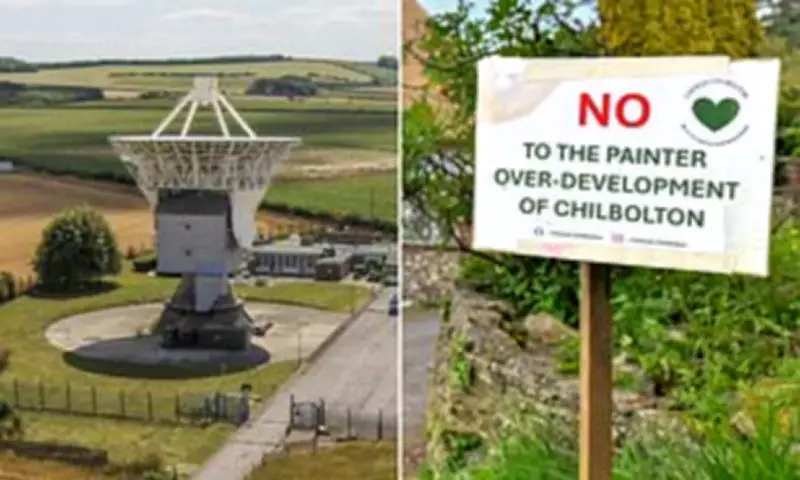
An observatory at the forefront of British science has hit out at plans to build 75 houses nearby, arguing the development would make its high-tech equipment inoperable. Situated in a rural village in Hampshire, Chilbolton Observatory uses highly specialised, cutting-edge technology to conduct crucial scientific research. It was built on the site of a disused RAF base chosen for its remoteness, sparse population, low vehicle traffic volumes, dark skies and 360-degree horizon.
But the observatory has now come under threat, it claims, from plans submitted by Southern Planning Practice LTD to construct dozens of homes on its doorstep. The application also includes plans to open a doctor's surgery, small shop or café, parish office, play area, sports courts, and public open space in what would be the largest single development in the village.
Observatory's Objections
The observatory's operators, the Science and Technology Facilities Council (STFC), argue the works would affect its ongoing viability. In an objection, it claims that the vital space, telecommunications and environmental research conducted at the observatory would be disrupted by light pollution produced by the housing development. The operators also fear that building works would create an increased amount of dust which would impact the site's Air Quality Supersite monitoring.

Chilbolton Observatory's two main functions are meteorological monitoring and Earth orbiting satellite monitoring, and the site is home to the world's largest fully steerable meteorological radar. But the STFC says such sensitive instruments could be rendered inoperable if the housing development plans are approved, due to increased electromagnetic interference caused by houses, traffic and mobile devices.
Official Statement
A spokesperson said: 'The UK's Chilbolton Observatory is objecting to new housing nearby due to our concerns that any future development will threaten the unique scientific capabilities and operational viability we offer on behalf of the nation. Chilbolton is a key UK governmental facility which provides, on behalf of all of us, critical atmospheric research and satellite data. Any potential residential growth nearby would threaten that work due to increased radio and electromagnetic interference that would have a negative impact on the performance of the sensitive scientific instruments on site.'
In its objection, the STFC argued that its current rare and unique location would be compromised by the new development. It stated: 'The Chilbolton Observatory is a unique and valuable National UK Science facility which provides a broad range of vital space, telecommunications and environmental research and operational capabilities to multiple Government Agencies and commercial partners. The rare and unique location and conditions at the Observatory, including the remoteness, sparse population, low vehicle traffic volumes, dark skies and 360-degree horizon are all crucial for the continuation of operations both now and in the future.'
Development Details
Submitted by James Painter through Southern Planning Practice, the housing development would see homes built to the north-east of the site on Drive Road. As well as the properties and amenities, a new junction and a footpath and cycle link towards Chilbolton would also be constructed. Mr Painter's planning statement argues that the council's lack of a five-year housing land supply and the site's draft allocation in the emerging Local Plan mean the benefits of the scheme outweigh any policy conflict with its countryside designation. He said that 40 per cent of the homes would be affordable, with a mix of predominantly two and three-bed properties to be built.

Local Opposition
However the plans have also come under fire from residents. According to local campaign material and parish updates, more than 200 public comments have been submitted to Test Valley Borough Council on the application. Locals have raised concerns over the scale, siting and potential impacts of what would be the largest single housing development in the village. Martin Armitstead, a resident in the village, objected to the plans, saying: 'The comment from Chilbolton Observatory is particularly telling. This is a nationally important installation, and nothing should be allowed to compromise its efficiency and integrity. With current world events this is even more important to protect, for the national benefit.'
Chilbolton Parish Council also objected to the plans because they would have a negative impact on the existing village and rural area. It said: 'The development is of an excessively large scale out of proportion with the rural character of the village.'
National Significance
Outlining the significance of Chilbolton Observatory, The National Space Operations Centre (NSpOC) said it works alongside the National Space Operations Centre to develop and operate the UK's space surveillance and protection capabilities. It said: 'The Chilbolton Observatory supports NSpOC with the provision of sensor services to provide observations of artificial space objects under the National Programme as tasked by NSpOC. This involves the radar dish CASTR and the COATS optical telescope. The services at Chilbolton also include the transfer of sensor data to NSpOC, to assist in the objects orbit determination and contribute to SDA services. Any development that could degrade the Observatory's current and future capabilities could impact NSpOC's mission sets that support the UK's space surveillance and protection.'
The application is still under consideration.