
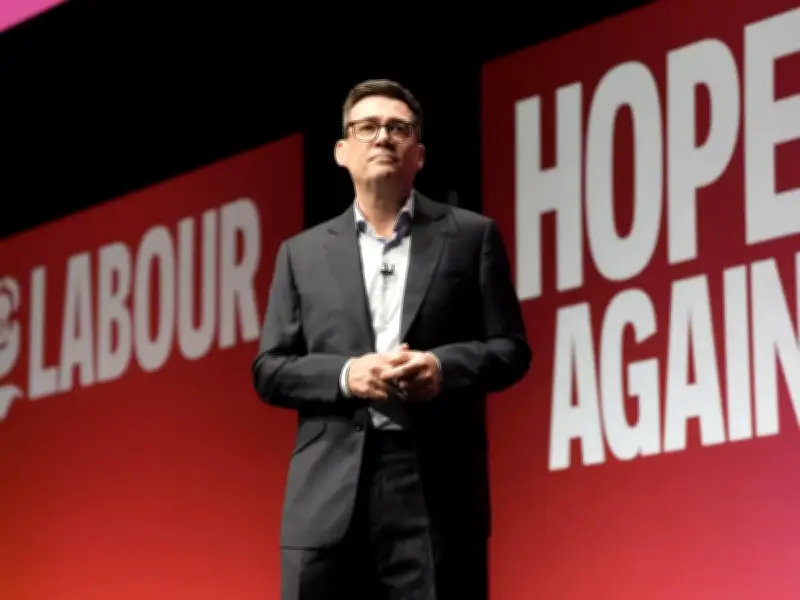
Prime Minister Andy Burnham has used his first Labour leader conference speech to announce a new landmark social care policy and major changes to pensions. The Prime Minister made the announcements during his address at the party conference in Liverpool, where he also set out policies on council housing and dealing with spiralling energy costs.
Mr Burnham told the audience: “We can’t carry on as we are. Politics-as-usual has taken Britain backwards. More of the same isn’t good enough and isn’t going to get us where we need to be.”
Criticism of centralised power and vested interests
The Prime Minister used the speech to criticise the centralisation of power in the hands of 'vested interests' and promised a break from the 'flawed thinking of the last 40 years'. Mr Burnham was giving his first speech as party leader, after replacing Sir Keir Starmer as Prime Minister on July 20 - a month after the former Greater Manchester Mayor was elected as MP for Makerfield.
He ended the speech holding back tears as he spoke about his dad Roy, who recently died following a battle with Alzheimer's.
Councils to take over poor-quality homes
Councils will be given the power to take over poor-quality homes if landlords refuse to improve them, Mr Burnham announced to party members. The Prime Minister said: “Go to almost any town across Britain, and you will see plenty of empty homes. We will give councils the power to take control of them and bring them back into the public housing stock.”
He added: “Landlords who rent out the worst quality homes will be given warnings to improve them. If they refuse, we will make it much easier for councils to acquire those homes – and we will legislate if necessary.”
Leasehold reform and water nationalisation
Andy Burnham has promised to introduce a bill before Christmas for 'long-overdue' leasehold reform. He told the conference: "The days of you being squeezed for every penny are coming to an end."
The government will end the ban on public ownership of water companies, paving the way for the nationalisation of firms that do not 'serve the public interest'. Mr Burnham said Angela Eagle “will present a strengthened Water Bill to Parliament”, with the centrepiece being the repeal of Margaret Thatcher’s ideological ban on public ownership of water companies.
Great British Grid and National Care Service
Mr Burnham announced a new publicly owned 'Great British Grid' in a bid to bring UK energy costs down to levels in line with European nations within a decade. The move will give “more public control” to help reform the “broken energy market”.
The Prime Minister also announced a new National Care Service that will be 'free at the point of use', with no charges imposed on the basic state pension. He apologised to care workers, saying: “I want to speak directly today to our care workers – you are not invisible to me. I see you, I thank you and I am sorry that my profession has let down yours for so long.”
Pension triple lock change and education reform
Mr Burnham announced Labour will 'adjust' the pensions triple lock from 2030, to pay for social care reform. Pensions would rise either by CPI inflation, or a minimum of 2.5%, removing the link to average earnings. He added that low-income pensioners would not have to pay income tax during this Parliament.
Mr Burnham said a “fundamental rethink” of the welfare system is needed to fund new opportunities for young people. He reiterated Labour’s plans to change the education system with academic and technical pathways from 14 and offer work placements and apprenticeships, as well as reducing waiting times for young people needing mental health support.
Electoral reform and UK-EU relations
Mr Burnham said Labour will fight the next election on a promise to introduce a form of proportional representation. He announced he would set up a new national commission on electoral reform, and would invite all political parties to be part of its work.
He also said he would set out 'options' on UK-EU relations later this year, telling the Labour conference that Britain needed to decide on its 'long-term relationship' with the bloc.




