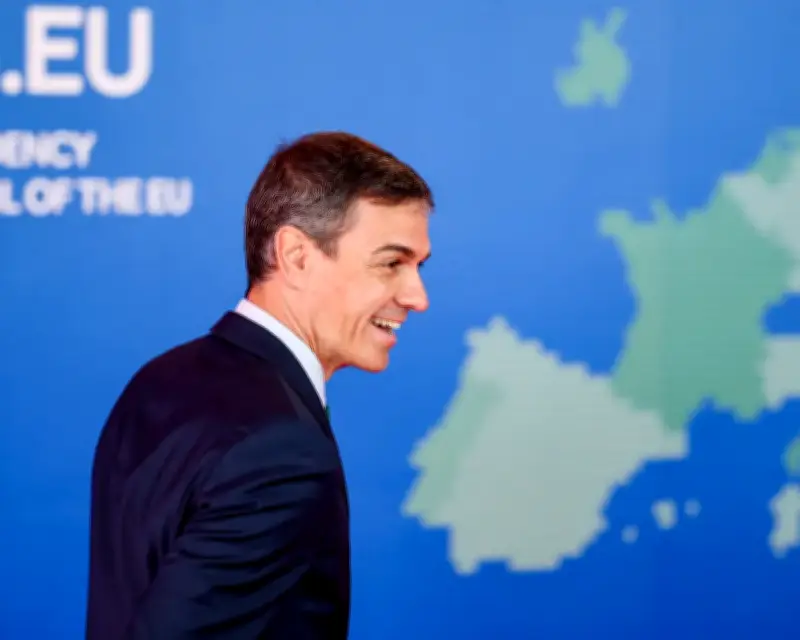
To international onlookers, Pedro Sánchez appears to have achieved the impossible. Where other European leftist and left-ish premiers have flopped and flailed, the Spanish PM has endured.
Since June 2018, Sánchez has ruled from Madrid, implementing a raft of progressive policies. More recently, he has emerged as a leading, and often lone, left-wing European voice on the global stage, striking a defiant tone on everything from the Trump administration's war in Iran (“the smokescreen of war to hide their failure”) to Israel's actions in Gaza (“exterminating a defenceless people”). The fact that the international press has nicknamed him El Guapo (the handsome one) can't hurt.
Home and away
At home, however, it's a more complex story. Sánchez's inner circle is in the midst of a damaging corruption scandal, and polling has his traditionally centre-left Spanish Socialist Workers' party (PSOE) faltering. Meanwhile, recent scenes in Ceuta and apocalyptic wildfires throw up thorny policy challenges. European leaders have publicly turned on Sánchez – and this is with a general election looming next year.
But just like the UK's own prime minister, while Sánchez has carved out a name for himself, he was not always the left-wing figure he is seen as today. For today's First Edition, we ask: who is the real Pedro Sánchez? And, what lessons can Andy Burnham learn from his tenure? Madrid-based journalist Eoghan Gilmartin helps us answer these questions.
The art of political reinvention
Andy Burnham and Pedro Sánchez share similar origin stories. Both initially entered, then departed, their respective parliaments having failed to achieve their ambitions; both returned, and subsequently secured the top job, after quiet reinvention.
We know the Burnham story now: the former Blairite minister lost out on the Labour leadership, and instead became mayor of one of the UK's largest cities, where he emerged transformed thanks to his vaguely articulated philosophy – Manchesterism.
Sánchez too wasn't always the progressive figurehead he is today. The former economics professor was first elected PSOE leader in 2014, firmly a centrist. “He was the compromise candidate between left and right,” says Gilmartin. “There were few expectations of him at the beginning.”
His first stint at the party's helm ended in 2016, after a series of electoral drubbings and a messy internal revolt saw him forced out by party grandees. And so marked the start of his remaking: 6ft 3in Sánchez squeezed into his Peugeot and road-tripped across España. “I'll get in my car and travel all round Spain to listen to those who haven't been listened to, to the grassroots members and left-wing voters,” Sánchez said.
Beyond Madrid, he morphed into an anti-establishment, man-of-the-people figure. By the summer of 2017, he was PSOE leader again. He formed a government in June 2018, and has been PM since.
“He's not necessarily a committed left-winger,” says Gilmartin, “but Sánchez understands that anchoring his party to the left and positioning himself as the leader of a wider progressive bloc is where he can govern. He's a very impressive pragmatist.”
In 2019, to shore up support from the left, Sánchez pledged to implement hundreds of progressive policies. And he has broadly delivered on this agenda: investing heavily in renewables, hiking up the minimum wage, extending abortion rights, banning so-called “gay conversion practices”, capping rent increases and raising taxes on the super-wealthy while reducing the tax burden on lower earners.
A winning formula
Eight years in, it's no great surprise Sánchez's popularity is on the wane. But his 2023 electoral success is worth considering. In the run up to that vote, he was on the brink of defeat. The right-wing People's Party led the polls, with far-right Vox primed to come in third. It seemed a right/far-right coalition beckoned. But says Gilmartin, “by framing the vote as him against the far-right,” Sánchez was able to turn the tide, pointing out all the policy gains and social protections that would be under threat otherwise.
Starmer tried this, too, in his 2025 Labour conference speech. But his vision of “patriotic national renewal under the Labour party … or the toxic divide and division of Reform” didn't land. Starmer couldn't communicate a coherent vision. He failed to point to policies that voters would miss. “Polarising against the right works for the centre left if you deliver on cost of living and other material issues,” says Gilmartin. Else, you're left with the empty progressivism of say, Hillary Clinton taking on Trump. “That's been proven to not be enough.”
Lessons for Burnham
Burnham knows he has to deliver, with less than three years before the next general election. It looked initially that he might be bold on policy: announcing his intent to end homelessness on day one.
But since then, (and in fairness, Burnham did take the reins right before a summer recess), he has gone rather quiet. And on both immigration and the environment – two major wedges between progressives and much of the right – he has said almost nothing at all.
Sánchez took a different tack. One of his first acts as PM was allowing the Aquarius to dock in Valencia: the ship carrying 629 people rescued off the coast of Libya that had been turned away from Italy and Malta. Since then, Sánchez has moved to regularise undocumented migrants in Spain. After 72,000 mostly Moroccans crossed into Ceuta last month, Sánchez didn't pander to the right, or bow to pan-European pressure. The results are clear: despite recent increases, Spanish people remain relatively unconcerned about immigration. In January, only 3.9% of Spaniards felt immigration was the biggest issue facing Spain; in June, it was 4.8%.
Similarly on climate, Sánchez hasn't held back. Where Burnham banned BBQs, Sánchez declared “climate change kills”. He's spending billions on the green transition while Burnham dithers on north sea drilling. “There's no sense here that you apologise for being proactive and progressive on climate,” says Gilmartin.
In occupying this space, Sánchez has gobbled up the left-wing vote. Sumar, Sánchez's left-of-PSOE coalition partners has dropped in the polls. When Sánchez first became PSO leader, further-to-the-left Podemos was polled up to 26%; today, it's hovering at 3%. Burnham might do well to learn from this: because while Starmer made attacking the left a defining feature of his time in office, Labour lost almost four times as many voters to the Greens than to Reform in the 2026 local elections.
For now, the wait continues to see if Burnham will prove a progressive PM, or at least an impressive pragmatist.