

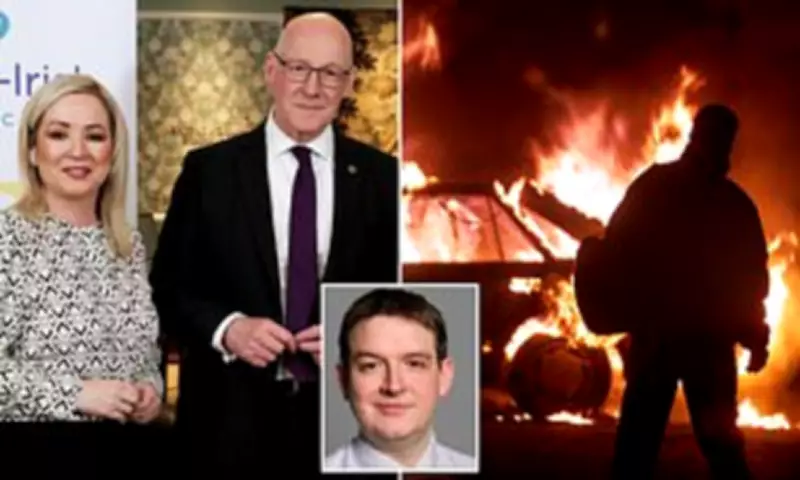
It should come as no surprise that John Swinney is willing to collaborate with Sinn Fein as part of his push for Scottish independence. Yet few could imagine a more compelling case for the argument that nationalism can induce a form of moral blindness.
True, one should not be naive about politicians of any stripe when advancing their agendas. Politics is not for the faint-hearted—consider the bloodletting and backstabbing unfolding in Whitehall. However, Mr Swinney cozying up to a party historically regarded as the political wing of the IRA to bolster his referendum crusade is surely a step too far.
That is how relatives of those slain by Republican terrorists perceive it. As revealed yesterday, some will stage a protest at Holyrood later this week. They are rightly furious that Mr Swinney suggested people should 'move on' from the Troubles, putting the slaughter behind them. This is easier for some than for others, but the First Minister remains unrepentant.

Responding to calls for an apology to victims, he insisted he has 'no intention' of apologising. Asked if his language was simply sloppy, Mr Swinney said: 'I think the issues involved in the peace process have required people to move on. That is exactly what they have done, and I am simply reflecting what has happened.' Far from tempering his position, Mr Swinney has doubled down.
What This Reveals About the SNP
It is worth examining what this episode tells us about the SNP and what the party is prepared to do to further its separatist goal. Mr Swinney is driven by ideological zealotry, though he acts the part of a mild-mannered moderate with a strong sense of personal integrity. If you buy into this charade—and few truly do—how do you explain Mr Swinney aligning the SNP with a party notorious during the Troubles for its links with IRA killers?
Once upon a time, the SNP would not touch Sinn Fein with a bargepole. In 1980, an invitation was extended by Irish nationalists to the SNP's left-wing 79 Group faction to address its Ard Fheis, or annual conference. It was considered but rejected. Leaked minutes showing it had been countenanced caused such a scandal that it contributed to the group's ringleaders, including a young Alex Salmond who argued against attending, being briefly expelled from the party he would later transform.
By contrast, at the recent Sinn Fein Ard Fheis in Belfast, before the Scottish election, a video message from Mr Swinney was shown to delegates. He claimed the parties were on the cusp of an 'absolutely seismic moment' in British politics. Changed days for the SNP indeed, though one might wonder if the same applies to Sinn Fein.
Sinn Fein's Ongoing Links with the IRA
In 2004, six years after the Good Friday Agreement, the Labour UK Government stated its view that both the IRA and Sinn Fein were 'inextricably linked'. A 2015 report commissioned by the UK Government on the status of Irish paramilitary groups, written by the Police Service of Northern Ireland (PSNI) and MI5, said the Provisional Army Council—the IRA leadership—still strategically oversaw both the IRA and Sinn Fein. This view was reiterated in 2020 by the PSNI, though Sinn Fein president Mary Lou McDonald, when asked if the IRA still exists as a political organisation, said: 'No, it does not, so far as I am aware.'
The IRA is held by many to be largely responsible for the 30-year-long Troubles in Northern Ireland, which saw 3,700 killed, including 1,000 members of the security forces—both soldiers and police. Sinn Fein currently helps form the government of Northern Ireland, albeit shared with the Unionist community, which remains an integral part of the UK under the Good Friday Agreement. However, a united Ireland remains Sinn Fein's main objective, although it claims to oppose paramilitary activity and support Northern Irish law and order.

The 'Pan-Celtic' Strategy
Against this complicated backdrop, Mr Swinney is determined to launch a 'pan-Celtic' political agglomeration, including Plaid Cymru, which ended a century of Labour rule in Wales on May 7. He insisted before the Scottish election that he would help 'to change the dynamics of the UK so that we can—I can—secure my objective of winning Scottish independence'. He added that although Scotland, Wales, and Northern Ireland would mount their own campaigns, he thought 'the UK would be changed irreversibly if that outcome was to be the case'.
How Mr Swinney sees those campaigns playing out is anyone's guess, given that there is no viable legal mechanism allowing the SNP to order a second referendum without UK Government consent. In Wales, Plaid Cymru says it is prioritising delivery over the constitution—we shall see how that goes—while only 36 per cent of people in Northern Ireland supported reunification with the Republic, according to polling in 2024.
Nonetheless, the 'pan-Celtic' axis is part of Mr Swinney's strategy for tearing Scotland out of the UK. It is a plan not without risks. One former senior police officer in Scotland told me: 'Scottish involvement in Ireland/Northern Ireland has never gone well, and my advice would be to leave well alone. The roots of Sinn Fein's disputes with the UK Government are manifestly different from those of the SNP.'
Moral Repugnance and Hypocrisy
Mr Swinney's appetite for building bridges with Sinn Fein shows there is plainly no level to which he will not stoop in a bid to realise his party's dream of dismantling the UK—however morally repugnant it may be to many in Scotland and across the Irish Sea. He will soil his hands doing business with Sinn Fein but seemingly draws the line at an olive branch for Reform UK, which he shut out of cross-party talks last week. Mr Swinney cannot stomach the division he believes Reform is intent on fuelling, yet he and the SNP are in a glass house of enormous proportions.
Grievance is central to the Nationalists' mission. Mr Swinney may want us to believe that working with Reform is a red line he will not cross, even if that insults the nearly 400,000 Scots who voted for the party on May 7. But let us face it: he would ditch his supposedly principled stance on refusing to break bread with Reform (or anyone else) in a microsecond if he thought it would help the independence drive. Mr Swinney, or whoever succeeds him as First Minister, will do whatever is required for the cause because it is the only thing that interests them. Voters will see his stance for what it is—a sickeningly cynical bid to advance the failed separatist cause, regardless of the consequences.





