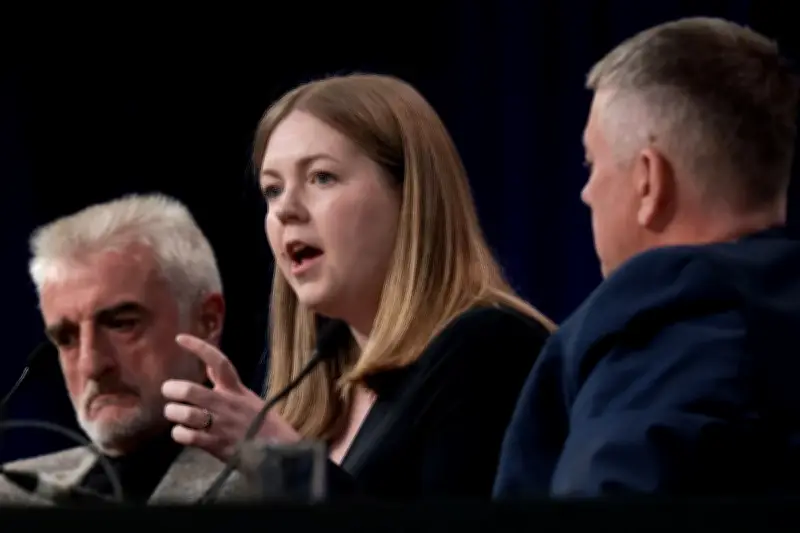
The co-leader of the Scottish Greens has said the debate over whether Zionism is racism is "unhelpful" to achieving peace in the Middle East. Gillian Mackay was speaking to journalists at the SNP conference, where she appeared to discuss Scottish independence.
The debate was sparked by a motion at the annual England and Wales Green Party conference, which was backed by members, defining Zionism as racist. Zack Polanski's party – which is not officially linked to the Scottish party but forms part of a wider international movement – has faced a backlash since the vote. Labour announced it will cut ties with the party at council level in England and Wales if representatives do not disavow the motion.
'A difficult one'
Ms Mackay said: "I don't think the conversation at that point is helpful because it focuses on definitions rather than actually focusing on how we achieve peace for the region as a whole and make sure that self determination for those there is what we're talking about and how we get to that point of peace."
However, Ms Mackay struggled to answer whether she thought Israel had a right to exist. "It's a difficult one," she said after a pause. She added: "They absolutely should have the right to have somewhere to be and to be able to live in peace."
She continued: "We absolutely condemn antisemitism in absolutely all of its forms and we want to see peace in the Middle East and self-determination for the people that are there. I think constantly having politicians from other places say what should and shouldn't be the thing for those people I don't think is always particularly helpful. But I think we need to make sure that self-determination piece is what we strive for."
Reaction to the motion
Asked whether she herself views Zionism as racist, Ms Mackay said the "realisation" of Zionism – the Israeli Government's offensive in Gaza and the treatment of Palestinians in the West Bank – is. "I don't think anybody can look at what's happening in Gaza and the West Bank at the moment and not see that the realisation of that political ideology is racist. It's resulted in the displacement of millions of Palestinians, the deaths of thousands of Palestinians, and I don't think anybody looking at the situation objectively could come to any other conclusion."
The Scottish Greens, who will meet for their annual conference in Inverness next weekend, will not have a similar debate, Ms Mackay said.
Scottish Conservative MP Andrew Bowie said afterwards: "Antisemitism has no place in Scotland. The Greens under Zack Polanski have allowed it to rear its ugly head. Their toxicity is replicated in the words of the Scottish party, and it is too late for Gillian Mackay and Ross Greer to distance themselves from the mire they helped create."
Reform UK's Scottish deputy leader Thomas Kerr was also critical, saying: "Even in the face of widespread condemnation of the UK Greens' motion, Gillian Mackay has joined Ross Greer in choosing their twisted interpretation of Zionism over the safety and security of Scotland's Jewish communities. At least Zack Polanski and three of the other four MPs immediately distanced themselves from the motion that conflicts with the International Holocaust Remembrance Alliance's definition of antisemitism. What is 'deeply unhelpful' is that the two Scottish leaders have delved deeper by supporting that antisemitic motion through opaque language, showing they care more about the lives of Palestinians than the 7,300 Jews living in Scotland."
Mr Kerr added: "Reform will not waver in standing up for Scots under fire, even if 'Never Again' in 2026 means calling out toxic rhetoric from another political party."