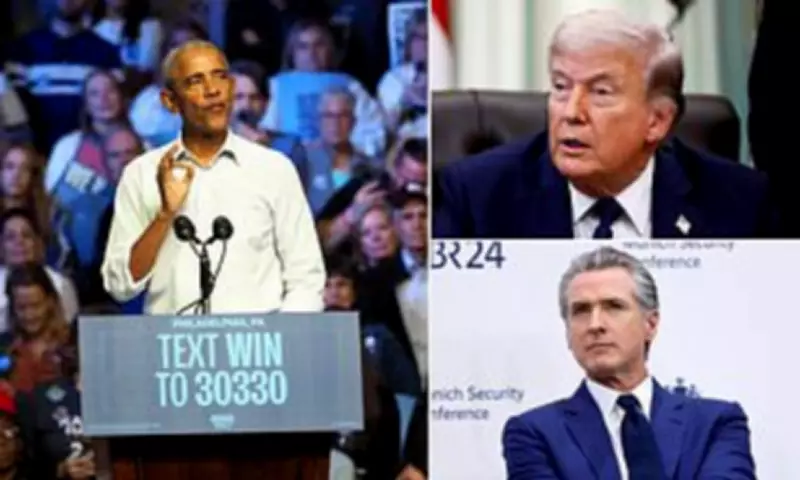
It has been a decade since Barack Obama held the most powerful position in the world, but the former president continues to wield influence by supporting the Democrats' fight in the partisan redistricting war. On Tuesday, Virginia narrowly voted to approve a congressional redistricting measure that would help Democrats capture up to 10 seats in the House of Representatives ahead of the midterm elections in November. State lawmakers can now redraw congressional districts, likely shifting four Republican-held seats toward Democratic control and potentially flipping the House.
Obama's Change of Heart
Even though Obama had previously been a fierce critic of redistricting, he changed his tune amid the redistricting wars, prompted by Donald Trump's push last summer for Texas Republicans to redraw their map. Obama became an unlikely player in Virginia's recent redistricting vote, with both Republicans and Democrats using the former president in advertisements to confuse voters.
On April 17, Obama posted a video message on X, calling on Virginians to vote 'yes' on the referendum to approve the Democrat-controlled redistricting map. 'By voting yes, you have the chance to do something important. Not just for the commonwealth, but for our entire country,' he said. 'By voting yes, you can push back against the Republicans trying to give themselves an unfair advantage in the midterms.'

He echoed a similar message in an advertisement earlier this year, urging Virginians to vote 'yes' to prevent Republicans from 'stealing seats' and 'rigging the next election.'
Republican Counter-Ads
However, Republicans caught on to the Obama trend as well, paying for ads featuring his past views on redistricting and gerrymandering to confuse voters. An ad urging Virginians to vote 'no' included a clip of Obama saying: 'Because of things like political gerrymandering, our parties have moved further and further apart, and it's harder and harder to find common ground.' The ad then accuses Richmond politicians of shredding the bipartisan process to redraw maps and steal votes.
Motivation Behind the Shift
Sources close to Obama told the Wall Street Journal that his U-turn on the issue was a response to Trump's 'blatant attack on democracy.' 'Obama views the Democratic response as appropriate in an emergency, as long as it is approved by voters and is temporary,' the Journal reported. Sources also told the publication that Obama supported the Democrats' fight against Trump's redistricting agenda, starting in California. People familiar with the matter said that Obama and his team discussed the redistricting strategy with Governor Gavin Newsom at the time. The former president reportedly became convinced that the new map was an extraordinary measure in an extraordinary circumstance.
Obama was also featured in a series of ads advocating for Proposition 50. Voters approved the measure in November, which could potentially help the Democrats win five additional seats in the midterms. Eric Holder, Obama's former attorney general and an advocate for fair congressional maps, helped coordinate the president's involvement in the measures. 'We had to have a more robust response than an op-ed and doing some interviews and bemoaning what Republicans did in Texas,' he told the Journal. 'The reality is we have to save our democracy now if we want to ultimately heal it.'
Broader Redistricting Battles
The win for Democrats in Virginia has marked the third major battle in the redistricting war. The fight kicked off last summer in Texas when Republicans drew up new congressional districts with Trump's support. The measure passed, delivering five additional seats to the House GOP. California responded with a new redistricting plan to offset the effects of the Texas measure, shifting five districts in Democrats' favor before Virginia followed suit this month. Republican-led assemblies in Missouri and North Carolina also passed redistricting measures in September and October, giving Republicans two additional seats. The string of redistricting measures could hand Republicans nine additional seats and Democrats 10 additional seats if the midterms hold to traditional voting patterns.

Republicans also face an uphill battle as the country is increasingly viewing the war in Iran unfavorably, and polling shows many Americans are disappointed by Trump's economic policies. Paul Shumaker, a longtime Republican strategist in North Carolina, told the Washington Post on Saturday: 'Midterm elections are about anger management and failed expectations. Right now, Republicans don't feel like their expectations are being met because what's taking place in the Middle East is not necessarily viewed as an America First strategy by the base. There's a whole lot of voters who supported Republicans in '24 with the expectation that we were going to fix the economy and curb inflation, and you don't see that taking place right now.'
A Fox News poll found that only 37 percent of respondents believed Trump cared about them, and, for the first time since 2010, a majority said Democrats would do a better job on the economy. The Daily Mail has reached out to the White House and Obama's team for comment.