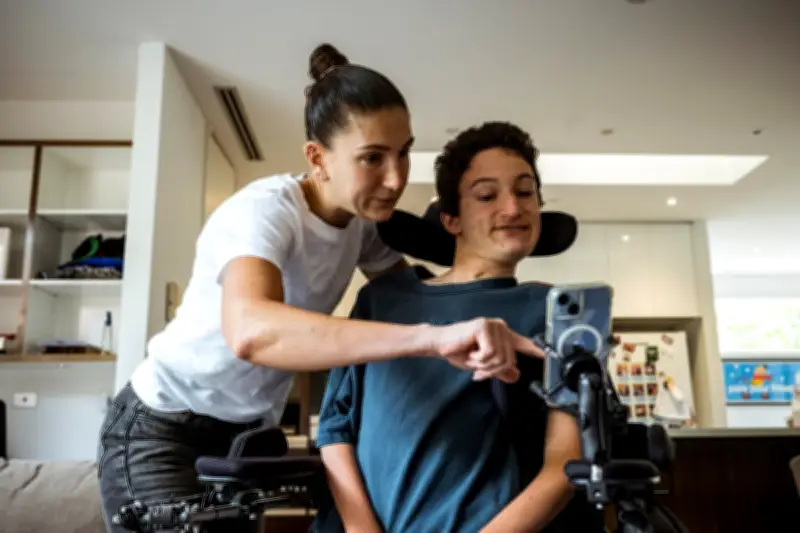
Natasha Sholl, a writer and lapsed lawyer from Melbourne, has shared a deeply personal account of her family's struggle with the National Disability Insurance Scheme (NDIS). Her 15-year-old son, Ezra, who has quadriplegia, faced a year-long battle to obtain a wheelchair, a fight that she says exemplifies the waste and misplaced priorities within the system.
A Wardrobe of Misdirected Priorities
Sholl draws a parallel between her son's childhood habit of hiding clothes in his wardrobe to avoid tidying up and the government's approach to NDIS reform. She recalls finding a messy pile of clothes hidden under a blanket, a tactic her pre-teen used to avoid responsibility. Similarly, she argues that the government's proposed cuts to the NDIS, through the "Securing the NDIS for future generations" bill, merely hide the problem without addressing the real issues.
"The difference is that policy-makers should be very aware of the long-term consequences of their actions, that hiding something from view doesn't make it go away," Sholl writes. She notes that their fully developed prefrontal cortexes should enable better planning and risk assessment.

A Life-Changing Diagnosis
Sholl's son Ezra was diagnosed with cancer at age 12, which triggered a rare neurological condition leading to quadriplegia. Despite the severity of his condition, accessing the NDIS was not straightforward. "It took multiple applications and rejections and reviews and substantial stress and tears for our quadriplegic child with a permanent disability to access it," she says.
The proposed bill would introduce stricter functional capacity criteria and a new definition of permanence, potentially removing 240,000 people from the scheme over four years and diverting 110,000 others. Sholl emphasizes that these changes do not make disabled individuals any less disabled; they simply shift responsibility elsewhere.
Legislating Parental Care
A key concern for Sholl is the proposed legislation that would codify the principle that parents are responsible for providing substantial care. This could mean that support is denied if authorities deem it should be provided by a parent, regardless of the parent's own health, work, or financial situation.
"As parents, there is nothing that my husband and I wouldn't do for our child," Sholl writes. She describes decannulating a tracheostomy with her eyes closed and her husband's superhero-like ability to lift their son, even after his own back surgery. However, she stresses that this care is given by choice and should be valued, not legislated.
Waste and Fraud: The Real Issues
Sholl argues that the bill wrongly implies disabled people and their parents are to blame for cost blowouts. Instead, she points to the National Disability Insurance Agency's (NDIA) own wasteful behavior. She recounts a recent tribunal decision that overturned the NDIA's rejection of her son's wheelchair application. Despite extensive medical reports justifying the need, the NDIA fought the application, leading to a year-long process and legal representation by a senior solicitor.
"The NDIA thought it was a wise use of funds to be represented by a senior solicitor at a major law firm, while we self-represented," she says.
Lack of Consultation
Public hearings into the proposed changes allowed only 11 days for submissions and three days for hearings. Sholl quotes advocate Hannah Diviney, who testified that the consequences of the bill would be "dire, far-reaching and near impossible to undo."
Sholl concludes by contrasting her son's resilience with the government's lack of imagination. "When our son's life changed overnight, he was forced to change the ideas he had about what his future would hold. He has not, even once in the last three years, stopped to feel sorry for himself. He doesn't look at what he is no longer able to do or what has been taken from him, he is always looking for what's possible. I just wish the government had one ounce of his drive, determination or imagination."