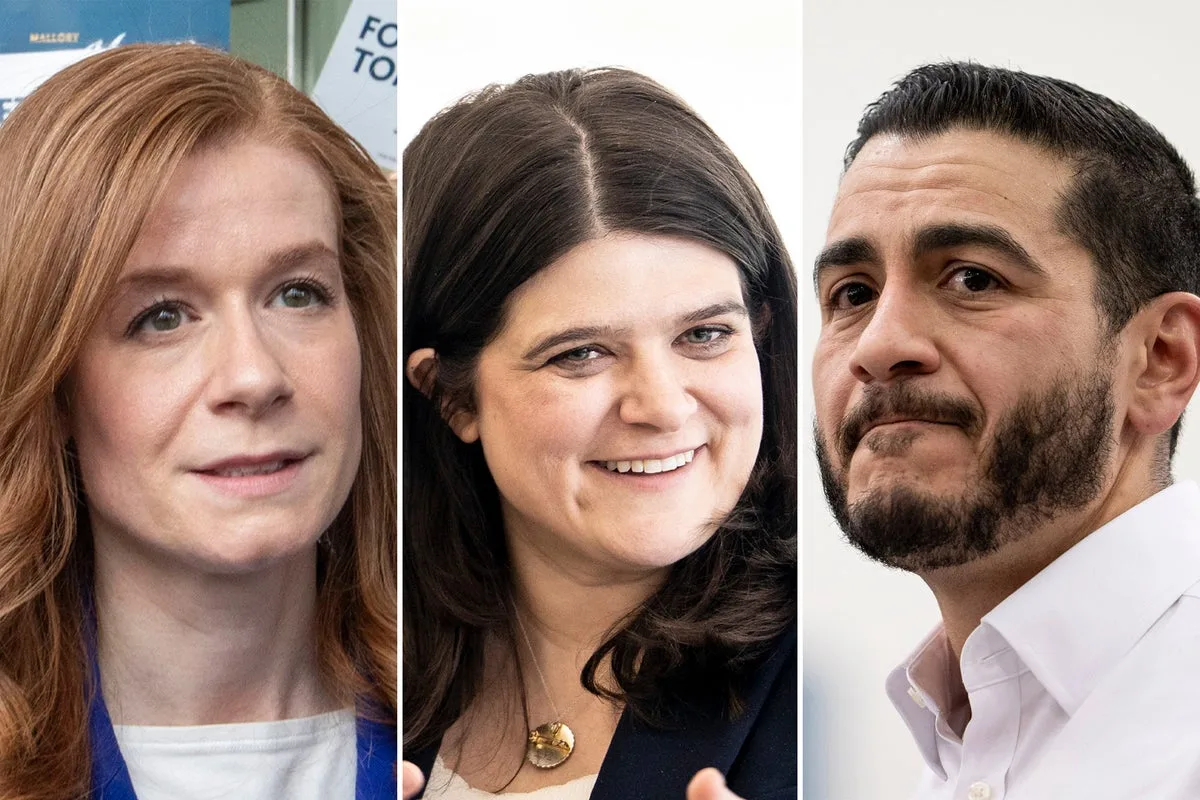
In a year when the Democratic base is inflamed over their party’s shutdown capitulation in the Senate, and sees its leaders’ resistance efforts as insufficient, there’s little appetite for bipartisanship in primaries for the make-or-break midterms. With that in mind — and with control of the U.S. Senate on the line — Michigan’s Democratic primary has become an all-out brawl over dark money and Israel, one that is central to the debate over the Democratic Party’s identity, but still risks opening old wounds at an inopportune time.
That debate was dialed up to 11 this past week with the news that Rep. Haley Stevens, viewed as the favorite of Senate Minority Leader Chuck Schumer, had become the beneficiary of a $5 million surge in dark money ad spending from a group aiming to boost Stevens’ image as an opponent of the Trump administration and ICE. The group is “strongly suspected to be linked to the American-Israel Public Affairs Committee [AIPAC],” HuffPost reported. And it’s no secret that AIPAC, which also supports some of the most right-wing, pro-Trump members of the U.S. Congress — and has tarred Democrats who show support for Palestinians as antisemitic — is increasingly a pariah with large portions of the Democratic base. Naturally, both of Stevens’ opponents in the primary leapt on the announcement with scorn.
“No amount of dark money will paper over the fact that Haley Stevens voted to thank Trump’s ICE agents and proudly took thousands in corporate PAC money from the company that makes ICE’s TASERs,” said a spokesperson for state Sen. Mallory McMorrow. “Michiganders will see through this clear attempt to buy this race for Congresswoman Stevens,” added Abdul El-Sayed’s spokesperson.
That news immediately followed a separate AIPAC-related bulletin: A fundraising page, launched by the controversial pro-Israel PAC, featured Stevens right next to Maine Republican Sen. Susan Collins, an effort to rally support for “pro-Israel candidates [running] for U.S. Senate.” “Right now, Democrats in Michigan and around the country are organizing to win this seat and flip the Senate. Meanwhile, my opponent Haley Stevens is fundraising with a Republican Senator who could block the Democratic Senate Majority,” wrote McMorrow on X, who went on to argue in a video message that it showed Stevens’ priorities were not with building a Democratic majority. A source with knowledge of the arrangement told The Independent that the page featuring both Collins and Stevens was set up without the campaign’s knowledge and was taken down when the Stevens campaign requested it.
Polling shows Israel losing support among Democrats at a record pace in the wake of Prime Minister Benjamin Netanyahu’s deadly onslaught against Gaza and the resulting humanitarian crises. Reports indicate the group is increasingly using tactics like this most recent announcement — funneling money through unrelated groups using messaging unrelated to Israel, all aimed at boosting pro-Israel candidates. Groups like TrackAIPAC have sought to identify candidates with financial backing from the PAC and its growing network of related organizations.
But the group’s influence threatens to roil the Democratic primary in Michigan in a way it did not in the Texas Senate primary, the first major Democratic contest of the year. Unlike in Texas, AIPAC has made clear which candidate it strongly prefers and has thus kicked off the first real opportunity for Democrats nationally, not just in Michigan, to hash out the debate over Israel’s influence and support within the party that voters and electeds have been having internally since November 2024.
Stevens, whose PAC-funded ad buy will put her on TV at a key moment while many voters are undecided, received 44% of her donations, minus PAC support and unitemized contributions, in the third quarter of 2025 through a network of pro-Israel groups including AIPAC, according to an analysis of her donor list and a list of AIPAC contributors reviewed by The Independent. That figure, not before reported, represents a major show of support from the group that essentially represents a lifeline for her campaign. The Independent reached out to the Stevens campaign for comment.
Allies of the congresswoman contend that support for Israel and AIPAC’s track records are not issues of high importance to voters in the primary, though their opponents clearly disagree. Michigan, in 2024, was the birthplace of the “Uncommitted” movement which sought to pressure the Biden and later Harris campaigns into taking a stronger stance against the Israeli war effort and strategy as it related to the Gaza Strip.
Polls for months have shown that issues like inflation, high fuel prices and fears about America’s economic future still remain the most pressing issues for voters nationally, especially as the war in Iran has caused gas prices to surge past $4.50 a gallon on average.
Stevens has taken fire on the issue of AIPAC in particular from both of her opponents. McMorrow and El-Sayed, however, have also locked horns over McMorrow’s own past support from corporate PACs including one tied to a major Michigan energy company, DTE, in her previous campaign for state senate. The Detroit Metro Times reported on her past comments defending taking money from corporate PACs in March. And El-Sayed’s supporters have pummeled the state senator’s campaign online over whether her repudiation of AIPAC is genuine, given that her husband previously interned for the group. The same newspaper reported that McMorrow also “reached out to pro-Israel Democratic groups, attended a private pro-Israel leadership event, and traveled to Israel on a trip sponsored by a prominent pro-Israel organization”.
“One of our opponents is partnering with AIPAC to fundraise alongside a Republican, while the other has conveniently forgotten that she too met with them earlier in the cycle and reportedly submitted a position paper. Abdul has been consistent on this issue and believes that our tax dollars should be spent here at home, rather than dropping bombs abroad,” Roxie Richner, a spokesperson for El-Sayed’s campaign, told The Independent.
McMorrow and El-Sayed’s own separate duel is playing out for control of the race’s progressive lane, which El-Sayed leads as the Bernie Sanders-endorsed candidate but McMorrow retains a sizable chunk of support as well, having won support from Elizabeth Warren. She and El-Sayed refer to Israel’s war in Gaza as a genocide; Stevens does not.
With three months to go until the primary, a clear frontrunner has failed to emerge. El-Sayed’s campaign is exuding confidence amid a recent polling uptick, while supporters of his opponent believe (or hope) that his support is reaching a ceiling. McMorrow and El-Sayed both remain extremely active on the trail, while Stevens is taking the opposite approach — she is holding fewer public events including town halls than her opponents, and has been hit by political analysts for an awkward campaigning style that isn’t connecting with voters with the same fervor that El-Sayed or McMorrow can evoke.
“I’m not seeing any enthusiasm for her campaign,” Michigan-based Democratic strategist Chris De Witt told NOTUS last October as the outlet reported that Stevens’ D.C. allies were growing nervous about her bid. “That certainly can change, but it doesn’t seem like there’s a lot of excitement about her effort.”
There’s good reason for Democrats to be nervous. Many in D.C. still blame the Uncommitted campaign for withholding support for Harris at a moment when her campaign needed Democratic unity. Plenty of other Democrats around the country see it the opposite way: They blame out-of-touch D.C. policymakers for wedding the party to a deeply unpopular war under an increasingly unpopular Democratic administration helmed by a man so old he was forced to drop out of the race after months of those same policymakers’ insistences to the contrary.
The August primary is still three months away. Until then, Democrats will have to sit back and watch as those 2024 wounds are re-opened, re-examined and hashed out in a state where Democrats need to defend an open seat to have any chance of winning back a Senate majority many still see as out of reach until the next election cycle.






