On America's 250th anniversary weekend, two competing visions of the United States emerged from dueling speeches. New York City Mayor Zohran Mamdani delivered a unifying call for looking out for one another, while President Donald Trump at Mount Rushmore offered a stump speech that rewrote the past.
Mamdani's Vision of Unity and Contradictions
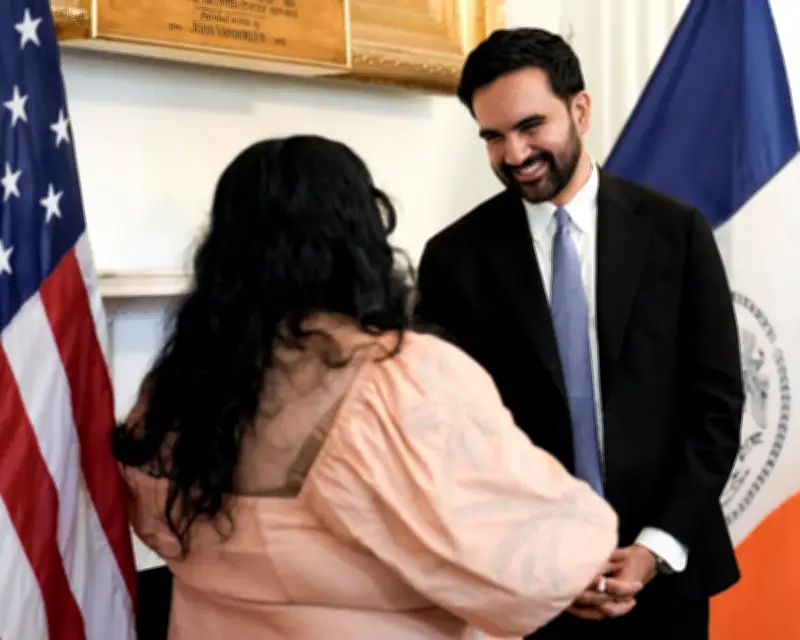
Speaking on July 3 at George Washington's desk flanked by newly naturalized citizens, Mamdani offered a starkly different assessment from Trump's 28-minute address. “We see a city of contradictions within a nation of contradictions,” Mamdani said. “We see the wealthiest country in the history of the world – one where children go to sleep hungry while the world's first trillionaire hungers for more.”
Mamdani's speech was rich with historical references, beginning with the Lenape people who lived on the land before Europeans arrived, and briefly acknowledging American chattel slavery before celebrating immigration. He noted Irish immigrants escaping famine “manufactured by imperial cruelty” and Jewish people fleeing pogroms.

A Warning Against Division
The mayor issued a sharp warning: “Those ideals upon which our nation was built – they are strong enough to endure any authoritarian regime, but only if we reach for them.” He described America as “a nation working each day towards the perfection in which it was conceived. A nation striving each day to better itself.”
Mamdani offered sober assessments of political opportunism, stating, “At every moment in our past, those who led through exclusion and isolation have tried to win power and enrich themselves by turning us against one another. Division is the oldest trick in politics, and the cheapest.”
Trump's Stump Speech and Historical Rewriting
Trump, clearly rattled by the success of the Democratic Party's left wing, delivered a speech on July 3 from Mount Rushmore, followed by a July 4 address in Washington, DC. The latter was nearly rained out and felt like a mix of a State of the Union and a game show, with flags and centenarian veterans paraded on stage.
Trump resurrected Cold War rhetoric, repeatedly labeling opponents “godless communists.” He claimed the United States was “laughed at, mocked” two years ago, but now “We are the hottest country anywhere in the world.” However, Pew Research Center found sharp declines in US favorability globally, and Mamdani polls at a higher approval rating (48%) than Trump (39%).
Stolen Land and Historical Context
Trump's Mount Rushmore speech targeted those who “peddle Marxist lies about our heritage, tell our children that we live on stolen land.” Yet Mount Rushmore sits in the Black Hills, sacred territory of the Lakota people. A 1980 US Supreme Court opinion described the theft of the Black Hills as “a more ripe and rank case of dishonorable dealings will never, in all probability, be found in our history.”
As historian Nick Estes notes, the court awarded the tribe $102 million, now nearly $2 billion with interest, but the Lakota refuse monetary compensation, insisting “The Black Hills are not for sale!” The land must be returned.
Choosing Between Reality and Fiction
Mamdani's speech emphasized his vision that the country is at its strongest when we look out for each other. “We see America each time working people demand more – not just for themselves, but for their fellow Americans,” he said. Trump's speech appealed to an abstract future greatness based on defeating fictionalized enemies and returning to a mythical past. Between these two versions of America, reality and fiction, we must choose where we want to live.