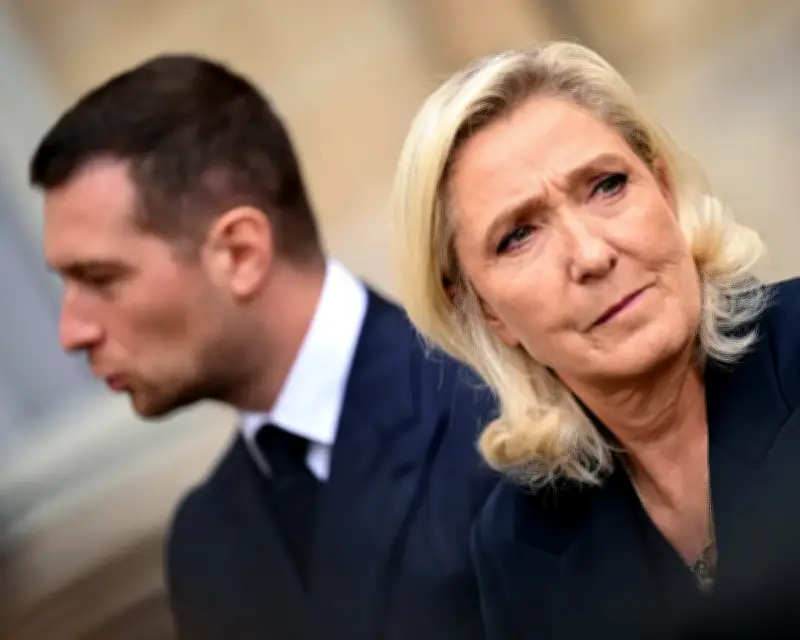
Marine Le Pen's political career has been resurrected, and she is now a far more formidable force than her understudy, Jordan Bardella. With the Paris appeal court lifting her electoral ban for fraud, Le Pen can run in next year's presidential election as an outsider and a scourge of political elites, despite holding electoral office continuously since 1998.
Senior French political figures, including former ministers, described her to Mujtaba Rahman during recent conversations in Paris as a "miraculous survivor", a "mother courage" and "a battling granny". Her party, the National Rally (RN), has adopted a new campaign slogan: "Renaissance", suggesting that the rebirth of Le Pen's career foretells the rebirth of France.
A reprieve, not an acquittal
Le Pen was not acquitted of fraud on 7 July. The judges ruled that voters, not courts, should decide who becomes president, reducing her five-year ban from electoral politics, imposed by the Paris criminal court last year, to time already served. She remains a twice-convicted embezzler of more than €4m in EU funds. If her final appeal to France's highest court is heard rapidly and rejected, she might have to campaign next spring wearing an electronic tag on her ankle.

Despite this, two opinion polls since her reprieve suggest she could defeat all imaginable opponents in the two-candidate second round next year. Previous polls were almost as good for Bardella, but there were doubts he would stay the course. The two-week-long second-round campaign traditionally tests whether candidates have the capacity not just to govern France but to represent it, prompting voters to ask if they have presidential stature.
The grey vote and economic stability
Bardella, who will be 31 in September, has been an RN party apparatchik since dropping out of college at 19. Voters might wonder if this talented but glib young man could stand toe-to-toe with leaders like Vladimir Putin or Donald Trump. Presidential weight is especially important for older voters: of the 50 million registered French voters, 28% are over 65, and they turn out in huge numbers.
A recent Ifop poll showed Le Pen beating former prime minister Édouard Philippe, the strongest candidate looking to carry Emmanuel Macron's centrist torch, by 54% to 46% in the second round, with almost exactly the same lead among over-65s. It is the first time any poll in any national election put the RN ahead with the "grey vote". Bardella was also popular with older voters, but his appeal was fading, partly due to a Sarkozy-like attraction to the high life.
Le Pen, born into a wealthy family, cultivates an image as a gruff-voiced people's champion, a single grandmother living with her best friend, a breeder of cats, and above all a survivor. However, economic stability is crucial for older voters. Le Pen's feeble TV debate performances on the economy in 2017 and 2022 helped Macron defeat her. The RN's economic policies remain an incoherent jumble of high social spending and low taxes, free markets and state interference. Bardella tried to shift the party towards a more traditional rightwing, low-tax policy and a more reformist approach to the EU, taking inspiration from Italy's prime minister, Giorgia Meloni.
A return to Marinomics
Le Pen's return means a return to "Marinomics" and a policy of wrecking the EU from the inside. With France €3.5tn in debt and teetering on the brink of fiscal crisis, the prospect of a far-right government may disturb older and better-off voters. Le Pen will have an obvious riposte: Macron bamboozled voters twice with clever talk, leading to another €1tn in debt, so it is time to give a down-to-earth woman a chance.
A President Le Pen or a President Bardella would take France and the EU into dangerous new territory. Bardella, at least, appeared aware of the difficulty of being so outlandishly anti-EU and trying to govern with slogans. Le Pen does not. A Le Pen presidency from next May is not a certainty, but it is, for the first time in seven decades of the family's involvement in politics, a strong possibility. The comfort blanket for mainstream parties of right, left and centre – the implausibility of a 31-year-old slightly more pragmatic President Bardella – has been snatched away.