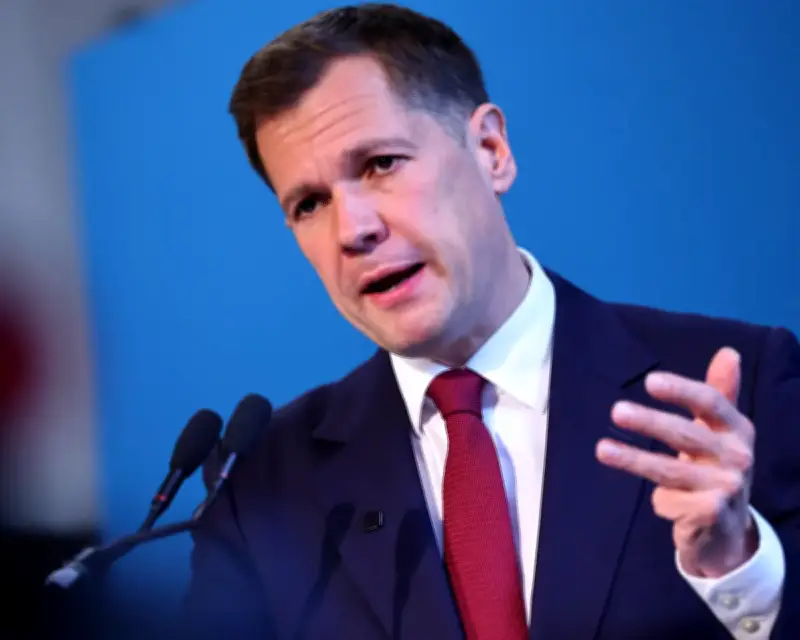
Robert Jenrick has launched an extended attack on Kemi Badenoch, calling her part of a metropolitan elite and saying a coalition deal with the Tories would be like being “handcuffed to a zombie”.
Reform UK’s economics spokesperson repeatedly called the Tory leader “Kensington Kemi” and claimed her party was for people who moaned about the decline of Mayfair clubs and complained that they could not find Ottolenghi recipe ingredients in the shops.
Accusations of ‘bungs for Belgravia’
He accused his former party of handing out “bungs for Belgravia” after the Conservatives said at their autumn conference that they would exempt property from inheritance tax and extend free childcare to higher earners if elected.
Jenrick’s attack on Badenoch, whose approval ratings among the public have improved, come at a time of deteriorating relations between the Conservatives and Reform. Jenrick was the target of much mockery at the Conservative conference, where he was depicted in multiple places on a satirical Bayeux tapestry of the political landscape as a crying baby. He was kicked out of the Tories in January for planning to defect.
Badenoch rules out ‘unite the right’
In her conference speech, Badenoch firmly ruled out any move to “unite the right” with a deal between Reform and the Tories, questioning who would want to join with a party that made her British-born mixed-race children feel as though they were not English.
The Reform leader, Nigel Farage, downplayed the idea of a post-election pact on Thursday, saying it was “extremely unlikely”. Jenrick took a tougher line against the Conservatives in his press conference on Friday, saying they were “nothing more than a metropolitan pressure group for the wealthiest” and likening a tie-up to being “handcuffed to a zombie”.
“Kensington Kemi knows who her people are. Millionaires, not Mansfield,” Jenrick said. “The wealthy, not workers. She’s for people who complain that Mayfair clubs aren’t what they used to be. For people who struggle to find all the ingredients for that Ottolenghi recipe. And people whose lives have got almost nothing in common with my constituents in Newark.”
Reform’s own links to wealth
Jenrick made the attacks on the Tories for having “retreated into the hinterland of Kensington and Chelsea” despite a number of senior Reform figures having lived in the area. Farage rented a house in Kensington and Chelsea during the Brexit years, paid for by the leave donor Arron Banks. Nick Candy, the party’s honorary treasurer and a property billionaire, sold his £275m Chelsea mansion this year.
Last year, Farage and Candy jointly announced a policy specifically designed to appeal to billionaires, offering them a flat £250,000 tax rate for non-dom status to attract the wealthy to London. Candy bemoaned the “very rapid exodus” from central London and how it was “tough to sell a house” in Kensington and Chelsea.
Farage is famously a member of an exclusive Mayfair club, 5 Hertford Street, while the party held its fundraiser at the trendy Oswald’s in Mayfair last year.
Asked whether Reform was also the party of billionaires, Jenrick said it was focused on delivering tax cuts for 40 million middle earners.
Questions on English identity and Islamification
Jenrick also faced questions regarding the suggestion by Reform figures that Badenoch could not be English because of her Nigerian heritage. He said the debate was “pretty overblown” and that it was possible to distinguish ethnicity, cultural identity and citizenship.
“Is there such a thing as the English ethnicity? Yes. Not always easy to define,” he said. “That is different from national identity. That is whether or not you ascribe to, you assimilate to, our heritage, our culture, our norms, our manners. And that is also different to whether or not you have a British passport in your bedroom drawer.”
He said he was most concerned about people who had a British passport but “do not love our country”.
Jenrick went on to defend his comments about the “Islamification” of the UK, which have now been reported to the police and the Prevent counter-radicalisation programme. He did not address the police reports, but he doubled down by saying there had been an increase in the use of sharia law, and in instances of young girls being forced to cover their faces, and churches being turned into mosques, which he said would not happen under a Reform government.