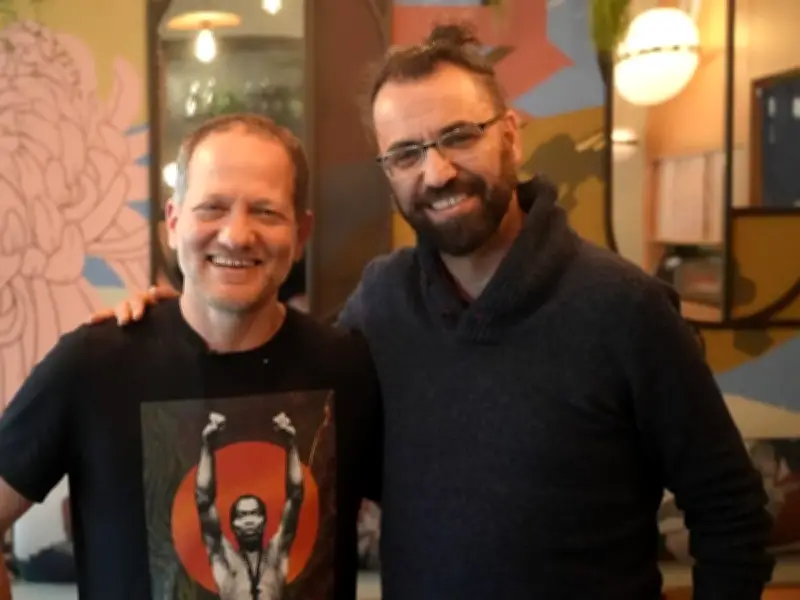
An Israeli and a Palestinian who have lost family members to the conflict are bringing their message of peace and hope to a live audience in North Manchester on Tuesday.
Maoz Inon's parents were murdered by Hamas terrorists on October 7. Aziz Abu Sarah's brother died after being detained for nearly a year in an Israeli military prison. Despite their losses, the two have become close friends and will share their personal journeys during their UK tour.
Friendship forged from grief
Maoz's mother and father, Yakovi and Bilha, were murdered at their home in Netiv HaAsara, close to the Gaza border. Their house was burned down and it took 14 days to identify Yakovi's body. Nothing was left of Bilha. Maoz also lost many friends in the terrorist attack.

“I will always be sad,” he said. “Every day I’m missing my parents. I miss my childhood friends. But I cannot let this sorrow or loss control or predict my future.”
Maoz and Aziz had met once briefly many years ago but reconnected after Aziz sent him his condolences after October 7.
Aziz is from Eizariya, also known by its biblical name Bethany, a Palestinian town bordering East Jerusalem. He was just a child when his 18-year-old brother Tayseer was arrested on suspicion of throwing rocks at Israeli troops. He was taken to an Israeli jail where he was beaten by soldiers. Within a year of being released, he died from internal injuries.
“That kind of loss completely breaks a family,” said Aziz. “It changes the dynamics of everything. It was a house of mourning for a very long time.”
A journey to peacemaking
Aziz's way of dealing with the grief was to become a youth activist in the Fatah party. He wrote 'angry' articles for its weekly magazine. Things changed when he enrolled at an ulpan (a Hebrew-language school).
“I started realising the power of us working together, instead of thinking in terms of us vs them,” he said. “That’s what brought me to peace-making.”
Maoz and Aziz have worked extensively since the October 7 attacks, travelling the world with their inspiring messages. They have met popes Francis and Leo. In January this year, they became the first Israeli and Palestinian to run with the Olympic torch in Verona.
Their new book, The Future Is Peace, explores each other's personal and national histories. They talk about loss, forgiveness, and why they remain hopeful despite the devastation of war. The book has been described as 'hopeful and inspirational' by acclaimed historian Simon Sebag Montefiore, and 'courageous' by Pope Leo XIV.
Sanctions and reactions
Aziz and Maoz's visit follows an announcement by the UK government to sanction illegal Israeli settlements in the occupied West Bank. Foreign Secretary Ed Miliband has defended the decision, saying the UK could not remain 'silent or passive' over the issue. Mr Miliband said the prospect of a two-state solution is 'being destroyed' by Israeli settlements in the illegally occupied territory.
Israel has described the move as 'morally distorted' and said it will close the British consulate in East Jerusalem. The UK's chief rabbi, Ephraim Mirvis, said it was 'a dark day for British Jews' and condemned the proposals as 'gesture politics'. However, Maoz and Aziz welcome the sanctions.
“This is what we’ve been asking for a long time. I think that, honestly, this is a minimum,” said Aziz. “Different governments in Europe have been talking about the two-state solution as they allowed the destruction of that solution with zero consequences. It makes no sense.”
Many in the British Jewish community believe this could lead to more antisemitism. The number of antisemitic incidents recorded across the UK since the start of the year is up by a fifth compared to last year, according to figures from the Community Security Trust (CST), an organisation that provides security support to the Jewish community.
Maoz believes the policy is a clear distinction between the Israeli public and illegal settlements.
“I would encourage diaspora Jews to differentiate themselves from the far right extremist [Israeli government], to differentiate themselves from those who claim to be acting in the name of God and in the name of Judaism,” he said. “I think it’s about time that the Israeli government will be accountable for breaking international law.”

A message of hope
Some of what Maoz and Aziz will say will no doubt cause controversy. Indeed, they often get some pushback from their respective communities.
“My parents always told me to say what’s in my heart and what I believe. I’m not a politician I don’t need to be popular,” said Maoz.
There are some who believe that peacebuilding is a 'waste of time'. But Maoz has one thing to say to the people of Manchester.
“Before the turning point of history, no one will believe it will happen,” he said, citing major milestones like the tearing down of the Berlin Wall, the Good Friday Agreement, and Egyptian leader Anwar Sadat, who made history by becoming the first Arab leader to visit Israel in 1977. “Two weeks before those historical events happened, no one believed it would happen. So it means we are only weeks away from the tipping point between the Israelis and Palestinians. Each one of us can do one thing today, tomorrow, and the day after to bring this tipping point into reality.”