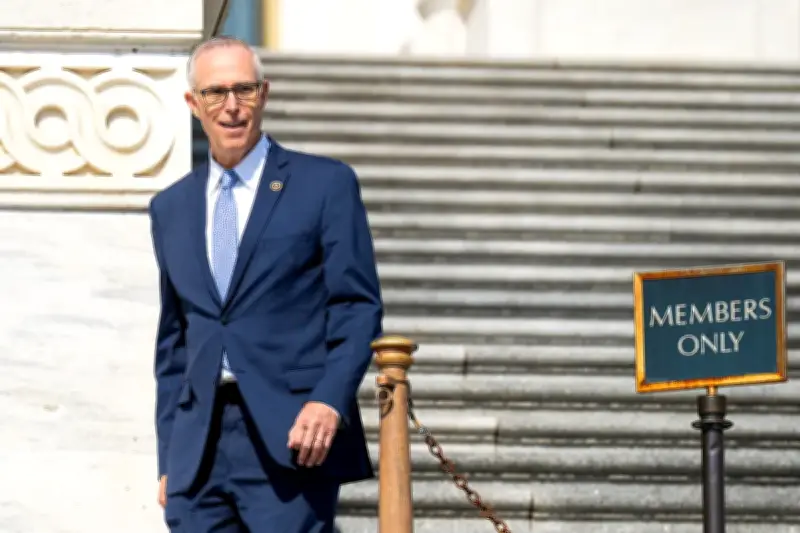
Congressman Jared Huffman, a Democrat from California, is sounding an alarm about the rise of Christian nationalism in the United States. In his new book, No Prophets: The Fight to Save Democracy from Christian Nationalism, he argues that the movement has grown more powerful after Donald Trump returned to the White House and now poses a greater threat to science, education and freedom than most people realise.
Huffman, 62, who was locked down alone in his office during the January 6 2021 attack on the US Capitol, described the event as a "very Christian coup." He said in a phone interview from his home in Marin County, California: "This Christian nationalist movement that I had seen growing so much stronger and more militant during my time in Congress erupted in plain view." He added that he believed January 6 would be a wake-up call, but "the country went back to sleep."
From devout Christian to humanist
Huffman is the only current member of Congress to admit he does not believe in God. He grew up in Independence, Missouri, and was ordained into the priesthood of the Reorganized Church of Jesus Christ of Latter-Day Saints (now the Community of Christ). His faith began to crack after his father's sudden death during his sophomore year at UC Santa Barbara. He later settled on the label "humanist," explaining that it is a more affirmative expression of belief than "atheist."

For decades, Huffman kept his secular worldview private. In 2013, on his first day in Congress, he stood before House speaker John Boehner, who asked who would hold the Bible for the swearing-in photo-op. Huffman put his hand on a Bible, a moment he said left him feeling "sullied and hypocritical." In 2017, after his mother's death and Trump's entry into the White House, he decided to go public as a non-believer, despite warnings from his wife, brother, senior staff and political advisers that it was "a terrible, career-wrecking idea."
Christian privilege and the January 6 report
Huffman defines "Christian privilege" as a cultural taboo that protects home-grown religious radicalism from scrutiny. He argues that this privilege was evident on January 6, when many of his colleagues did not notice the religious elements of the group trying to kill them. He also asserts that Christian nationalism was deliberately erased from the final report of the House January 6 select committee.
According to Huffman, the committee's "Purple Team" documented the role of charismatic evangelical networks, particularly the New Apostolic Reformation (NAR), in radicalising the insurrectionists. Chairman Bennie Thompson told Huffman that the team's report showed "rightwing Christian extremists, actually had a lot to do with it." However, vice-chair Liz Cheney demanded the section be excised, arguing it would "distract" from Trump's culpability. Huffman credits Cheney's courage in standing up to Trump but says she "did the country a huge disservice with her Christian privilege."
A coalition of religious subcultures
Huffman describes modern Christian nationalism as a temporary coalition of three subcultures: the NAR, a network of self-declared "apostles" and "prophets" who cast Trump as a modern King Cyrus; the "Rad Trads," a Catholic subculture that resents Vatican II reforms and includes sympathisers like vice-president JD Vance and strategist Steve Bannon; and the "Theobros," Protestant Reconstructionists led by Pastor Doug Wilson, who advocate for "Mere Christendom" and have forged ties with Silicon Valley venture capitalists like Peter Thiel.
Huffman points to Pete Hegseth, Trump's "secretary of war," as an embodiment of Christian nationalism, noting his Crusader tattoos and the Pentagon prayer services he hosts. Huffman said: "The nicest thing I can say about Pete Hegseth is to thank him for his lack of subtlety."
Inside the Capitol, Huffman describes a "shadow theocracy" with a tax-subsidised "ministry-industrial complex." He cites Ralph Drollinger's Capitol Ministries, which hosts weekly Bible studies for members of Congress and the cabinet, teaching a "free-market gospel" that frames environmentalism as a sin.

Threat to Enlightenment values
Huffman warns that Christian nationalism's ultimate target is Enlightenment values dating back to Thomas Jefferson. He quotes Voltaire in his book: "Those who can make you believe absurdities can make you commit atrocities." He profiles Mary Miller of Illinois, who quoted Adolf Hitler in a 2021 rally and dismissed solar panels because God "controls the sun, and the sun controls the weather."
Huffman reflects: "This is potentially the unravelling of a 250-year truce between fundamentalist Christians and the Enlightenment." He insists the fight is still winnable but requires a broad coalition of moderate Christians, non-Christians and secular Americans. He also draws a warning from history, comparing the current situation to the fall of the Weimar Republic: "That's absolutely how the United States could unravel and evolve into fascism – and Christo-fascism in our case."