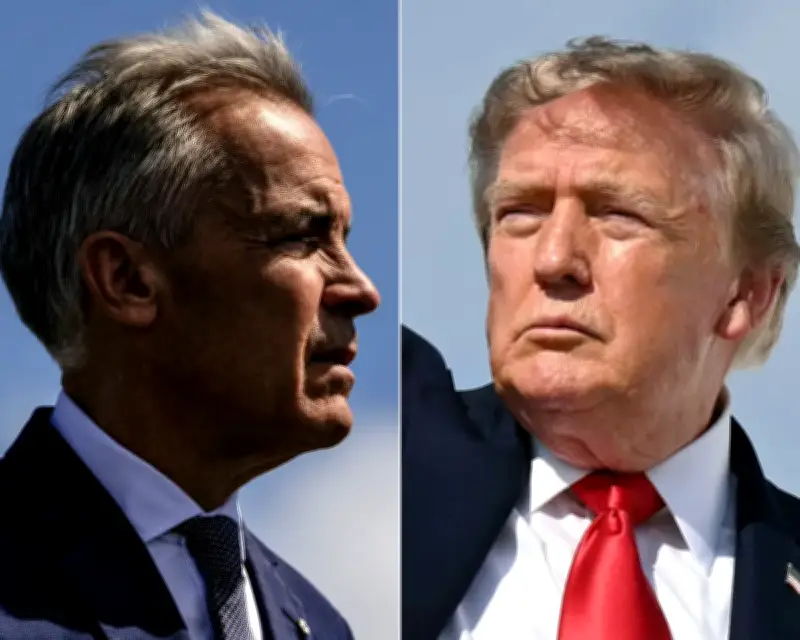
Mark Carney, the prime minister of Canada, has become a thrilling orator, delivering two remarkable speeches in 2026. The quiet-spoken former banker speaks calmly, without many vocal inflections, yet his words have signaled major political shifts.
Davos Speech: A Rupture in World Order
In his first speech at Davos, Carney described a "rupture in the world order" and "the end of a pleasant fiction," meaning the world could no longer depend on the United States to lead the Pax Americana that has kept the peace since World War II. He called for a new "geometry," allowing nations with shared values to align and asking middle-sized powers to act together, "because if we're not at the table, we're on the menu." The US was not invited to join, and the speech was delivered on 20 January, the first anniversary of Donald Trump's second inauguration.
Ottawa Address: Calling Off Trade Talks
The second speech, a 23-minute address delivered on 22 August from a government interior in Ottawa, signaled an earthquake. Carney announced he was calling off trade talks that many expected to resolve trade frictions with the US, which have been in place since Trump's first round of tariffs on Canada. The failure came as a surprise to Trump, who had announced a deal was imminent, but US negotiators had undermined their own position with last-minute power moves.

Carney's words stung, with a tone that contrasted sharply with Trump's frenzied counterattack on social media. Trump threatened to rename Lake Ontario "Lake America," called Canadian officials "clowns," and dismissed Carney as a "governor" instead of a prime minister. Carney, unlike the easily-rattled president, focused on facts and moral authority, beginning with greetings in both English and French—a reminder that US attempts to strong-arm Canada into relaxing French language protections would not work.
Economic Interdependence and New Policy Direction
Carney furnished precise statistics, revealing how intertwined the US and Canadian economies are: Canada buys more American cars than the UK, Japan, and China combined, and supplies 99% of US natural gas imports. He referred to "the storm blowing in from Washington," possibly referencing recent forest fires, and announced Canada would seek to diversify its relationships abroad, based on a near-total lack of trust in the US, a nation that blusters so unpredictably that it is as if "its signature was written in pencil."
The loser in this negotiation is the United States. Beyond financial and political benefits, the loss is larger, as Canada seeks new relationships. As Carney said: "We are masters in our own home and the partner of choice abroad." He added: "We have been under no illusions. We recognized from the start that America has changed."
Impact on US-Canada Relations
The US-Canadian friendship is the healthiest foreign relationship the US has ever enjoyed, with deeply connected economies and militaries, including Norad, which has protected both nations since 1958. The border is 5,525 miles long, and Alaska cannot be reached by land without going through Canada. In 2025, Canadian tourism in the US declined 25%, and US businesses are feeling it.
Carney's final words left little doubt about Canada's path: "Canada is becoming stronger and less dependent on America. We are already giving ourselves more than they can take away. And we are just getting started. Canadians don't submit to the weather – we thrive in it. We don't wait to see which way the wind is blowing. Or surrender ourselves to the waves to be storm-tossed by events. We set our own course. We make our own weather."