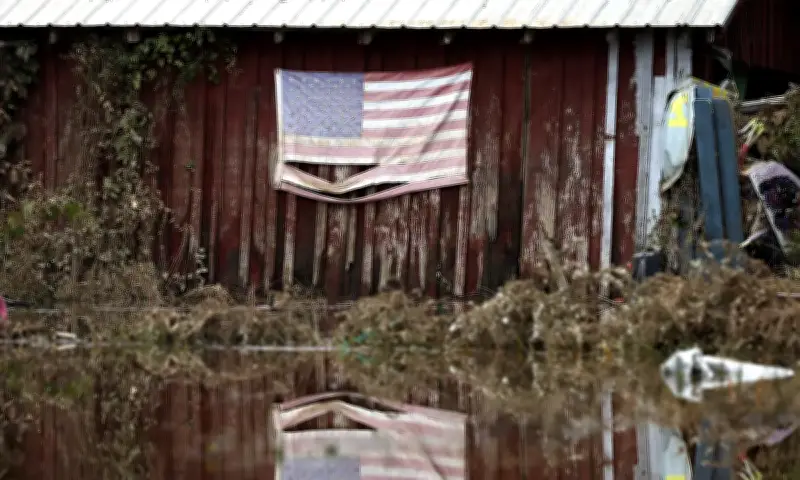
Two years after Hurricane Helene struck western North Carolina, killing at least 107 people and causing nearly $60bn in damage, the recovery effort has become a defining issue in the state's US Senate race. Democrat Roy Cooper and Republican Michael Whatley, the frontrunners to succeed retiring Senator Thom Tillis, each blame the other for the bungled response to the storm.
Recovery failures and political blame
Life in the hardest-hit areas appears back to normal, with lively downtowns, reopened roads and rivers flowing below their banks. But evidence of the disaster's costly impacts remains, from "for rent" signs in storefronts whose businesses never returned to storm debris still lurking in some waterways.
Cooper, who was governor when Helene arrived as a tropical storm in September 2024, has accused Whatley of failing in his role as the hurricane "recovery czar" - a title Whatley's campaign says he was never given. The label stems from President Donald Trump's statement that Whatley would be "in charge of making sure everything goes well" with the recovery.

"I don't think it's to anybody's political benefit to be tapped as the person who was in charge of Helene recovery - Democrat, Republican, Green, Libertarian - doesn't matter," said Christopher Cooper, a political science professor at Western Carolina University. "People ... in western North Carolina are fairly united that there wasn't enough done and that Helene relief has been more of a failure than a victory. The question is who they blame for that."
National stakes in a red state
The debate carries national implications. No Democrat has won a US Senate election in North Carolina, or carried it at the presidential level, since 2008. This year, Democratic leaders have put North Carolina among the small group of red states where they hope to win Senate seats, and recent polls show Cooper leading Whatley.
Western North Carolina is generally a Republican area, with none of its congressional districts in Democratic hands. In 2024, Trump won the state with 51% of votes cast after accusing Joe Biden's administration of bungling the disaster response.
In Marshall, a riverside town of 961 residents, the French Broad River climbed 27ft above flood level, nearly to the windows of second-story buildings. The flood water took the town hall and post office and inundated the historic courthouse, rendering it unusable. Today the main street is artsy, but the courthouse remains shuttered, with plans to build a new complex on high ground using state and federal money.
Joel Friedman, owner of Zuma Coffee, said the nine-to-five economy that once sustained his cafe has been replaced by visitors who show up after work or on weekends. Sales have recovered, but margins are smaller due to inflation, and his employees struggle with higher healthcare premiums after Congress let temporary federal subsidies expire.
"I don't have a lot of hope for it, to be honest with you," Friedman said of the Senate election. "I think we have an administration right now that's rogue, and is going to do what they want to do, and living in a state with a Democrat governor is not very helpful right now."
Local perspectives on the candidates
Matthew Wechtel, a Republican commissioner in Madison county, said Cooper deserved no credit for helping Marshall bounce back, accusing the then governor of being a "no-show" despite a visit about two weeks after the hurricane. "I don't think Governor Cooper did much at all for Madison county, or for western North Carolina, when it came to storm recovery," Wechtel said.
In Canton, a town south of Marshall, Helene added to years of economic injury. Tropical Storm Fred flooded the town in 2021, and two years later 1,100 jobs disappeared when a paper mill closed. Then Helene put Canton underwater. "Everything was flooded. We lost homes, businesses, things that we had rebuilt from '21, gone again," recalled Zeb Smathers, the town's Democratic mayor.

Smathers said Canton's recovery was hampered by Kristi Noem, Trump's first homeland security secretary, who required personal approval of all spending over $100,000 by agencies such as Fema. The pace has improved under the new secretary, Markwayne Mullin. As for Whatley, Smathers said he's never heard from him. "He wasn't named the recovery sidekick. He was named the recovery czar," Smathers said. "His leadership and presence has been absent."
DJ Griffin, a spokesperson for Whatley's campaign, pointed to Whatley's position on the Fema Council Review Board, saying: "If you look very, very, very, very closely, you'll notice there's no czar in that description. Not a czar of any sort." Griffin said Whatley had collaborated with Republican members of the state's federal delegation to bring North Carolina $10.75bn in hurricane relief, but "the job is not yet done and Michael [Whatley] will continue speaking with local leaders about what they need help with."
A spokesperson for Cooper's campaign argued that those federal dollars covered only about 15% of the damage, while Cooper signed two bills allocating more than $877m in state funds to hurricane relief before leaving office. "DC insider Michael Whatley has completely failed in his role as federal recovery czar," the spokesperson said.
Brandon Rogers, a Republican county commissioner, complimented Cooper's response, remembering the then governor arranging for water, food and insulin to be delivered on helicopters. But Rogers, who opposes abortion, won't vote for Cooper in November. "As far as Whatley's concerned, I think he would do a great job," he said. Rogers recalled telling Cooper during a visit: "I appreciate you bringing the check. However, a lot of our other politics may not line up." The two ended up laughing about it. "That doesn't mean we couldn't work together."