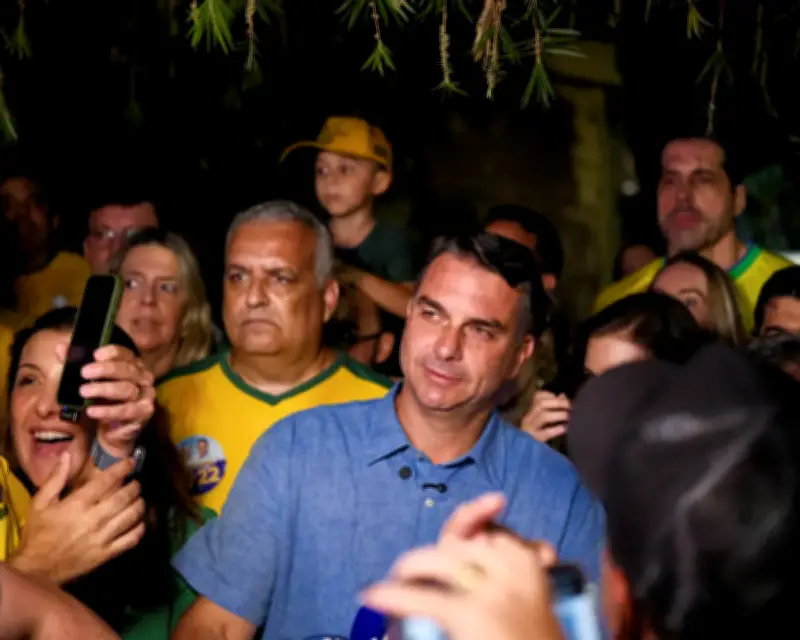
Flávio Bolsonaro is in pole position to win Brazil's presidential election after a far-right surge propelled him to a shock first-round victory over the incumbent, Luiz Inácio Lula da Silva, leaving progressive voters reeling.
The 45-year-old rightwing candidate received 56.1m votes to Lula's 53.8m – 47.03% to 45.16% – meaning the 80-year-old leftwinger has a mountain to climb if he is to bounce back in the second round on 25 October. Never, since the return of democracy to Brazil in 1985, has the first-round runner-up managed to turn the game around and win the second ballot.
“Miracles are possible in politics. But I don't see that happening,” the political scientist Miguel Lago said of Lula's chances of snapping back. “I don't see Flávio losing this election now.”
Bolsonaro clan triumphs in congress
The far-right surge was a triumph – albeit an incomplete one – for the Bolsonaro clan and its 71-year-old patriarch, Jair Bolsonaro.
The disgraced ex-president, who is serving a 27-year sentence for plotting a coup after losing the 2022 election to Lula, saw four relatives elected to congress. His 44-year-old wife, Michelle Bolsonaro, won a seat in the senate, as did his second son, Carlos Bolsonaro, who is 43. Bolsonaro's youngest son, 28-year-old Jair Renan Bolsonaro, and the ex-president's 62-year-old brother, Renato Bolsonaro, both won seats in the lower house of congress.
Across Latin America's biggest democracy, key congressional and gubernatorial races were also won by staunch Bolsonaristas including Tarcísio de Freitas, who was re-elected as the governor of São Paulo state, and Sérgio Moro, who was elected governor of the southern state of Paraná. Both men were ministers during Bolsonaro's 2018-22 government.
Senate majority and amnesty prospects
Bolsonaro's Liberal party (PL) will now boast the largest caucus in the senate with 28 of its 81 seats. Combined with the seats of other hard-right parties, that number rises to 43, giving the movement an upper house majority.
Meanwhile, pro-Lula senate candidates, including the former environment minister Marina Silva, the leftwing veteran Benedita da Silva, and the centrist former planning minister Simone Tebet, suffered bitter defeats.
Nikolas Ferreira and Lucas Pavanato, two young Bolsonarista social media warriors, became the best-voted congresspeople in Brazilian history, securing more than 3m votes.
“We are experiencing a revolution … The far-right is growing in a very consistent way, election after election,” said Lago, calling the election the worst for progressive and moderate centrist parties since the late 80s.
Lago believed Lula had managed to interrupt the advance of Bolsonaro's populist movement in 2022, thanks to positive voter memories of his first two terms, from 2002 to 2010. Back then, a global commodities boom allowed Brazil's first working-class president to fund major social welfare programmes that helped millions escape poverty. “But it was just an interregnum,” Lago said.
Control of the senate should allow pro-Bolsonaro politicians to approve an amnesty for their movement's charismatic leader, allowing the former president to emerge from the Brasília mansion where he is living under house arrest and reassert his leadership of the far right.
“I think he will be freed and I think he will be very important during Flávio Bolsonaro's [presidency],” said Lago. “Flávio will be running the country and [Jair] Bolsonaro will be doing what he has always done: leading the revolution.”
The senate majority may also help Bolsonaro's third son, Eduardo Bolsonaro, return from self-imposed exile in the US. The 42-year-old, who has close ties to Donald Trump's Maga movement, was sentenced in absentia to four years in prison earlier this year for coercion – the result of his lobbying the Trump administration to interfere in his father's coup trial. Eduardo Bolsonaro reportedly hopes to become foreign minister if his brother wins the presidency.
International reactions and Lula's response
Trump, who has been accused of trying to sway the election in Bolsonaro's favour, has yet to comment on Sunday's result, although writing on his Truth Social network, he praised the speed of the vote count. But the US president will be delighted by the strong rightwing showing, a major boost to his attempt to expand the conservative “orange wave” sweeping Latin America to its biggest democracy and economy. Recent years have seen a succession of pro-Trump presidents win power in the region, from Costa Rica, Honduras and El Salvador to Chile and Colombia.
One of Trump's most enthusiastic regional cheerleaders, the Argentinian president, Javier Milei, celebrated Bolsonaro's “historic” victory against “the communist Lula”. “The American continent belongs to citizens who want to live in freedom,” Milei wrote on X.
The prime minister of Israel, Benjamin Netanyahu, wished Bolsonaro “good luck in the final” and celebrated his “great victory”. He wrote on X: “I look forward to restoring the extraordinary friendship between Israel and Brazil.”
Speaking after Sunday's result was confirmed, Lula put a brave face on what analysts called a catastrophic night for the left. “From tomorrow we will launch a new campaign: [and in] a campaign with only two candidates we will be able to show the difference between our proposals for Brazil,” he said, vowing to expose his rival's “dark past”, which involves well-documented ties to members of Rio's underworld and corruption allegations, which Bolsonaro has denied.
But the mood at Lula's post-election event was reportedly funereal and Bolsonaro goes into the second round as the firm favourite. He is likely to be boosted by the migration of votes from the election's other rightwing candidates – Ronaldo Caiado, Renan Santos and Romeu Zema – who, between them, won more than 5.5m votes.
Santos quickly announced he would endorse neither candidate, considering both Lula and Bolsonaro to be “crooks”. Zema has vowed to vote against Lula's Worker's party (PT) in the runoff, while Caiado has yet to declare his intentions.
Lula's best hope may be convincing some of the record 33 million Brazilians who did not vote to turn out next time. “He will need to mobilise these apathetic voters who, in a sense, have already abandoned politics, which will be an extremely difficult task,” said Camila Rocha, a political scientist who studies Brazil's new right.
Rocha has spent recent months interviewing undecided voters and identified “a great deal of voter apathy, especially among those who are not aligned with Bolsonarismo, and who could potentially vote for Lula”.
Although Flávio Bolsonaro has held political office for more than 20 years, “for undecided voters, his main positive characteristic is this idea of 'renewal', despite his possible involvement in corruption and with paramilitary groups,” Rocha added.
Lago believed only a dramatic shift from Lula's campaign – such as changing the candidate, or a severe scandal involving Bolsonaro – could change the election's outcome. But he was doubtful that would occur.