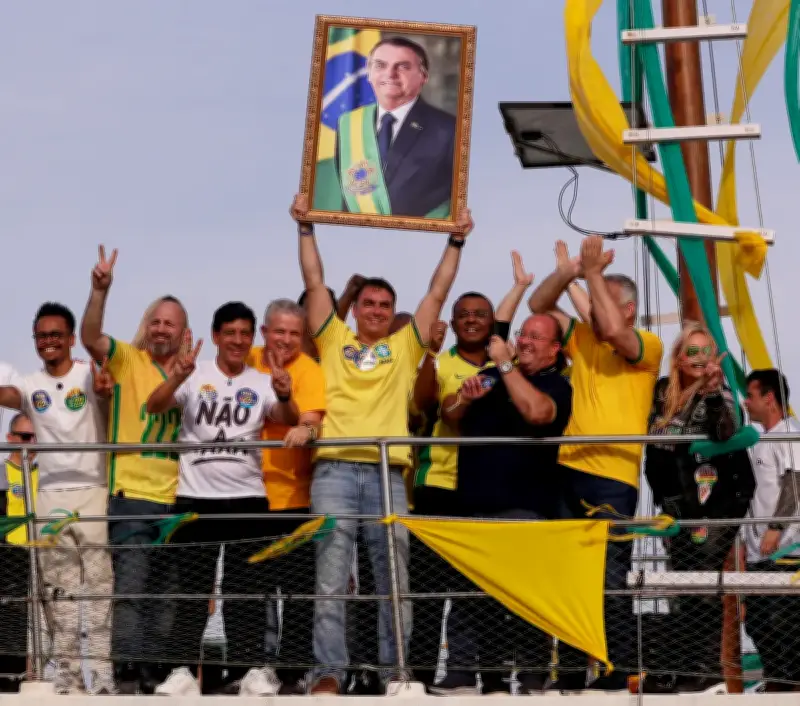
Brazil's weekend elections propelled Flávio Bolsonaro into the lead in the presidential race and highlighted the rise of a political dynasty built by his father, former President Jair Bolsonaro. As Flávio heads into a runoff against leftist incumbent Luiz Inácio Lula da Silva, a sweeping far-right victory in congressional races also secured seats for Jair Bolsonaro's wife, two of his sons and one of his brothers.
Family Members Elected to Office
Former first lady Michelle Bolsonaro, 44, who divided her campaign with caring for her husband as he serves a sentence under house arrest for attempting a coup, ran for public office for the first time and was elected senator. Bolsonaro's second son, Carlos Bolsonaro, 43, regarded as the most radical of the siblings, was also elected senator for the first time. His previous political career amounted to 25 years as a city councillor in Rio de Janeiro, starting at age 17 when his father put him up for a seat against his own mother, Rogéria Bolsonaro, who had divorced Jair. Carlos won. Rogéria also ran last Sunday for a seat in the state legislature, still using the Bolsonaro surname, but lost.
The patriarch's fourth son, Jair Renan Valle Bolsonaro, 28, who dropped his two middle names on the ballot to run simply as Jair Bolsonaro, jumped from city councillor to federal congressman. Of Bolsonaro's five children, only his 15-year-old daughter has never held political office. Even the former president's younger brother, Renato Bolsonaro, 62, nicknamed the “brother who can't win” after losing seven consecutive elections for lower-level offices, was elected. He went from fewer than 10,000 votes in a mayoral race two years ago to 380,000 votes for congress.
Campaign Dynamics and Family Friction
During the campaign, Renato caused some friction within the family by saying that “Flávio is not Jair. He doesn't draw crowds”. At the polls, however, Flávio ended up winning more votes than his father did in 2018 and 2022, although the result is seen by some as more of an anti-Lula vote than a strong preference for the senator. The number of Bolsonaros in office could have been even higher had “son 03”, Eduardo Bolsonaro, 42, not abandoned his seat in congress and gone into self-imposed exile in the US, where for more than a year he has lobbied for what Lula and many others see as Donald Trump's attempts to interfere in Brazil's elections.
Michelle Bolsonaro's Rise and Popularity
Although Michelle is the most recent member of the family to enter politics, it is she who is often considered to be the leading figure among the Bolsonaros. In a July poll, she was named the most powerful woman in Brazilian politics, well ahead of the current first lady, Janja Lula da Silva, in addition to a supreme court justice and many members of congress. “She is a phenomenon,” said Camila Rocha, a researcher at the Brazilian Center for Analysis and Planning, who has interviewed voters and studied the Brazilian right for a decade. “Even Bolsonaro voters don't like his sons very much, but many of them like Michelle, who is very charismatic.”
The daughter of a housewife and a retired bus driver from the metropolitan region around Brasília, Michelle was working as a parliamentary secretary for another politician when, at 25, she met Bolsonaro, then a 52-year-old congressman. She is his third wife. When he took office as president in 2019, Michelle made history by becoming the first and only Brazilian first lady to deliver a speech at an inauguration. She did so in Brazilian Sign Language, which she had mastered while working as an interpreter at evangelical church services – her religiosity is seen as one of the main assets behind Bolsonaro's close relationship with evangelical voters.
Despite playing by Bolsonaro's party's rules, Michelle was at the centre of one of the most contentious moments of Flávio Bolsonaro's campaign, when she said that she had been “humiliated”, “disrespected” and “mistreated” by the senator. Reports of friction between her and her stepsons are frequent. Given her popularity, Flávio had to apologise publicly – although Michelle accepted it, the two did not campaign together. Polls suggested Bolsonaro supporters would have preferred the former first lady as the presidential candidate, but the patriarch opted for his eldest son, and gave her the senate mission instead. “That was the mission my husband entrusted to me, and I will represent him, God willing,” she said in August.
Michelle and Bolsonaro's sons were also widely seen as helping secure victories for other far-right candidates from Bolsonaro's party, which will have by far the largest bloc in the next congress. “Although the family has been in politics for a long time, many voters still see the Bolsonaros as representing 'renewal' and an anti-system vote,” said Rocha. “So, to change everything, these voters want to throw a 'bomb' that blows up congress and Lula. And that bomb is the Bolsonaro family,” she added.