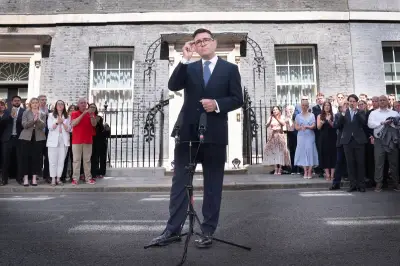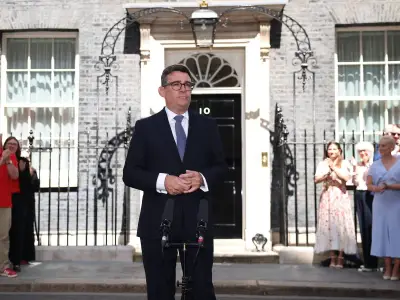
Andy Burnham has appointed the first cabinet of his premiership. Much has been made of how key allies of his predecessor, Keir Starmer, have been demoted or sacked, but what is the demographic makeup of the new team of senior ministers, and how does it differ from other governments?
Women make up half of the cabinet for the first time
For the first time in British political history, half of the cabinet is female, a huge change from the situation less than 50 years ago. When Margaret Thatcher came to power in 1979, she did not appoint a single other woman to the cabinet. Under her successor, John Major, there was even a period when there were no women in any of the top jobs.
Tony Blair began to tilt the balance the other way, but even in the era of “Blair’s babes” women remained a minority around the cabinet table. Blair’s first cabinet in 1997 included five. The trend was reversed by his successor, Gordon Brown, and the gender gap oscillated during the Conservatives’ 14 years in power.

Parity was nearly achieved in 2024 when Starmer appointed his first ministerial team. Cabinet, including those who attended but were not full members, was made up of 46% women. Parity was finally achieved this week with Burnham’s new appointments – though some Starmerites point out that the replacement of Rachel Reeves with John Healey as chancellor means one fewer woman in the four great offices of state.
The north-west overrepresented
It is little surprise that Burnham, the former Greater Manchester mayor and “King of the North”, has given an outsized number of cabinet posts to MPs representing seats from the north-west. Politicians from that region, which has been Burnham’s power base for several years, make up just over a quarter of the cabinet – but only 11% of the UK population live there.
The north-west was already overrepresented under Starmer, in contrast with Rishi Sunak’s cabinet, which contained only two MPs with constituencies in the north – one of whom was Sunak himself.
An increase in private education
At one point under Starmer, not a single full cabinet minister had attended private school for most of their secondary education. The historically high levels of state education caused Bridget Phillipson, the education secretary, to call Starmer’s team in opposition “probably one of the most class-conscious shadow cabinets that we’ve had for some time”.
That has shifted under Burnham, with 22% of the cabinet now having been educated mainly at private school, more than three times the rate among the general population. It is still below the last Conservative era however, where ministers who attended private schools made up more than half of the cabinets formed by Sunak, Liz Truss and David Cameron. The proportion reached almost two-thirds in Boris Johnson’s first cabinet, and after his 2020 and 2021 reshuffles.
More than half from Oxbridge
Unlike the past six prime ministers, Burnham did not go to Oxford but instead studied English at Cambridge, becoming the first Cantabrigian in No 10 since Stanley Baldwin, according to the Sutton Trust. The cabinet is still heavily dominated by Oxbridge alumni, with more than half having studied at one of the two universities, compared with just 1% of the wider population.
The proportion of Oxbridge students is similar to that in Sunak’s cabinet and higher than that under other Conservative prime ministers, including Truss and Johnson.
Ethnic minority representation remains steady
Four of Burnham’s cabinet are from a minority ethnic background, including the home secretary, Shabana Mahmood, the energy secretary, Miatta Fahnbulleh, and the minister for AI Kanishka Narayan. This means that 14% of the new cabinet come from a black or minority ethnic background, roughly mirroring the 16% of the UK population. The representation is better than under Starmer, but still short of the level achieved by Sunak, Britain’s first prime minister of colour, in 2022.