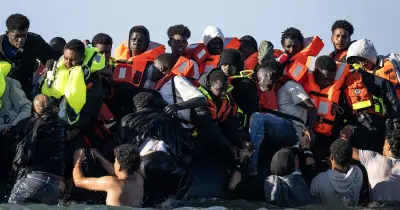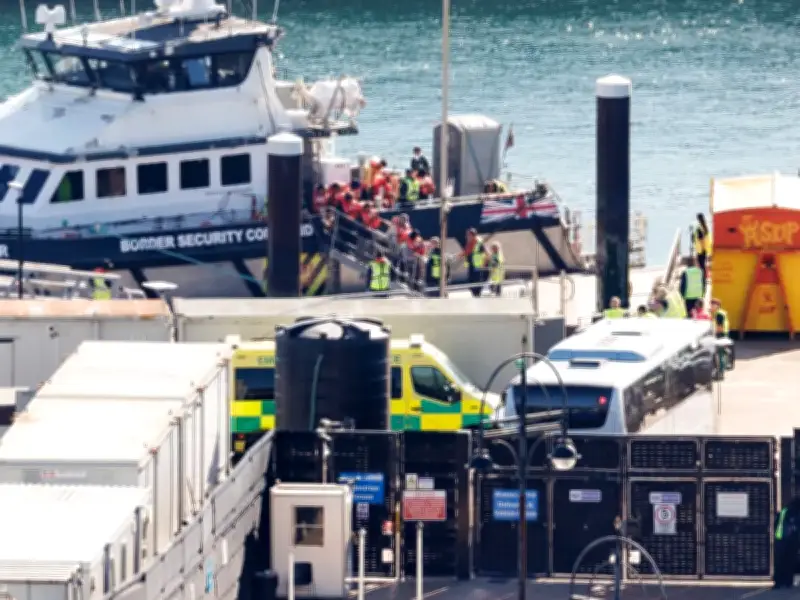
Tensions over the small boats crisis erupted into violence after far-right demonstrators clashed with police in Hampshire following the arrival of nearly 150 migrants on a single dinghy. Around 300 protesters gathered at Haslar Marina in Gosport on Sunday evening, blocking emergency vehicles and hurling abuse at officers as the migrants were brought ashore. Hampshire and Isle of Wight Constabulary confirmed that six people were arrested during the unrest, which saw flares set off and agitators chanting "deport the lot" after the vessel was escorted in by two RNLI boats.
The Home Office confirmed that up to 149 people were aboard the vessel, which had travelled from Normandy in what appears to be a new route designed by smuggling gangs to evade detection.
Clash between domestic law and international obligations
The violent scenes have reignited the fierce political debate over whether the UK actually possesses the legal framework required to tackle illegal migration and secure its borders. Cam Ashouripour, a partner at Rosenblatt Law, explained that the situation exposes a stark clash between Britain's domestic legislation and its international obligations.
Speaking to the Daily Star, he said: "On one hand, the UK does have domestic laws designed to curb illegal immigration and reduce incentives for those who enter the UK illegally. On the other, international human rights laws that are codified into domestic law require the government to rescue, protect and provide a process for individuals once they enter the territorial boundaries of the country."
Figures have dropped, but are rising again
He highlighted that entering the UK without permission has long been a criminal offence, which was strengthened by the Nationality and Borders Act 2022. This legislation made it a distinct offence to knowingly enter the country without proper clearance, addressing a legal loophole where individuals rescued at sea had not technically "entered" the UK in a legal sense. The Act also allows some asylum claims to be set aside where the person has a connection to a safe country.
"On paper, that is a real power," Ashouripour noted. "In practice it only works if that country will take them." While Border Force officers have the authority to stop, board, divert and detain boats suspected of being run by criminal facilitators, these powers stop short of ignoring vessels in distress. Previous proposals to turn boats back were quietly abandoned because they could not be executed safely or lawfully in the Channel.
Subsequent efforts, such as the Illegal Migration Act 2023, attempted to impose a duty to remove illegal arrivals, but much of that scheme has since been repealed, meaning asylum claims are once again decided in Britain.
'In practice it only works if that country will take them'
"These laws can punish the crossing and the trade behind it," Ashouripour said. "They do not cancel the duty to hear a claim for protection, or the ban on sending someone back into serious harm. Britain can treat a claim as inadmissible where a safe country will take the person. France is generally regarded as safe. It has not agreed to take back the people who leave its beaches."
According to the legal expert, the fundamental issue is not a lack of legislation, but rather whether governments possess the political consensus, resources, and willingness to implement these powers effectively. He pointed to the failed 2022 Rwanda deportation scheme as a prime example of the gap between legal theory and practical enforcement, noting that despite passing a law telling British courts to treat Rwanda as safe, the scheme was dropped after the 2024 election before anyone was sent.
"Successive governments have tried different approaches, including stronger enforcement, changes to the asylum system and greater international cooperation, yet small boat crossings remain a persistent challenge," he explained. "That should tell us that simply passing another piece of legislation will not, on its own, resolve the issue."
Ashouripour stressed that the United Kingdom's geography presents an obvious logistical hurdle for enforcement. "As an island nation with hundreds of miles of coastline, it is simply not realistic to treat border enforcement as a question of putting more officers at known landing sites," he said. "If resources are concentrated in one area, smuggling networks can adapt, routes can change, and boats can attempt to arrive elsewhere. Moreover, because of relevant human rights obligations, the government has a practical problem dealing with individuals once they have crossed into UK territory."
Instead of focusing purely on the coastline, he argued that authorities must target the complex international trade behind the crossings. Investigators have traced many of the inflatable boats to factories that sell them online, which are then shipped to Turkey, transported through the European Union, and driven to beaches in northern France.
"That route can be attacked at every link, but only with European partners. Treating each landing as a separate event leaves the organisers untouched," Ashouripour concluded. "Until there is greater agreement about what the UK is prepared to do in practice, the political debate risks becoming overly focused on creating new powers rather than how existing ones can be used more effectively."