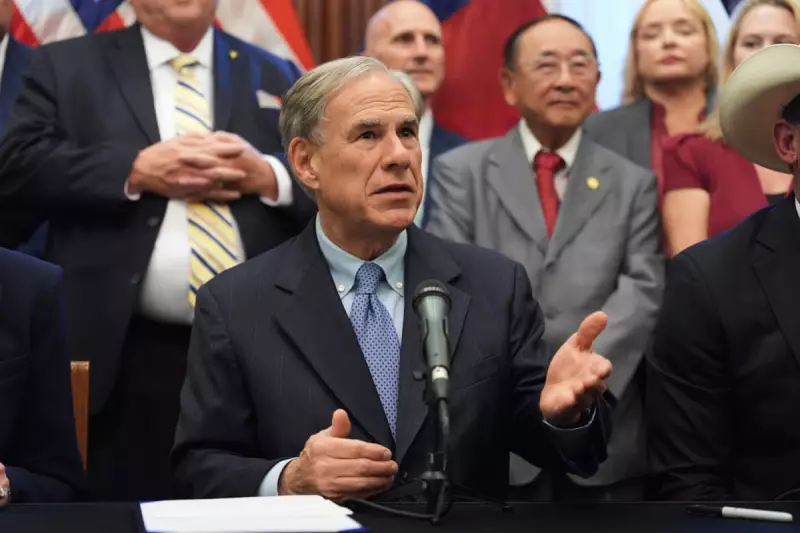
Governor Greg Abbott of Texas is embroiled in a significant constitutional clash after unilaterally designating a prominent Muslim civil liberties organisation as a terrorist group, a move that has ignited a federal lawsuit and intensified debates over religious discrimination in the state.
Unilateral Proclamation Sparks Federal Lawsuit
On 18 November 2025, the hardline Republican governor issued a proclamation declaring the Council on American-Islamic Relations (CAIR) and the Muslim Brotherhood to be terrorist organisations. This action, typically reserved for the federal government, authorised heightened enforcement and prohibited the groups from acquiring land in Texas. Just two days later, Abbott directed the state's Department of Public Safety to investigate CAIR.
In swift response, CAIR's Texas chapters filed suit in federal court against both Governor Abbott and Texas Attorney General Ken Paxton. The lawsuit contends the governor's proclamation violates core constitutional protections, including free speech, due process, and property rights, and emphasises that the US federal government has never designated CAIR as a terrorist entity.

A Pattern of Escalating Hostility and Fear
CAIR's national deputy director, Edward Ahmed Mitchell, told The Guardian that the governor's hostility has grown following several legal victories CAIR has secured against him in recent years. These included free speech cases defending Texas students and a teacher who expressed support for Palestinians.
"The governor is trying to turn conspiracy theories into policy," Mitchell argued. He criticised the proclamation for listing eight individuals with supposed ties to terrorism, noting that some have no connection to CAIR, while others were individuals for whom CAIR had advocated after wrongful charges.
The legal challenge is being led by attorney Charles Swift of the Muslim Legal Fund of America, who described Abbott's move as a clear "escalation." His reason for taking the case is straightforward: "It's constitutional, and the governor is trying to exercise powers he does not have."
Broader Context of Rising Anti-Muslim Sentiment
This legal battle unfolds against a backdrop of sharply rising Islamophobia both nationally and within Texas. CAIR has reported significant increases in anti-Muslim violence and rhetoric over the past two years. The state has witnessed several high-profile incidents, including a case in Euless where a woman was initially released on a $40,000 bail after attempting to drown two Palestinian American children.
Other Texas politicians have also engaged in inflammatory rhetoric. Republican congressional candidate Valentina Gomez posted a video of herself burning a Quran with a flamethrower and made derogatory statements about Islam. Agriculture Commissioner Sid Miller has a history of sharing violent, Islamophobic content on social media.
Imam Dr Omar Suleiman, founder of the Yaqeen Institute for Islamic Research, labelled Abbott's declaration "political theatre." He stated, "Throughout Governor Abbott’s tenure, Islamophobia has become increasingly normalized and instrumentalized in Texas politics. Muslims have repeatedly been used as convenient targets."
Epic City Development and Institutional Suspicion
Prior to targeting CAIR, the Abbott administration engaged in a separate confrontation over Epic City, a planned Muslim community in North Texas featuring over 1,000 homes, a mosque, a school, and senior housing. In March 2025, Attorney General Paxton launched an investigation into the development, while Abbott ordered multiple state agencies to probe it for potential fair-housing violations.
Although the US Department of Justice closed its own civil rights inquiry in June without filing charges, the state investigation persists. Furthermore, in the same month, the Texas legislature passed a bill prohibiting certain residential developments from using "religious-organisation" exemptions, a move critics say directly targeted Muslim-led projects like Epic City.
"The Epic City case is one of the clearest examples of Islamophobia shaping policy," argued Dr Suleiman. "The law institutionalized suspicion toward Muslim-led community planning."

As the federal lawsuit proceeds, advocates stress the need for leadership that affirms the place of Muslim Texans in society. "We need leaders willing to affirm publicly that Muslims are integral to Texas," Suleiman concluded, "and who refuse to weaponize fear for political gain."