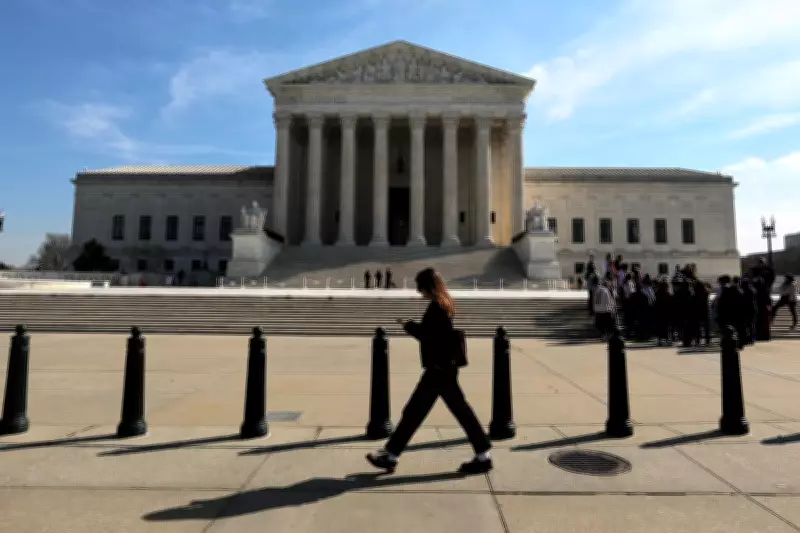
US Supreme Court to Rule on Birthright Citizenship Amid Trump Order Legal Battle
The Supreme Court of the United States is currently deliberating arguments regarding an appeal from the administration of former President Donald Trump, which seeks to reverse a federal judge's decision that halted an executive order aimed at terminating birthright citizenship. This order, signed by Trump on the inaugural day of his second term, has been universally blocked by federal courts, which have determined it "likely violates the Fourteenth Amendment of the Constitution" and federal law.
Constitutional Clash Over Citizenship Clause
The contentious executive order, part of Trump's broader immigration enforcement strategy, has never been implemented. At its heart lies the interpretation of the 14th Amendment's Citizenship Clause, which states that citizens include "all persons born or naturalized in the United States, and subject to the jurisdiction thereof." Judges across the federal judiciary have consistently articulated their view that Trump's order is unconstitutional, diverging from long-standing interpretations of citizenship, conflicting with a 126-year-old Supreme Court precedent, and misaligning with the original intent of the 14th Amendment when ratified in 1868.
They have also advocated for the necessity of preventing the order from taking effect nationwide, even following a Supreme Court ruling that restricted the use of nationwide injunctions by federal judges. Among the most outspoken critics are the three liberal justices of the Supreme Court. Justice Sonia Sotomayor, supported by Justices Elena Kagan and Ketanji Brown Jackson, dissented from a decision by the court's six conservative justices that utilized an earlier phase of the birthright citizenship dispute to limit nationwide injunctions.

Judicial Opinions and Historical Context
In June, Justice Sotomayor wrote, "With the stroke of a pen, the President has made a 'solemn mockery' of our Constitution," citing an 1809 opinion by Chief Justice John Marshall. She further asserted, "Children born in the United States and subject to its laws are United States citizens," noting that the Trump administration departed from its usual practice of seeking nationwide enforcement for citizenship restrictions. "Why? The answer is obvious: To get such relief, the Government would have to show that the Order is likely constitutional, an impossible task in light of the Constitution's text, history, this Court's precedents, federal law, and Executive Branch practice," she explained.
Consulting an 1865 dictionary, Justice Sotomayor defined "subject to the jurisdiction" as "to be bound to its authority and its laws," concluding, "Few constitutional questions can be answered by resort to the text of the Constitution alone, but this is one. The Fourteenth Amendment guarantees birthright citizenship." Conversely, Justice Amy Coney Barrett, authoring the majority opinion that curtailed nationwide injunctions, clarified the limited scope of last year's case, stating, "The principal dissent's analysis of the Executive Order is premature because the birthright citizenship issue is not before us. And because the birthright citizenship issue is not before us, we take no position on whether the dissent's analysis is right."
Lower Court Rulings and Appellate Support
Lower courts have demonstrated equal determination. U.S. District Judge Joseph N. LaPlante in New Hampshire, whose ruling is now under Supreme Court review, wrote in July that the executive order "likely violates the Fourteenth Amendment of the Constitution" and federal law. Applying his decision to a nationwide class of children born to mothers in the U.S. illegally or temporarily, Judge LaPlante warned that denying citizenship "would render the children either undocumented noncitizens or stateless entirely. ... The children would risk deportation to countries they have never visited."

In August, U.S. District Judge Deborah Boardman in Maryland reaffirmed her initial ruling against the order, stating, "The Court reaffirms here its prior finding that 'the Executive Order flouts the plain language of the Fourteenth Amendment to the United States Constitution, conflicts with binding Supreme Court precedent, and runs counter to our nation's 250-year history of citizenship by birth.' The plaintiffs are extremely likely to succeed on the merits of their claim that the Executive Order is unconstitutional." Appellate courts have mirrored these views. Judge Ronald Gould of the San Francisco-based U.S. Court of Appeals for the 9th Circuit, joined by Judge Michael Daly Hawkins, wrote in July, "Perhaps the Executive Branch, recognizing that it could not change the Constitution, phrased its Executive Order in terms of a strained and novel interpretation of the Constitution. The district court correctly concluded that the Executive Order's proposed interpretation, denying citizenship to many persons born in the United States, is unconstitutional. We fully agree."
Judge Gould contended that the executive order misinterprets American history, noting, "The Defendants' proposed interpretation of the Citizenship Clause relies on a network of inferences that are unmoored from the accepted legal principles of 1868." He concluded, "We reject this approach because it is contrary to the express language of the Citizenship Clause, the reasoning of Wong Kim Ark, Executive Branch practice for the past 125 years, the legislative history to the extent that should be considered, and because it is contrary to justice." Judge Patrick Bumatay dissented, not on the order's legality, but on the basis that states challenging it lacked standing to sue.
Historical Precedents and Ongoing Debate
Similarly, Judge David Barron of the U.S. Court of Appeals for the 1st Circuit in Boston, in a unanimous three-judge panel opinion in October, stated, "But the length of our analysis should not be mistaken for a sign that the fundamental question that these cases raise about the scope of birthright citizenship is a difficult one. It is not, which may explain why it has been more than a century since a branch of our government has made as concerted an effort as the Executive Branch now makes to deny Americans their birthright." Referencing the Supreme Court's Dred Scott decision, which denied citizenship to Black Americans and precipitated the 14th Amendment, Judge Barron wrote, "Our nation's history of efforts to restrict birthright citizenship ... has not been a proud one." He added, "The 'lessons of history' thus give us every reason to be wary of now blessing this most recent effort to break with our established tradition of recognizing birthright citizenship."
These judicial opinions frequently cite the 1898 Supreme Court case, United States v. Wong Kim Ark, as a definitive precedent. In that 6-2 decision, Justice Horace Gray authored the majority opinion, affirming Wong's citizenship due to his birth on American soil. He explained that the 14th Amendment, by qualifying "all persons born in the United States" with "and subject to the jurisdiction thereof," intended to exclude only specific cases such as children of alien enemies in hostile occupation or diplomatic representatives. Justice Gray stated, "The fourteenth amendment affirms the ancient and fundamental rule of citizenship by birth within the territory, in the allegiance and under the protection of the country, including all children here born of resident aliens." He concluded, "The amendment, in clear words and in manifest intent, includes the children born within the territory of the United States of all other persons, of whatever race or color, domiciled within the United States." Chief Justice Melville Fuller, in dissent, argued Wong could not be a citizen because his parents still owed allegiance to the Chinese emperor and were not fully "subject to the jurisdiction" of the United States.
As the Supreme Court hears arguments, the consistent and forceful rejection of Trump's birthright citizenship order by federal courts highlights the profound constitutional issues at play and the deeply entrenched legal principles it confronts.