
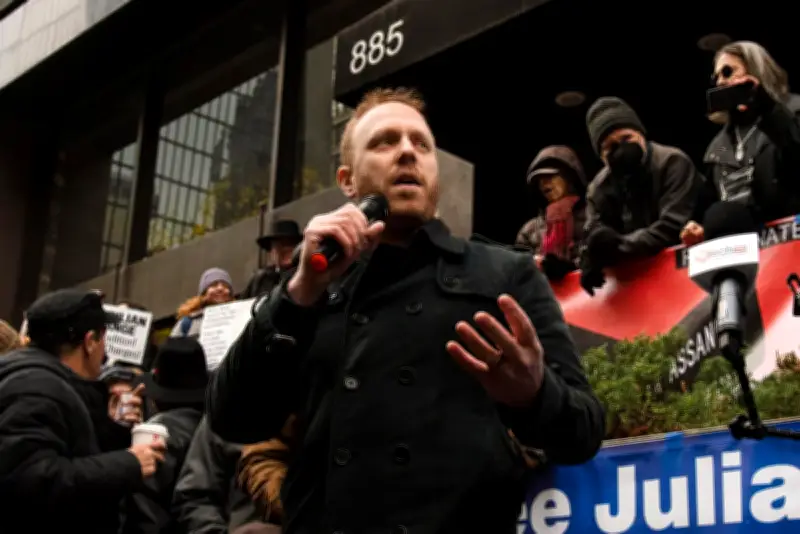
Uploading video from the funeral of Iran's supreme leader Ali Khamenei at a Tehran cafe a few weeks ago, Max Blumenthal began to see social media posts from the Trump ally Laura Loomer aimed at him. One suggested he should be "taken off the plane by US Marshalls when he lands back in the US … [and] detained".
"I began to prepare myself for being harassed on my return," Blumenthal said.
That, effectively, is what happened. The episode has produced a legal fight that press freedom advocates say reveals the Trump administration's determination to crack down on media members whose reporting it dislikes.
Phones seized at Dulles
On 10 July, border patrol agents at Virginia's Dulles airport flagged Blumenthal, founder of the independent outlet The Grayzone, for a "secondary inspection". They asked how he paid for his trip to Iran, whether he knew the people who had hosted him, and whether he planned to return. They then asked to see his two phones. He refused to give them the passwords, and they took the phones without taking his laptop or digital cameras.
The agency returned the cell phones a week later, less than 24 hours after the American-Arab Anti-Discrimination Committee (ADC) filed an emergency motion in district court seeking their return. The government said it could not get into the phones and returned them, making the motion moot. But on Wednesday Blumenthal returned to court and obtained a ruling that the government must prove that claim by supplying evidence of who had his phones, when they had them, and what they did with them. Judge Leonie M Brinkema gave the government 14 days to respond.
Free-press alarm
Blumenthal's treatment raises "serious constitutional problems", said Seth Stern, chief of advocacy at the Freedom of the Press Foundation. "The Trump administration is finding any excuse it can to target journalists it dislikes, and border searches are one more play in the playbook."
The case is the second involving cell phone seizures at US airports to reach federal court in recent weeks, after a case brought by an activist against the Atlanta police-training center known as "Cop City" had its first evidentiary hearing. Brinkema pointed to a recent fourth district ruling separating a basic cellphone search, where the owner allows an agent to open the phone, from an "advanced" search in which "equipment, wired or wireless, [is used] to copy and/or analyze the contents of an electronic device". The judge said that under fourth circuit case law, a search warrant would be required for that degree of intrusion into a cell phone. No such warrant was produced for Blumenthal.
Questions of sources and motive
The incident is also the second recent case in which the federal government has appeared to try to learn journalists' sources, after its failed attempt to subpoena New York Times reporters. The ADC's president, Jenin Younes, said the agents took only Blumenthal's phones. "They didn't take his laptop or digital camera," she said. "That suggests they're interested in contacts, sources, personal communications – maybe even tracking data."
At Wednesday's hearing, Brinkema mentioned the New York Times subpoena case. "[G]iven the fact that this plaintiff is a reporter, this case has particular concern to the court because there's been so much recently in the ether about attempts by the government to intrude upon a reporter's right to report," she said. "And, you know, just recently in New York, we had the issue of the subpoenas that were issued to the New York Times reporters. I don't think that can be overlooked."
Younes said: "We want to know what they did with [Blumenthal's] phones. We want to make sure the administration recognizes the serious privacy interests at stake in taking anyone's phones – especially journalists."
Targeted views
The judge suggested Blumenthal could "probably have an expert take a look at his phones to see if there's any indication [...] they were somehow tampered with or accessed in some way". Blumenthal said he is "working on that – but it costs a lot".
Younes noted that many other US journalists were in Iran covering Khamenei's funeral, including for mainstream outlets such as CNN and the New York Times, but there has been no public disclosure that any other reporter was detained on return. Loomer's posts, she said, "raise the specter he's being targeted for his views, for his journalism. This strengthens the first amendment aspect of his case."
Blumenthal said the views that make him a target include being a "Jewish anti-Zionist". Wednesday's hearing, he said, was positive not just for him. "It has positive consequences for other journalists who have faced or will face this kind of repression, from an administration that isn't responsive to the rule of law."
Possible prolonged fight
Younes cautioned that the information Blumenthal seeks may turn into "a protracted battle", because the government's attorney raised the possibility that some of what was done with his phones may be "law enforcement privileged information".
"You explain how this is done, and the individuals who we are trying to get information from are able to 'beat it'," he said.




