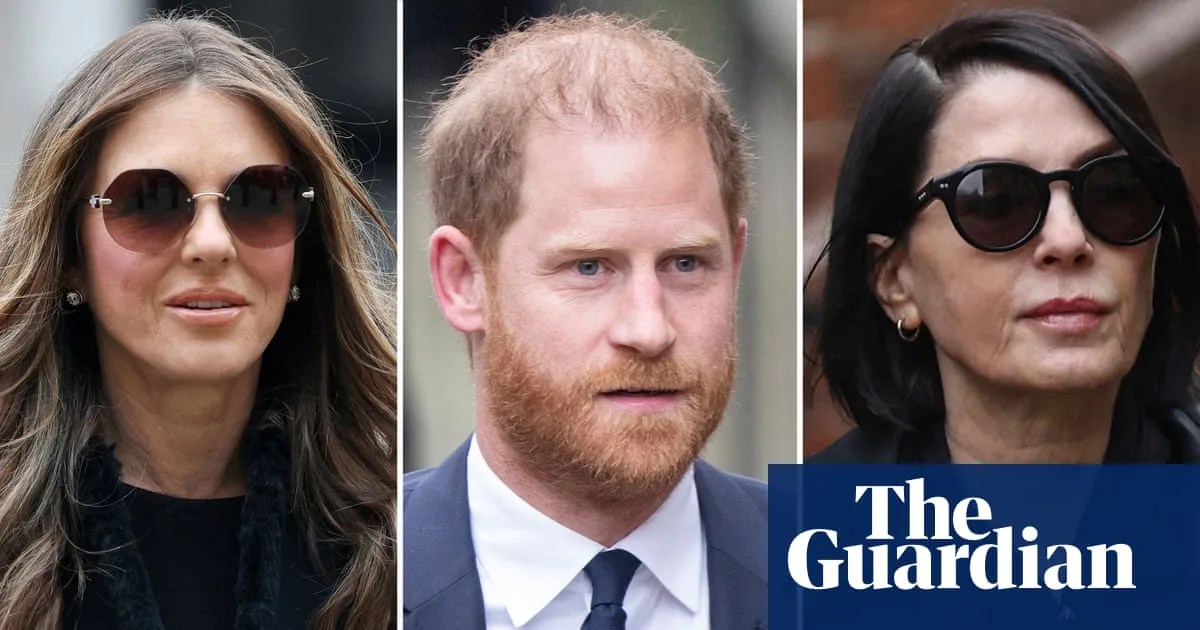
Prince Harry's £38m High Court Showdown with Daily Mail Begins
Prince Harry's High Court Trial Against Daily Mail Begins

A legal battle of unprecedented scale and significance opens at the Royal Courts of Justice in London on Monday, as Prince Harry and a cohort of prominent public figures face off against one of Britain's most powerful media groups.

A Formidable Coalition Takes on the Tabloids

The Duke of Sussex is not fighting alone. His action against Associated Newspapers, the publisher of the Daily Mail and the Mail on Sunday, is joined by an extraordinary group of co-claimants. They include music icon Sir Elton John and his husband David Furnish, actors Liz Hurley and Sadie Frost, former Liberal Democrat MP Simon Hughes, and Baroness Doreen Lawrence, the mother of murdered teenager Stephen Lawrence.

The allegations they present are severe. The claimants contend that journalists and private investigators working for the newspapers engaged in a widespread campaign of unlawful information gathering. This is said to have included not just the interception of voicemails, but also the hacking of landlines, the bribing of police officers, the blagging of confidential medical records, and even the bugging of private homes.

Wide Pickt banner — collaborative shopping lists app for Telegram, phone mockup with grocery list

Associated Newspapers has robustly denied all accusations, labelling them "preposterous smears" and an affront to its journalists. The trial, expected to last nine weeks in Court 76, is projected to incur total legal costs of around £38 million.

Deep-Rooted Grievances and High-Stakes Gambles

For Prince Harry, this litigation is the latest salvo in a deeply personal war with the press. His animosity is rooted in the death of his mother, Diana, Princess of Wales, and has been fuelled more recently by what he perceives as the media's mistreatment of his wife, Meghan. In his memoir, Spare, he suggested his relationship with King Charles and Prince William deteriorated partly over their reluctance to confront alleged press misconduct.

Harry's legal crusade has already yielded significant victories. In 2023, he became the first royal in over 130 years to testify in court, winning £140,600 in damages after a judge ruled the Mirror had hacked his phone. Last year, he settled a separate claim against the publisher of The Sun for a reported £10 million, which included an apology for unlawful activities.

However, this case represents his biggest and most complex challenge yet. The claimants must convince Mr Justice Nicklin that their evidence is reliable. If they lose, they could be liable for the Mail's enormous legal bill, with insurance potentially falling short.

Controversial Witnesses and Explosive Allegations

The trial promises to scrutinise three decades of tabloid journalism practices. Key witnesses will include former Daily Mail editor-in-chief Paul Dacre, while the evidence of controversial figures like ex-reporter Graham Johnson will be pivotal. Johnson, a self-confessed former "professional liar" who was convicted for phone hacking in 2014, has been investigating the Mail titles for years.

Perhaps the most shocking claim centres on Baroness Lawrence. Her legal documents allege the Daily Mail instructed private investigator Jonathan Rees to bug and conduct covert surveillance on her in the aftermath of her son's murder. Rees, who has a criminal conviction for perverting the course of justice, told a Channel 4 Dispatches programme he was aware such surveillance occurred but was not personally involved. Associated Newspapers firmly denies ever using his services.

Baroness Lawrence has stated she was "floored" when Prince Harry informed her of the suspected hacking. She now says she is "more determined than ever" to seek accountability, relying on documents that appear to show payments from the Mail to other private investigators around the time stories about her were published.

No Clear Winners in a Battle of Principles

As the proceedings commence, the outcome remains fiercely uncertain. The Mail may argue the case is time-barred, as claimants have six years to bring a privacy claim from the point of discovery. Yet, such a technical victory could prove pyrrhic in the court of public opinion.

Pickt after-article banner — collaborative shopping lists app with family illustration

For Prince Harry and his fellow claimants, the trial is a monumental point of principle, a direct confrontation with the methods of the tabloid press. For Associated Newspapers, it represents a gruelling, expensive examination of its historic reporting tactics. Over the next nine weeks, the High Court will decide not just on matters of law and evidence, but on a clash of cultures with profound implications for privacy, press freedom, and power in modern Britain.




