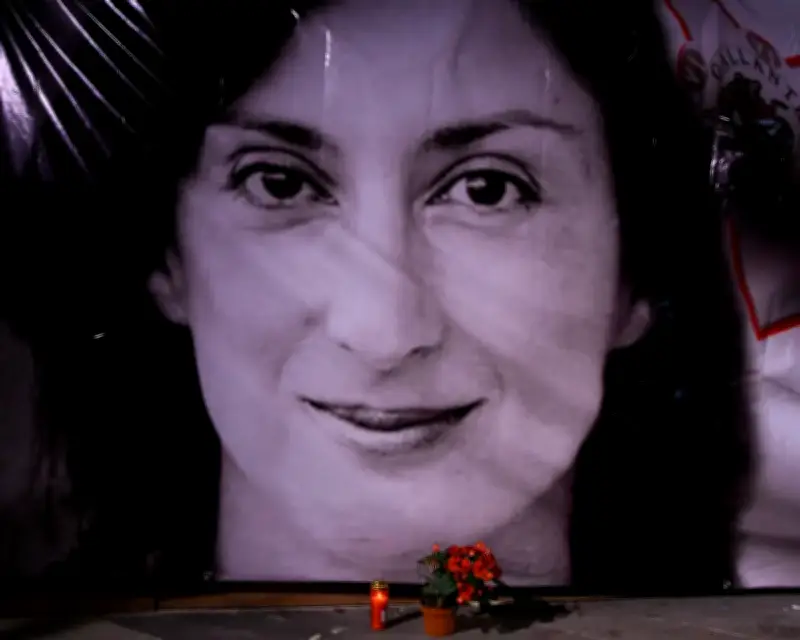
Malta is reeling today from the shock acquittal of one of the country’s wealthiest and best-connected men for involvement in the murder of the anti-corruption journalist Daphne Caruana Galizia.
As the EU’s smallest member state once again faces intense international scrutiny over its response to the 2017 killing, opposition MPs are demanding the parliament be recalled for an immediate debate on a verdict that Caruana Galizia’s eldest son Matthew has denounced as “justice denied”.
Acquittal sparks outrage
Nearly nine years after Caruana Galizia’s death in a car bombing in October 2017, Yorgen Fenech, the head of one of Malta’s most successful business families, was found not guilty of both counts with which he had been charged: complicity in voluntary homicide, and association with the intention of committing a crime.

Always a possibility, the complete acquittal – delivered by the jury at 7.30pm on Wednesday evening – was unexpected, after the longest-running murder trial in Maltese history which had gripped the small country over 55 days.
As family members broke down in tears, Fenech exited the court house to chants of “mafia”. Following him into the balmy evening came Caruana Galizia’s sister, Corinne Vella, who told reporters: “This signals you can kill journalists with impunity.” Demonstrators later assembled outside the parliament building to demand action.
A landmark case for press freedom
Although five other men were convicted of carrying out the assassination and procuring the bomb used to kill the one of Malta’s most prominent journalists, Fenech’s acquittal leaves many unanswered questions. Fenech had been accused by prosecutors of paying €150,000 (£129,000) via a middleman to have her killed – so if he wasn’t the mastermind, who was?
Caruana Galizia’s immediate family are bitterly disappointed, says Juliette Garside, the Guardian’s European financial affairs editor, who spoke from Malta’s capital Valletta. “She hadn’t investigated [the other men who were convicted]; they had no power or political influence. The only prosecution that really mattered to the family was this one.”
The verdict was also a huge shock for the political establishment: “You got the sense they wanted a guilty verdict as a strong demonstration within the EU that Malta was able to hold people accountable”. For campaigners who regard the case as a landmark action in the fight to protect press freedom in Europe there is considerable dismay – Reporters Without Borders said it was “beyond outraged”.
The Daphne Project
Juliette talks as she’s packing up her hotel room. “This is a story of many twists and turns, but at base it is a story about press freedom, and one woman who pursued corruption at its highest levels,” she says.
Juliette first became aware of Caruana Galizia’s work a year before she died, when she made contact with her eldest son Matthew, who was working with his mother on a tranche of leaked documents from the Panama Papers that suggested Labour figures set up offshore companies soon after entering government.
She remembers the day Caruana Galizia was killed: a contact sent her a photograph of the mangled car wreckage, and Juliette ran over to the foreign desk to press the editor to give the assassination the coverage it deserved. “She was killed because she was an incredibly effective investigate journalist. She set her sights on the most powerful people in the country. She was interested in where crime and politics collided.”
The Guardian later contacted Caruana Galizia’s family to follow up on what could be done – and the Daphne Project was born, a loose collective of journalists, from Reuters, the Times of Malta, Le Monde and Süddeutsche Zeitung, who agreed to work together to complete her investigations.
Juliette met the family again in a safe house near London in November 2017, where they were having a break from the spotlight in Malta and also taking security advice. Before her murder, Caruana Galizia endured a campaign of intimidation including the killing of her pet dogs and fires set in her home – her remaining family were now targets.

These attacks had intensified as she began to dig into a leak about a flagship power station project. “Matthew told us about the leak she’d been investigating, detailing the bizarre way the power station deal was structured. That’s what we focused on.”
But the Daphne Project also asked questions about the police investigation into her death. “The administration that she attacked hadn’t bargained on much interest in her death outside Malta,” Juliette says. “But when the family took their campaign to the European parliament and the Daphne Project gave it an international news platform, that really forced the Maltese police to go higher than the hit men.”
What next for Malta?
While acknowledging that it is important to respect the verdict of the jury, Juliette says there’s a sense among the Maltese media that this is a chilling verdict: what happens the next time a journalist writes about corruption? The editorial headline in the Times of Malta yesterday was bleak: “We’ve turned the clock back to 2017”.
It is likely that the prosecution will appeal, and details of the close relationship between big business, police chiefs and regulators exposed in the trial may feed into a number of other pending corruption cases both of which are unlikely to have got this far without the diligent reporting that followed her assassination. “What would really be unusual is if people got convicted,” Juliette adds.
But, just like that Times of Malta headline, Juliette worries that the country has returned to business as usual. Malta has a small economy that runs on patronage; the political class is tribal and split between two parties, Labour and Nationalist. “There’s not much means to get neutral, independent information.”
“After her death, it initially felt like the beginning of a stronger civil society, but the momentum behind change has slowed”.
What next for Europe?
A public inquiry into Caruana Galizia’s killing concluded in 2021 with a recommendation to introduce Europe-wide laws to protect journalists from strategic lawsuits against public participation, known as Slapps, which are increasingly used to silence whistleblowers, victims of sexual assault and those who report on them. Caruana Galizia was facing 47 lawsuits when she died.
Although this was voted through by the European parliament, no member state has yet implemented it. Yesterday, European parliament president Roberta Metsola vowed to continue fighting for justice for Caruana Galizia in a Facebook post addressed directly to the assassinated journalist.
“When they assassinated you, in broad daylight, outside your family home, we promised that we would not let them sweep it under the carpet … That promise holds today,” she wrote.
“Hopefully this will be an impetus for EU member states to put this law on to their statute books”, says Juliette.
There’s more to be done. An unsuccessful car bomb attack on an Italian investigative reporter, Sigfrido Rannucci, which appeared to be timed to coincide with the eighth anniversary of Caruana Galizia assassination, has intensified European Commission concerns about the silencing of government critics.
Meanwhile, at a UK level, two private members’ bills designed to crack down on these potentially financially devastating lawsuits were introduced just before summer recess and are expected to attract cross-party support.
The Guardian is now part of the UK Anti-Slapp Coalition, a group backed by charities including Amnesty International and Index on Censorship, and Juliette has written at length about how the courts have been weaponised in particular against victims of sexual violence.
“The fact that the public know what a Slapp is at all – and that there’s now a coordinated push to protect whistleblowers, journalists and victims of sexual assault from being sued by those who wish to silence them – is all because of what happened to Daphne. That is her legacy.”