Judge Weighs Reversing Pentagon Press Policy That 'Deprives Americans of Vital Iran War Information'
A federal judge is considering whether to overturn a controversial Pentagon policy that restricts journalist access, with attorneys arguing it is depriving Americans of crucial information about U.S. military operations while the country is engaged in conflict with Iran.
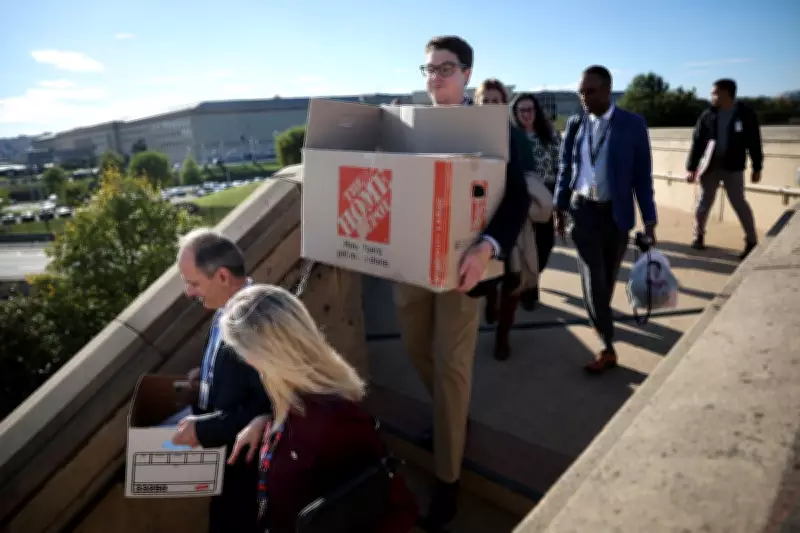
During a hearing on Friday, U.S. District Judge Paul Friedman heard arguments from The New York Times' legal team, who urged him to block the new rules and reinstate press credentials for reporters who walked out of the Pentagon building last October rather than agree to the restrictions.
'More Important Than Ever for Public to Know'
Theodore Boutrous, attorney for The New York Times, told Judge Friedman that "it's more important than ever for the public to know as much as they can" about military activities, particularly given the ongoing U.S. attacks on Iran and resulting American troop casualties.

Judge Friedman, who was nominated to the bench by Democratic President Bill Clinton, appeared skeptical of key government arguments defending the policy. He suggested it is "more important than ever" for Americans to hear "a variety of views" about federal government activities and elected leaders.
"A lot of things need to be held tightly and secure, but openness and transparency allows members of the public to know what their government is doing," the judge remarked during the proceedings.
Government Defends 'Common Sense' Security Rules
Justice Department attorney Michael Bruns argued that the credentialing policy reflects the government's "compelling interest" and "statutory obligation" to protect national security information, calling it "not a trivial exercise."
The Pentagon has maintained that the policy imposes "common sense" rules designed to protect the military from unauthorized disclosure of sensitive information. Government attorneys wrote that "the goal of that process is to prevent those who pose a security risk from having broad access to American military headquarters."
Current Press Corps Composition and Legal Challenges
The current Pentagon press corps now comprises mostly conservative outlets that agreed to the policy. Reporters from organizations that refused to consent to the new rules, including The Associated Press, have continued reporting on military matters from outside the building.
The New York Times sued the Pentagon and Defense Secretary Pete Hegseth in December, claiming the credentialing policy violates journalists' constitutional rights to free speech and due process. Times attorneys argue the policy is designed to silence unfavorable press coverage of the Trump administration.
"The First Amendment flatly prohibits the government from granting itself the unbridled power to restrict speech because the mere existence of such arbitrary authority can lead to self-censorship," they wrote in legal filings.
Inconsistent Application and Security Standards Questioned
The Times presented evidence suggesting the Pentagon has applied its rules inconsistently. The newspaper noted that Trump ally Laura Loomer, a right-wing personality who agreed to the Pentagon policy, appeared to violate its prohibition on soliciting unauthorized information by promoting her "tip line," yet faced no objection from the government.
Meanwhile, the government concluded that a Washington Post tip line does violate the policy because it purportedly "targets" military personnel and department employees. Boutrous called this discrepancy "mystifying" and said "it just doesn't make any sense."
Judge Friedman pressed Bruns on what standards are used to determine if a reporter poses a security risk, asking "Don't there have to be some criteria that are applied in a uniform way?" Bruns acknowledged the need for criteria but argued the government has "far more leeway" to restrict speech in secure facilities like the Pentagon.
Historical Context and Press Association Concerns
Yale Law School professor David Schulz, representing the Pentagon Press Association, told the judge that the challenged policy represents a "stark break from the past," noting that "the press has been in the building since the day it opened. It has always been there."

Charles Stadtlander, Times spokesperson, said in a statement that "today was an important opportunity for The New York Times's lawyers to make our case for the clear importance and public service of allowing journalists to report fully on the Pentagon." He emphasized that U.S. attacks on Iran "illuminate the public's right to access deep, impartial reporting on the details of the military actions happening as we speak."
Judge Friedman indicated he intends to issue "as prompt a decision as I can, because I know it's important for lots of reasons," though he didn't immediately rule on whether to order the Pentagon to reinstate press credentials for the affected reporters.