
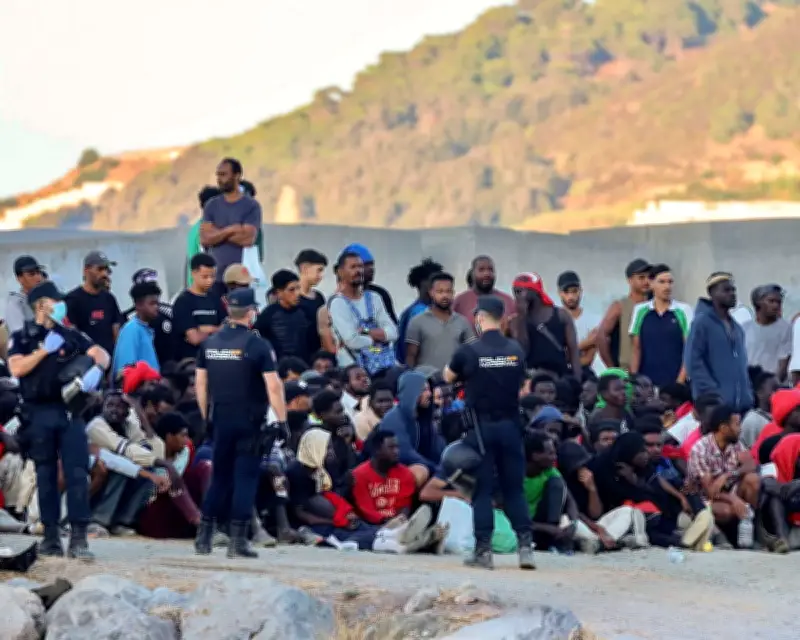
Around 2,500 migrants remain in the Spanish enclave of Ceuta following last week's massive border rush from Morocco, Spanish officials said. At least 88 people died during the chaos, some drowning and others trampled in the crush.
EU allies turn on Spain
Italy and Denmark led accusations that Madrid failed to secure the EU's only land border with Africa, despite Ceuta not being in the Schengen area. Italian Prime Minister Giorgia Meloni suspended Schengen rights for travellers from Spain, and she and Danish counterpart Mette Frederiksen wrote to the EU demanding emergency talks on tightening external borders.
Spain's Prime Minister Pedro Sánchez protested the "selfish, polarising and unlawful" response of his EU allies, who were backed by all but five of the 27 EU leaders.
Spain's humanitarian stance isolated
Paul Taylor, a senior fellow with the European Policy Centre, said many EU governments had a "shamelessly cynical interest" in isolating Madrid. "Most EU governments are conservative or rightwing-led and have an interest in scapegoating Spain, which is governed by a socialist-leftist coalition," he said.
Taylor noted Spain has been "an outlier, welcoming migration and actively working to integrate migrants into the economy and society," which is seen as an "affront" by conservative politicians and a "pull factor" for migrants.
Hypocrisy and double standards
Taylor highlighted the hypocrisy of Spain's critics, saying many had introduced similar regularisation schemes themselves. "Italy and Germany have both given work permits and/or the right to remain to irregular migrants already working there," he said.
The EU's justice and home affairs ministers endorsed a plan to strengthen external borders, including an early warning system and better "cooperation" with non-EU countries, possibly code for more "cash for migration" deals.
What provoked the surge?
The exact cause remains unexplained, but theories include misleading social media posts following a Spanish supreme court ruling on deportations, and geopolitical mischief by Morocco, which previously allowed 10,000 people to cross into Ceuta in 2021 during a diplomatic standoff.
In the European parliament, far-right and rightwing MEPs celebrated the return regulation with chants of "send them back!", reflecting a normalised sentiment among mainstream leaders.




