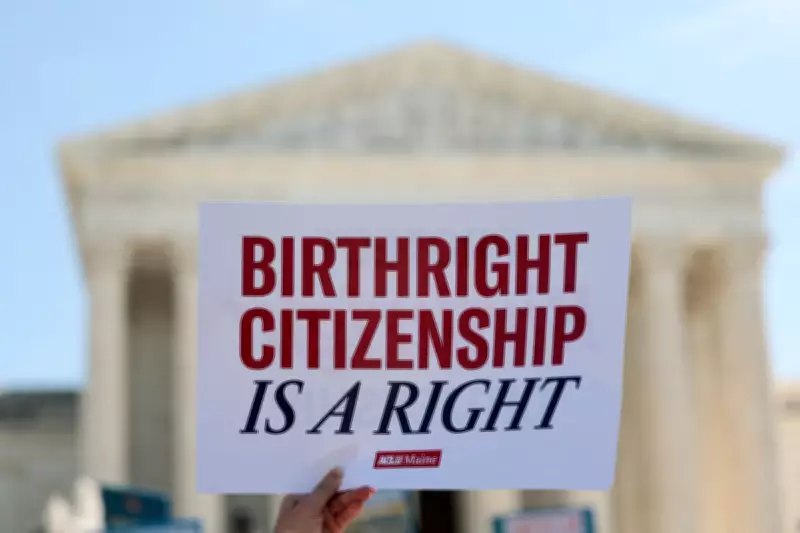
Supreme Court Birthright Citizenship Decision Could Unleash Bureaucratic Chaos
Legal experts and advocacy groups are warning that a potential Supreme Court decision to uphold former President Donald Trump's executive order ending birthright citizenship would create a logistical nightmare affecting all parents in the United States. The ruling could render thousands of children stateless and force every parent to prove their own citizenship to secure their child's access to healthcare, education, and social services.
Constitutional Challenge to 14th Amendment Principle
The Supreme Court heard arguments on Wednesday regarding the constitutionality of Trump's order, which seeks to revoke the long-standing principle that anyone born on U.S. soil automatically receives citizenship regardless of their parents' legal status. This principle has been enshrined in the 14th Amendment for more than 150 years.
"It would mean, essentially, the creation of second-class residents of the United States, people who can never become fully part of the American community," said Noah Baron, assistant director of litigation at Asian Americans Advancing Justice.

Far-Reaching Implications for All Americans
While the immediate impact would fall hardest on immigrant families, the consequences would extend to all U.S. citizens. Parents would need to provide copies of their own birth certificates to prove their children's legitimacy, creating new bureaucratic hurdles for accessing essential services.
"The long-term effect would be to give the government kind of a free-ranging power to strip people of their citizenship, even if they were born in the United States," explained Aziz Huq, a constitutional law professor at the University of Chicago.
Practical Chaos in Healthcare and Documentation
Aarti Kohli, executive director of the Asian Law Caucus, highlighted how the current streamlined hospital paperwork process for newborns obtaining Social Security numbers would be disrupted. "Parents would have to prove immigration status before their child's citizenship is recognized. That sounds manageable until you understand the reality," Kohli said, noting that immigration verification databases are "notoriously unreliable."
The new requirements would apply universally, raising troubling questions about abandoned children. "Does every foundling suddenly become a non-citizen? Who would bear the burden of proof? How would a child bear that?" Huq questioned.
Voter Disenfranchisement and Documentation Crisis
Baron warned that long-term complications could lead to voter disenfranchisement, particularly given proposed legislation requiring voters to prove U.S. citizenship. Birth certificates, which currently serve as foundational documents for obtaining passports, driver's licenses, and accessing services, would no longer be sufficient proof of citizenship on their own.
"A birth certificate is how Americans get a passport, a driver's license, enroll in school, access healthcare. For children born after this order takes effect, it would no longer be sufficient proof of citizenship on its own," Kohli emphasized.
Broader Implications for Citizenship Standards
The Trump administration's move represents part of a larger agenda to reduce illegal immigration, but experts warn it establishes dangerous precedents. "Setting aside the implications of the principle of undermining the 14th Amendment, it provides the executive branch a terrifying amount of discretion in terms of how to make these decisions," Baron stated.
Huq cautioned that once the door opens to citizenship revocation, there's "no reason" the administration couldn't extend scrutiny to grandparents or earlier generations. "Once you open the door, it's not clear how the citizenship-stripping power that the Trump administration is claiming can be limited or countered."

Legal Landscape and Potential Outcomes
While lower courts have ruled against the executive order and legal experts consider its justifications fringe, the conservative-majority Supreme Court could still choose to uphold it. Huq noted from Wednesday's oral arguments that the government's logic appeared "peculiar" and "weird," making full upholding seem "unlikely" but not impossible.
The decision could throw much of the federal bureaucracy into chaos, affecting healthcare for pregnant women and babies, increasing the undocumented population, and fundamentally altering how American citizenship is determined for generations to come.