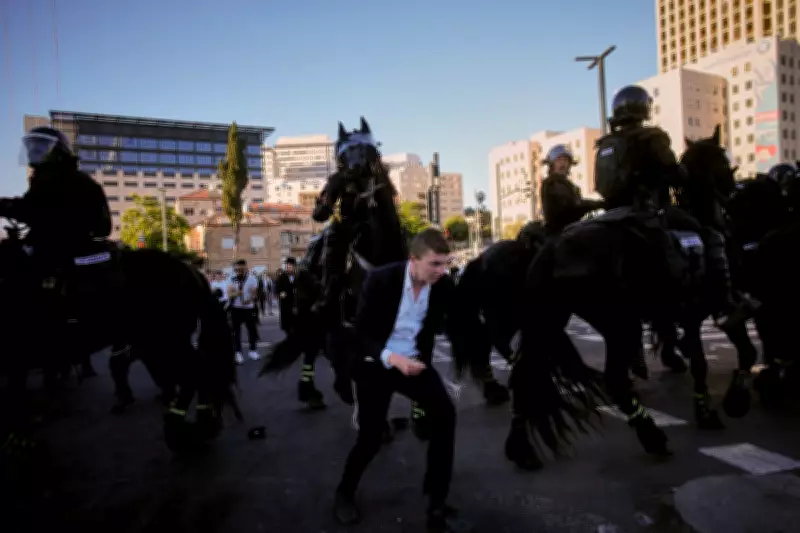
Tens of thousands of ultra-Orthodox Israelis demonstrated across the country on Monday, blocking roads and trains and setting cars on fire to protest mandatory enlistment in Israel's military.
Israel's police said demonstrators blocked major intersections and attacked a soldier who disembarked from a bus near a protest. Police struggled to control the crowds with water cannons and horses. The protest largely crippled the country's center, with highways closed and public transportation halted by the massive crowds in both Jerusalem and the Tel Aviv metro area.
Background of the Dispute
Military service is compulsory for most Jewish men and women in Israel. The politically powerful ultra-Orthodox parties have won exemptions for their followers to forgo military service and instead study in religious seminaries, but those exemptions are under threat.

Many Israelis are tired of the longstanding system that has allowed ultra-Orthodox men to skip military service at a time when the military is stretched to its breaking point and many have served multiple tours of reserve duty. The issue is tearing apart Prime Minister Benjamin Netanyahu's governing coalition, possibly moving elections up by several weeks this fall after the ultra-Orthodox parties withdrew their support for Netanyahu.
Conscription Statistics
Each year, roughly 13,000 ultra-Orthodox men reach the conscription age of 18, but less than 10% enlist, according to a parliamentary committee. Faced with severe shortages of soldiers, the military is looking to extend the period of mandatory service. Most Jewish men are required to serve nearly three years of military service, followed by years of reserve duty. Jewish women serve two mandatory years.
Protesters' Perspectives
“This public is determined, they see this as a war for their lives,” said Israel Tropper, a demonstrator in Jerusalem. “From their perspective, going into the Israeli army means giving up religion ... we don’t want to give up our religion, so from our perspective it’s a war for our lives.” He added that there is no way to force tens of thousands of people vehemently opposed to the idea to serve in the military. Some protesters held signs condemning Israel saying “We would rather die as Jews than live as Zionists” and “We refuse to serve an army for the sake of the Zionist religion.”
Historical Context
The ultra-Orthodox, who make up roughly 13% of Israeli society and are the fastest growing sector, have traditionally received exemptions if they are studying full-time in religious seminaries. The exemptions date back to the birth of the state in 1948, when a small number of students sought to revive the Jewish scholarship system after it was decimated by the Holocaust.
Those exemptions — and the government stipends many seminary students receive up to the age of 26 — have infuriated many Israelis. Israel is currently maintaining a simultaneous military presence in Gaza, Lebanon and Syria, in addition to fighting a war with Iran, which has stretched its robust military to the breaking point.
The Supreme Court said the exemptions were illegal in 2017, but repeated extensions and government delay tactics have left them in place.
Among Israel's Jewish majority, mandatory military service is largely seen as a melting pot and rite of passage. Many in the insular ultra-Orthodox community fear that military service would expose young people to secular influences.