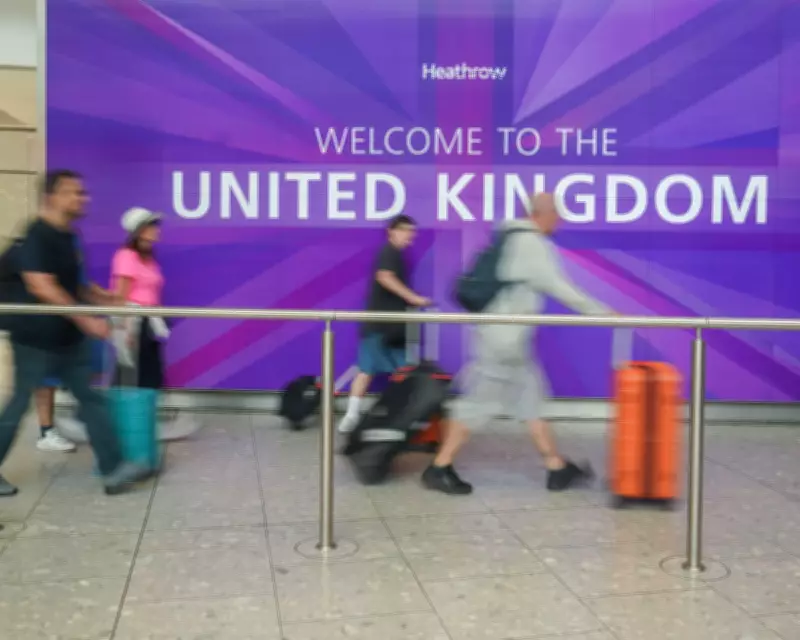
Net migration to the United Kingdom plummeted by nearly half to 171,000 last year, according to official figures released on Thursday, providing a significant boost to Prime Minister Keir Starmer's administration. Data from the Office for National Statistics (ONS) revealed that the difference between arrivals and departures was at its lowest level since 2021.
The figure represented a 48% year-on-year decline from 331,000 in 2024, continuing a sharp downward trajectory from the record peak of 944,000 witnessed in 2023. Separate Home Office statistics indicated that the number of asylum seekers accommodated in so-called asylum hotels also decreased, registering a 35% year-on-year drop to 20,885 by the end of March.
Ministers have pledged to reduce migration numbers and phase out the use of these hotels by the conclusion of the current parliament. Migration has emerged as a pivotal political issue, particularly in the context of the rising influence of Nigel Farage's Reform UK party.

Drivers of the Decline
The primary factor behind the sustained fall in net migration was a 47% reduction in the number of non-EU nationals arriving for work-related purposes in 2025. Over the same period, overall emigration decreased slightly. Additionally, there was an 87% plunge in the number of family members of international students granted permission to enter the UK since 2023. Restrictions on both categories were initially introduced by Rishi Sunak's government and subsequently tightened further by Labour's former and current home secretaries, Yvette Cooper and Shabana Mahmood.
Home Office data showed that asylum applications fell by 12% in the year ending 31 March, totalling 94,000, though this remained elevated compared to historical levels. Grant rates for initial asylum claims continued to decline, dropping from 49% in the year to March 2025 to 39% in the year to March 2026. The number of asylum seekers housed in hotels fell by 9,800 in the first quarter of 2026, primarily due to a reduction in the backlog of initial applications.
Expert Analysis
Ben Brindle, a researcher at the University of Oxford's Migration Observatory, commented: "Migration is down now, but the economic impacts depend more on who is – or is no longer – migrating than how many. Today's data illustrate a challenge the government faces, namely that the categories of migration it would most like to reduce are the ones least amenable to policy. As a result, migration of groups that make positive or broadly neutral economic impacts – such as skilled workers and partners of students – is down, while asylum-related migration remains high."
An estimated 813,000 people immigrated to the UK, while 642,000 emigrated. The ONS noted that the continued decline in net migration was driven by fewer non-EU arrivals for work.
Humanitarian Concerns
Refugee charities have voiced concerns that the number of people permitted to enter the UK via safe and legal routes has halved to 3,600. Jon Featonby, chief policy analyst at the Refugee Council, stated: "The sharp decline in resettlement figures paints a worrying picture. While Channel crossings have fallen for now, families fleeing war and persecution have almost no safe and legal way to reach the UK, increasing the risk that they will be driven towards dangerous journeys out of desperation to find safety and reunite with loved ones."
Research from the thinktank British Future, released ahead of the latest migration figures, revealed a significant gap between public perception and reality. A substantial portion of the public mistakenly believes net migration is rising, despite the figures dropping to their lowest level in years.
Political Reactions
Reacting to the figures, Prime Minister Starmer stated that his government was delivering on its promise to "restore control to our borders." Home Secretary Shabana Mahmood acknowledged that "there is still work to do," adding: "That is why I am introducing a skills-based migration system that rewards contribution and ends Britain's reliance on cheap overseas workers."
Shadow home secretary Chris Philp urged the government to take further action, asserting: "Brits are leaving on a massive scale and non-EU immigration remains far too high."