
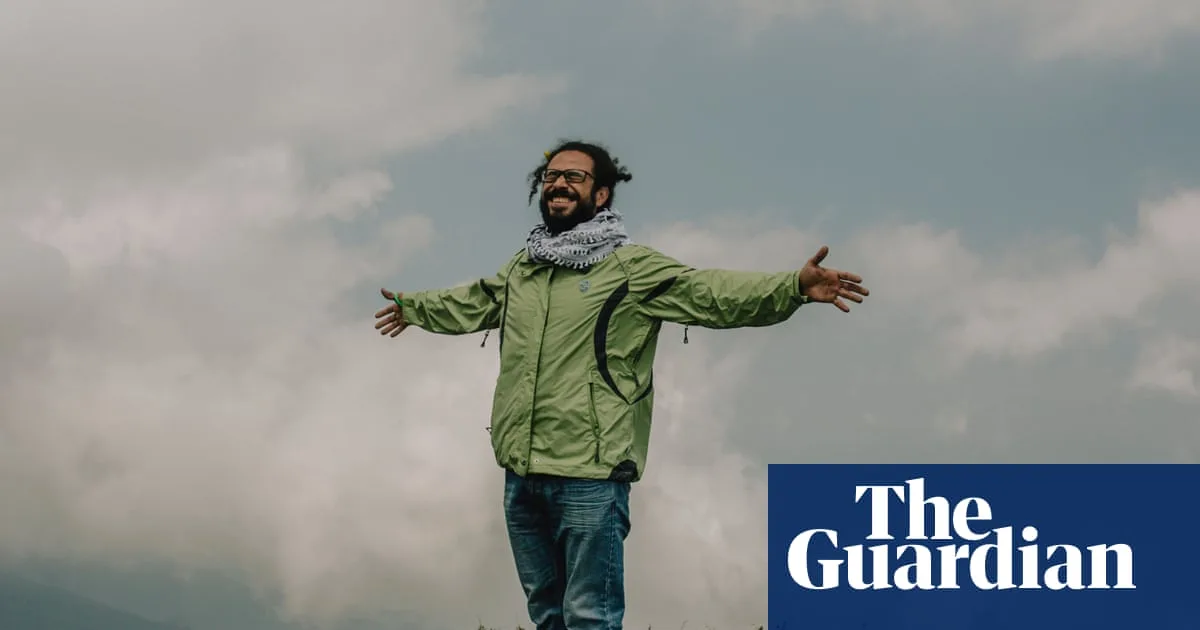
Ten years after Angela Merkel declared ‘We can do this’ at the height of the 2015 migration into Europe, Syrian refugee Somar Kreker looks back at his 44-day odyssey. The trip would be tough, Somar Kreker knew, but he was not overly fearful. It was the summer of 2015, and in a small flat in Amman, Jordan, this young Syrian’s only thought was how to turn a long and arduous journey into something more bearable. The engineering student had fled Syria three and a half years earlier after refusing to enlist in the brutal regime’s army. He was now ready to begin a new chapter of his life, starting with a new task: to reunite with his younger sisters, still trapped in Damascus, and lead them to Germany, where their brother was living.
“I was never worried or stressed about the trip,” says Somar, just 27 years old at the time. “I never had any thought about danger or failure. My only thoughts were how I could make the trip a happy adventure for me and my sisters. For some reason,” he adds, “I was sure that I would arrive safely in Germany.”
In 2015, nearly 1 million asylum seekers attempted to reach Europe – it was a year officials and aid workers would later describe as the peak of the migration crisis, that would put to the test the core values of the EU – itself born from the ashes of a war that displaced millions. At a press conference at a refugee camp in Dresden on 31 August, the then German chancellor Angela Merkel said “Wir schaffen das” (“We can do this”) as the country opened its borders to those in need.
Today, Somar and his sisters’ journey would be immeasurably more difficult. Ten years have passed since then. A decade in which migration has reshaped political landscapes across the continent and paved the way for the rise of far-right parties. The year before, in 2014, Somar’s brother, Mousab, had managed to get from Libya to Sicily with his pregnant wife by boat. But for him, repeating that journey with his sisters was not an option: it was too dangerous. A few months earlier, on 18 April 2015, a fishing boat designed to carry no more than 30 passengers, crammed with more than 1,000 asylum seekers, collided with a Portuguese freighter that had approached to offer help. The vessel sank in the dark waters off the Sicilian coast. Most of the bodies would remain trapped inside the hull, wedged about 400 metres deep on the seabed. More than 800 people would lose their lives in what became the deadliest shipwreck in the history of the European migration crisis.
There was only one alternative. Perhaps less deadly, but longer and more exhausting: the Balkan route, which, after travelling from Turkey to Greece in a rubber dinghy, cuts across at least four countries, through mountains and – in the colder months – snow-covered forests. “The plan was to meet my sisters, Salsabil, 21, and Lubna, 14, in Istanbul. They were arriving on a flight from Damascus. I reached Turkey on a flight from Amman,” says Somar. After a cross-country bus ride, they reached Kaş, a coastal town on Turkey’s Mediterranean shore, where smugglers would ferry them across to the Greek island of Kastellorizo – for about €1,000 each. “We established my sisters would leave before me,” says Somar. “That was the most dramatic moment of my journey. Thinking that they had to cross alone – from Turkey to Greece – on a dinghy, drove me crazy with anxiety.”
A few days before, on 13 September, at least 34 people, including 15 babies and children, drowned when their overcrowded boat capsized in high winds off the Aegean island of Farmakonisi. According to data from the UNHCR, the UN’s refugee agency, and International Organization for Migration (IOM), approximately 731 people died in the Aegean Sea attempting to reach Greece in rubber dinghies in 2015. Fortunately, the sea was calm that day and his sisters arrived safely in Kastellorizo – followed a few days later by Somar. Kastellorizo had experienced an influx of migrants, who now significantly outnumbered the residents. “It was a wonderful island, with crystal‑clear water,” says Alessio Mamo, a Guardian photographer who had met Somar in Turkey and decided to document his journey. “The contrast between the stream of tourists and the thousands of migrants was stark. To shake off the fear after the dinghy crossing, we played football. Syria versus the rest of the world. Instead of shirts, the opposing team wore lifejackets.” The group set off again taking the ferry to Athens. From there, after a c




