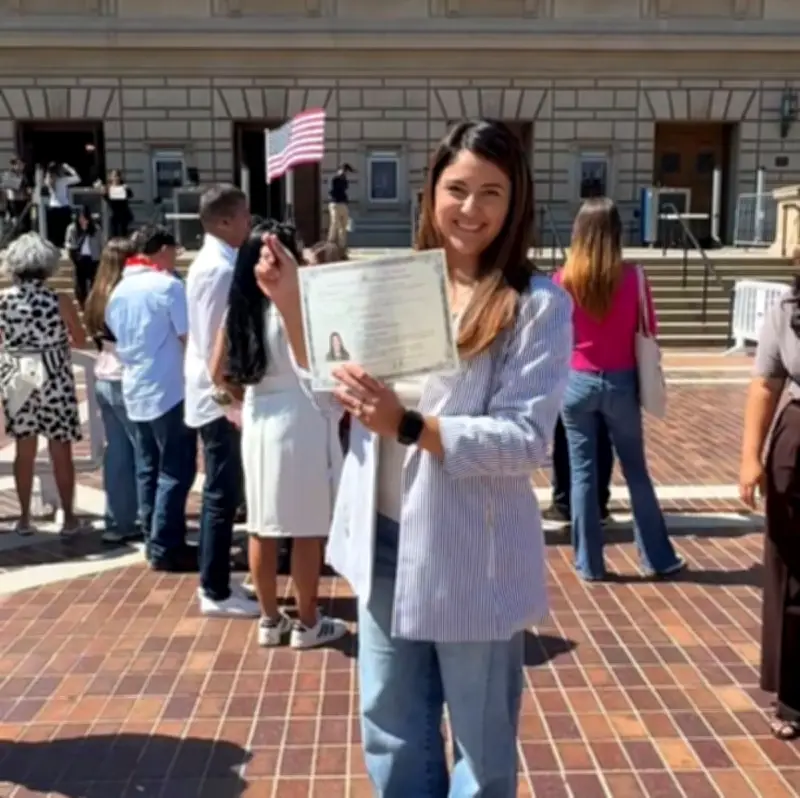
In June, Yesica McKeone officially became a US citizen at a naturalization ceremony in Pasadena, California. Raising her hand to take the oath of allegiance, she joined thousands of others on the verge of the nation's 250th anniversary. Some cried softly.
"I'm finally here," McKeone, 32, recalled thinking. She left Michoacán, Mexico, with her family at age two and settled in California as a permanent resident. Now living in Solvang, the mother of two felt a long chapter of uncertainty close. But pride was tempered by memories of federal immigration arrests in her neighborhood. As a new citizen, she feels more legally protected but conflicted. "You see around you people constantly being pushed out," she said. "It's just weird times."
Naturalization Under Strain
The Trump administration's efforts to limit who can reside in the US have made naturalization more burdensome: longer waits, tougher civics tests, and higher filing fees. The Department of Homeland Security proposed raising the application cost to $1,280 online or $1,330 on paper, ending fee waivers. Community groups report that fear of immigration arrests—even of permanent residents and citizens—is deterring eligible immigrants from applying.
"It's survival," said Dahni Tsuboi, CEO of Asian Americans Advancing Justice Southern California (AJSocal), a nonprofit providing citizenship workshops and legal services. At AJSocal, some clients have chosen not to proceed with naturalization due to fear, cost, and other barriers amid a broader wave of arrests.
Historical Context of Citizenship
The first naturalization law in 1790 limited citizenship to "free white persons." Abraham Lincoln later argued that anyone believing in the Declaration of Independence's equality principle was an American. The 1965 Hart-Celler Act dismantled restrictive quotas, opening the door to diverse immigration. Compared to countries like Qatar and Kuwait, the US has an accessible process, said Irene Bloemraad, a professor at the University of British Columbia. "The United States is remarkable in saying: 'Come here. Spend some time here. Learn a little bit about us, and then you can become one of us,'" she added.
Mixed Feelings at 250
As the US marks its 250th year, it confronts old questions, said Rogers M Smith, emeritus professor at the University of Pennsylvania. The Trump administration has challenged birthright citizenship, restricted legal immigration, and renewed focus on denaturalization. "We are a country that right now is sending signals that Americans are putting America first," Smith said. "And not being as welcoming as in the past."
For Kwan "Dawn" Tang, 32, born in Hong Kong, the friction of permanent residency—extra screenings at airports, no voting rights—pushed him to naturalize. After six months, he became a citizen in June. "At some point, I just wanted to get it over with and leave," he said about the ceremony. Now he plans a Fourth of July party with stars-and-stripes decor and a civics trivia game. McKeone also plans to celebrate. "It's survival," Tsuboi reiterated, reflecting the dual sense of pride and unease among new citizens.