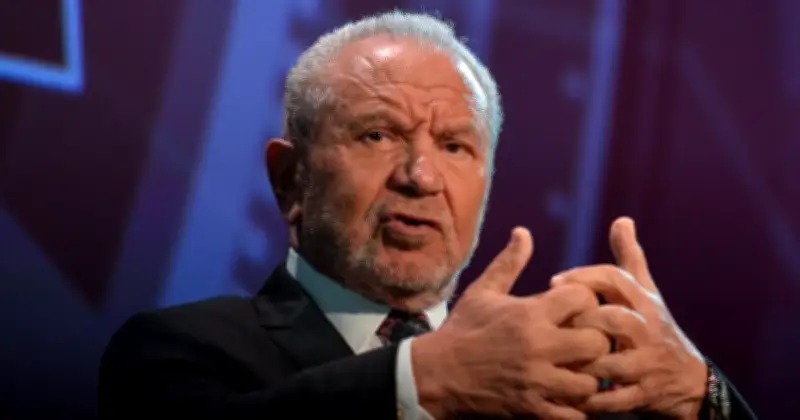
Lord Alan Sugar has said he would ask the Royal Navy to stop asylum seekers arriving on small boats if he were prime minister. The star of the BBC series The Apprentice included the idea in a list of his priorities in response to requests from fans to outline what he would do if he were in charge of the country.
Priorities include new prisons and more officers
Top of his list is building five, large "modern-day" prisons as well as recruiting 10,000 more police and prison officers, paid for by cutting back on military spending.
The crossbench peer detailed his final priority by writing on X: "My understanding of asylum seekers is that if they are trying to leave an oppressed county where they are in danger, they are supposed to go to nearest safe county (sic).
"The people arriving on the shores of the UK have passed through plenty of safe countries. I would ask the Royal Navy to stop them arriving."
Reaction and legal context
Lord Sugar's immigration priority was welcomed by many of his followers, but quite a few disagreed with his military spending proposal. Some cautioned him to be careful in case critics labelled his "far right".
The entrepreneur's understanding of where people should first claim asylum also differs from international law. This does not say refugees have to claim asylum in the first safe country they arrive at. People fleeing persecution can seek asylum in any country which is a signatory to the 1951 United Nations Convention Relating to the Status of Refugees.
Lord Sugar may have been thinking of EU regulations, which state that a country inside the bloc can return an adult asylum seeker to the first European country they reached.
Similarities with Reform UK plan
His support for using the Royal Navy to intercept migrant vessels is similar to Reform UK's "Operation Fortress" proposal, which would involve using navy offshore patrol vessels instead of Border Force to "shadow" dinghies.
Migrants would then be escorted to France or Belgium in what Reform UK leader Nigel Farage has described as the largest military operation in the English Channel since the Second World War.
Under former prime minister Boris Johnson's Government, the UK launched Operation Isotrope, which included plans for "pushbacks". But the plan to force small boats to turn back to France was abandoned amid concerns it would be dangerous and could result in legal action against navy personnel.
A founding principle of maritime law is that mariners must rescue anyone in distress at sea. Mr Farage argues his plan is not "pushback", but involves rescuing and returning Channel migrants.
Reform UK's home affairs spokesman, Zia Yusuf, said if France refused to accept the returns, marines would take them back regardless. Experts have warned that such moves would be illegal and cause a diplomatic row between the UK and France.
A Government minister said such a policy would result in a lot of arguing between London and Paris with nothing much getting done to actually solve the problem. Energy Secretary Miatta Fahnbulleh told the BBC the Government's action against people smuggling gangs was working and the idea was "gimmicky".