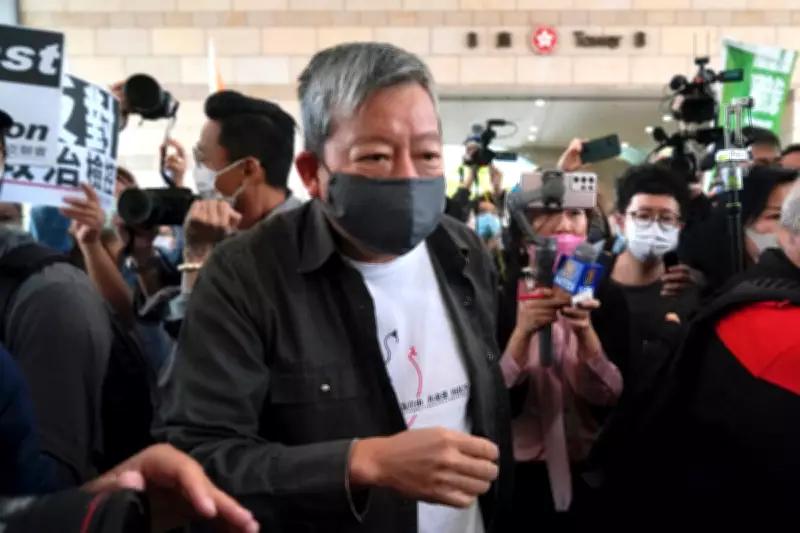
A Hong Kong court was hearing the final arguments on Monday in the national security trial of two former organizers of large vigils commemorating the 1989 Tiananmen Square crackdown. Chow Hang-tung and Lee Cheuk-yan, former leaders of the Hong Kong Alliance in Support of Patriotic Democratic Movements of China, have pleaded not guilty to inciting subversion under a Beijing-imposed national security law. If convicted, they could face up to 10 years in prison.
Background of the Case
For decades, Hong Kong was the only place in China where large-scale public commemorations of the Tiananmen crackdown were held. However, the vigils were banned in 2020, and the two former organizers were charged in 2021. The national security law, enacted by Beijing, has significantly curtailed the city's pro-democracy movement. Observers note that the prosecution reflects Hong Kong's decline in Western-style civil liberties, which Beijing had promised to maintain for 50 years after the handover from British rule in 1997. Both Beijing and Hong Kong governments maintain that the security law is essential for the city's stability.
Key Arguments in Court
During the trial, the prosecution focused on the alliance's core demand of "ending one-party rule," arguing that this advocacy incited others to use unlawful means to overthrow the leadership of China's ruling Communist Party. The prosecution alleged that the defendants were not simply advocating for constitutional amendments. On Monday, prosecutor Ned Lai stated that freedoms of speech, assembly, and association are not absolute rights, accusing Lee and Chow of attempting to blur the focus with human rights arguments. "The freedoms of speech, association and assembly mentioned by D2 and D4 are not ‘trump cards’ that can override the law," Lai said, referring to the defendants by their numbers.

In previous hearings, Lee denied that "ending one-party rule" means ending the Communist Party's leadership. He argued that it actually involves moving toward democracy and letting the people decide who leads them, and that the Communist Party should not enforce a dictatorship. Chow, a barrister who defended herself, argued that her past writings were not about inciting action or hatred but were intended to foster Hong Kongers' understanding of mainland China, where many Chinese also hoped to pursue democracy.
Co-Defendant and Trial Progress
Their co-defendant, Albert Ho, entered a guilty plea when the trial began in January. Pleading guilty typically results in a sentence reduction. The trial, initially scheduled to last 75 days, is expected to conclude earlier. However, the judges have not yet indicated when a verdict will be delivered.
Broader Context
Tens of thousands of people attended Hong Kong's annual Tiananmen vigils until authorities banned them in 2020 due to the COVID-19 pandemic. After pandemic restrictions were lifted, the former vigil site was occupied by a carnival organized by pro-Beijing groups. Some individuals who attempted to commemorate the event near the site on June 4, the anniversary of the crackdown, were detained.