
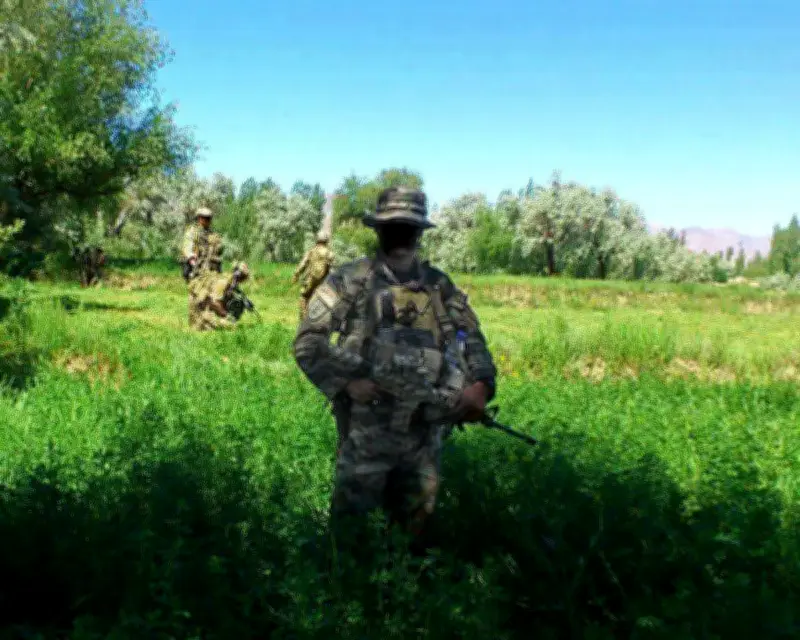
Abbas, a former Afghan national army commando who fought alongside US and Australian troops, now lives in exile in Iran, feeling abandoned by the foreign forces he once served with. Five years after the fall of Kabul, he remains trapped in the middle of a new American war, facing threats from the Taliban and an uncertain future.
War from childhood
War is Abbas's earliest memory. As a child, the first iteration of Taliban rule forced his family to flee with nothing but the clothes on their backs and what food they could carry, seeking relative safety in far-distant hills.
War became his profession. Joining republican Afghanistan's fledgling army, Abbas fought alongside American, Australian and British troops, believing in the foreigners' ultimately false promise that they could bring peace and prosperity to his homeland.
Conflict is his constant attendant now, over Afghanistan's border in neighbouring Iran, as the US, the country he fought with, rains bombs on the land of his exile. Back home, the resurgent Taliban – unreformed, unrepentant and firmly in charge – seek him still.
Fighting with foreign forces
Abbas joined the military initially for the money. For a poor boy from the provinces, the army represented a regular income and a full belly, a reliable way to support his family. After basic training, he passed a selection course to serve in the special forces.
“At first I joined for money but when I entered the commandos everything changed,” Abbas tells the Guardian. “There were foreign forces teaching us … they gave speeches about global terrorism. It was not about money any more. I became very committed, I just wanted to serve my country and fight Taliban and destroy the terrorist groups.”
He spent 12 years in the Afghan national army, most of those wearing the distinctive red badge of the special forces, and fought many hard battles. Abbas served alongside Australian troops in southern Afghanistan, on night-time missions by helicopter in late 2011, in the restive and mountainous Khas Uruzgan district.
“There were many forces we served with: Germans in Kunduz, French in Kapisa, and especially we were with Americans. The Australian forces were in Uruzgan, and we went there. We took part in combat alongside them, especially in Khas Uruzgan, we … executed two missions with them by air.”
Abbas said he and his comrades “were always on the frontline”. “We spent many days and nights with foreign forces. I performed combat duties in [approximately] 20 provinces of Afghanistan.”
Wounds and broken promises
He was wounded in a firefight in Laghman district, shot twice at close range. His bulletproof vest deflected the bullet that struck the left side of his chest, “but another hit my left arm, breaking the bone”. He was taken by US helicopter to Bagram hospital: “I still have a metal plate in my left arm.”
Abbas remembers the camaraderie of his days serving alongside western troops with fondness: “We risked our lives to help each other on and off the battlefield and to rescue one another. They always called us brothers.”
But he remembers too the commitments that were made to him. “They promised they wouldn't abandon us. But in the end, when they withdrew, they simply left us. And they did it in such a way that we were left with our hands tied, the entire army was disarmed. Those who were high-ranking officials left, while the rest of us, sergeants like me, were left behind. No one even asked about us.”
When Kabul fell, Abbas was forced to burn most of his documents and destroy photographs: incriminating evidence in the eyes of the Taliban. A bare handful remain secretly in his possession: pictures on patrol with western forces, certificates of appreciation from foreign militaries commending his “outstanding commitment, dedication and support” to their operations.
Life in exile
Life since the fall, with a wife and young son, has been precarious, often dangerous. As the Taliban swept northwards across Afghanistan, expanding and consolidating its control, there were fewer and fewer places to hide. With his family, Abbas fled over Afghanistan's arid, inhospitable border into Iran.
There, with no legal rights, he is vulnerable to exploitation and extortion: landlords demand thousands of dollars for tiny apartments that have been condemned as unfit for habitation; he has been forced to take dangerous, illegal work for far less than a living wage. When US bombs started raining down on Tehran, Abbas and his family fled once again for the mountainous countryside.
“Our life in Iran is very difficult, refugees face a lot of problems. Especially for us former military personnel … we are still being threatened by Taliban groups even here. We also fear that we might be deported to Afghanistan.”
Abbas said his family's future depends on being able to find a safe country, far from the reach of the Taliban, and the American war which has blighted his Iranian exile. “I am waiting to see what will happen, but I am hopeful … I will build a better life for my family, a better future for my son.”
Broader abandonment
Many in Afghanistan feel as Abbas does – betrayed by the foreign forces in whom they placed their trust. On the day of his second inauguration as US president, Donald Trump halted all Afghan refugee resettlement by executive order. The shutdown left more than 1,000 Afghan former interpreters and soldiers stranded in a US-run camp in Qatar, and hundreds of thousands more vetted applicants stuck in neighbouring countries like Pakistan.
In Germany, a new government sought to renege on a commitment to resettling hundreds of Afghan refugees it had identified as being at risk. The country's highest court ruled it could not arbitrarily cancel hundreds of resettlement places it had already promised.
And in Britain, a House of Commons committee report this month reported that a massive data breach from within the UK government's Afghan relocations and assistance policy exposed thousands of Afghans to potentially life-threatening danger. Afghans still trapped inside the country are being told by the UK government to “self-move” to safe third countries, a policy that “risks excluding people the UK has promised to help,” the committee chair, Tan Dhesi, said.
A spokesperson for Australia's foreign affairs minister, Penny Wong, said five years on from the fall of Kabul: “We stand firm in our pursuit to do all we can to protect the people of Afghanistan from the oppressive acts of the Taliban, particularly women and girls. We also remain committed to assisting those who helped Australia's mission in Afghanistan.”
Until 2023 the Australian government ran a dedicated “locally engaged employee” (LEE) program for Afghans who worked for and with Australia “and are at risk of harm as a result of their work”. The program certified 2,059 Afghans – but only 1,208 of those have reached Australia, according to the latest government figures (along with 4,493 immediate family members).
But hundreds of Afghans still living in hiding inside the country, or stranded in perilous situations elsewhere, say they were unable to apply before the LEE program closed, or had their applications rejected despite providing evidence of support for Australia, including fighting alongside Australian troops. A government review of the program found it was riven by “delays, double handling and confusion”, and it imposed an unreasonable administrative burden on those fleeing the Taliban seeking safety.
Abbas has family in Australia, and, having fought alongside Australian troops on their missions in Afghanistan, he applied for LEE protection from Australia. He was rejected, the government ruling he had not been “in a direct employment relationship with defence”. “While the applicant might have worked alongside the coalition forces, including members of the Australian Defence Force in partnership on operations in Afghanistan, it does not appear that the applicant was 'employed with' the ADF,” the government decision states.
Wong's spokesperson said the current government had approved more LEE applications than any before it. “Since the Albanese government took office, Dfat has certified close to 650 applications from Afghan Locally Engaged Employees, more than the total approved under all previous foreign ministers combined since the program began in 2013.” Australia, too, has provided broader support – more than $310m in humanitarian assistance, through established partners and UN agencies – “to ensure our aid supports those most in need – not the Taliban”.
Zaki Haidari, a former Afghan refugee who is now an Australian citizen, remains in close contact with dozens of former soldiers, interpreters and others who supported western nations in their failed two-decade mission in Afghanistan. “Almost every conversation I have with people inside Afghanistan is filled with fear, uncertainty and hopelessness. Families tell me they struggle to afford food, many have lost their livelihoods, and parents worry constantly about the future of their children,” Haidari, Amnesty International's Australian refugee rights advocate, says.
Haidari said women live under constant surveillance, fearing arrest for speaking out or failing to comply with the Taliban's ever-tightening restrictions. Members of the Hazara ethnic and religious minority – for decades Taliban targets – are forcibly evicted from homes, and face discrimination and violence. Haidari said Australia's LEE program “undoubtedly saved lives”, but there were still thousands endangered by their support and assistance for Australia.
Hopes that a Taliban desperate for international legitimacy would temper their more repressive instincts have proven illusory: with global attention shifted to other conflicts, the Taliban has further entrenched their brutality across Afghanistan. Australia's obligation to the people of Afghanistan “did not end with the military withdrawal”, Haidari says. “Many people who supported Australia's mission remain at risk and continue to wait for protection. Many fear for their lives every day.”




