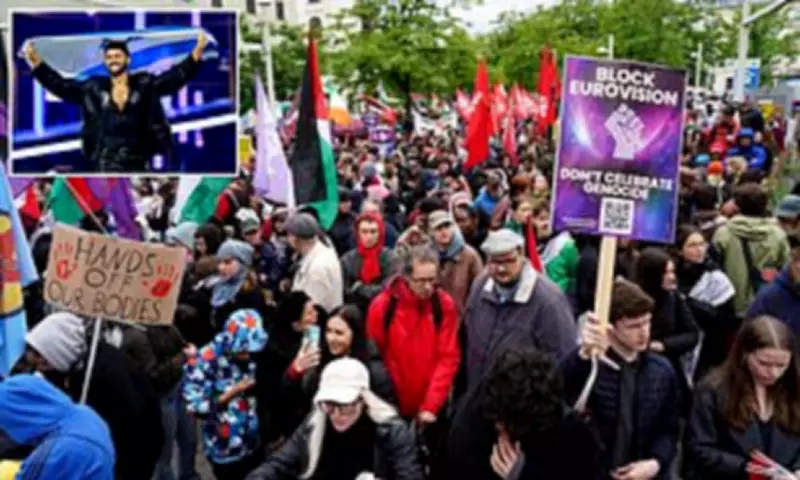
Eurovision fans gathered in Vienna to protest Israel's participation ahead of the singing contest's final tonight. Divisions over Israel's involvement are casting a shadow over the event's 70th anniversary.
Protests and Boycotts
Host city Vienna has been adorned with hearts and the contest's 'United by Music' motto this week, as singers and bands from 35 countries compete for Europe's musical crown. However, Spain, Ireland, the Netherlands, Slovenia, and Iceland have decided to boycott the competition over Israel's inclusion.
Pro-Palestine groups staged an outdoor concert on Friday under the banner 'no stage for genocide,' and a demonstration against Israel's participation is planned ahead of tonight's show.

'Inviting Israel on such a beautiful stage as the Eurovision Song Contest stage is an affront to all the people who believe in humanity, who believe in love and togetherness,' said Congolese-Austrian artist Patrick Bongola, one of the organisers.
Jamil Sawalmeh, the Country Director for ActionAid Palestine, stated: 'Justice cannot be a song Europe sings for some and silences for others. As Eurovision takes centre stage across Europe today, the humanitarian crisis in Gaza continues, with Palestinians facing bombardment, forced displacement and deepening suffering, while the Israeli Government steps up its assault on Palestinian life and rights in the West Bank.'
'As Eurovision places Europe's values on display, governments must show that principles like humanity, dignity and solidarity are more than rhetoric when it comes to Palestinians,' she added.
Street protests opposing Israel's inclusion over its war against Hamas in Gaza have been smaller in Vienna than at the 2024 contest in Malmo, Sweden, and last year's event in Basel, Switzerland. However, four protesters were ejected after trying to interrupt Israeli competitor Noam Bettan's performance during Tuesday's semifinal. He will perform the ballad 'Michelle' in tonight's final. Like last year's Israeli competitor, Yuval Raphael, he has had to practice singing while being booed.
Third Year of Controversy
The competition has been clouded for a third year by calls for Israel to be excluded over its conflicts in Gaza and elsewhere. Spain announced its boycott in December after the European Broadcasting Union said Israel would be allowed to compete, and has been joined by Ireland, Slovenia, the Netherlands, and Iceland. Some Spanish fans respect the choice to take a stand, even if it's bittersweet. Spain's broadcaster has repeatedly expressed disapproval over Israel's participation.
In last year's semifinals, RTVE's commentators introduced Israel's singer in the same breath as they mentioned Palestinians killed in the war. Before airing the final, the network transmitted the message 'Peace and justice for Palestine' on a black background to hundreds of thousands of Spanish televisions.
As Eurovision finals take place in Vienna, RTVE will air a tribute to the network's musical history, featuring a performance by Tony Grox and Lucycalys, the musicians who RTVE would have dispatched to represent Spain. Ireland's national broadcaster will play a Eurovision-themed episode of sitcom Father Ted instead. Slovenians will be shown an episode of a 10-part program about Palestinians.
People can still watch Eurovision on the European Broadcasting Union's YouTube channel, but the lack of a performer or commentator from their own country renders the vibe decidedly less passionate. The boycotts are a financial blow to Eurovision, which is funded largely by participating broadcasters, and to public broadcasters at a time when many are under financial pressure from government funding cuts and competition from social media.
Politics and Pop
Long a forum for good-natured and sometimes more pointed national rivalries, Eurovision has found it hard to separate pop and politics in recent years. Russia was expelled in 2022 after its full-scale invasion of Ukraine. Tensions rose again after Hamas' October 7, 2023, attack on Israel, which killed some 1,200 people, and Israel's subsequent campaign in Gaza that has left more than 70,000 people dead.

The last two Eurovision contests have seen pro-Palestinian protests both outside and inside the venues, forcing organisers to clamp down on political flag-waving. Several performers and countries have called for the exclusion of Israel, which has competed since 1973, one of a few non-European countries to do so.
The 2024 contest in Malmo, Sweden, and last year's event in Basel, Switzerland, saw pro-Palestinian protests that called for Israel to be expelled over the conduct of its war against Hamas in Gaza and allegations it ran a rule-breaking marketing campaign to get votes for its contestant after Israel finished second last year.
When organisers declined to kick Israel out, five countries announced in December that they would not participate this year. The European Broadcasting Union, which runs Eurovision, has toughened voting rules in response to the vote-rigging allegations, halving the number of votes per person to 10 and tightening safeguards against 'suspicious or coordinated voting activity'.
Israel last year got 83 per cent of its points from the public for its song 'New Day Will Rise' and came second overall. The winner, Austria's 'Wasted Love', got just 41 per cent of its votes from the public, relying on national juries to power its way to the top.
Posts and photos from the Israel X account run by Israel's foreign ministry, dated on the day Israel competed in last year's semi-final, had encouraged people to vote for its singer Yuval Raphael, adding that 'you can vote up to 20 times'. 'We saw some activity last year which we could describe as disproportionate marketing and promotional activity that we felt was out of sync with the nature of the show, so we put some rules in about that,' Eurovision Song Contest Director Martin Green told Reuters, without referring directly to the posts.
Tonight's Final
Despite this year's protesters, contestants from 25 countries are gearing up to take to the stage tonight at the Wiener Stadthalle arena in the Austrian capital to battle for Europe's pop crown. Winners are chosen by a mix of votes from the two, translated into points by a system confusing even to Eurovision fans. The act with the most points wins, and its country gets to host the competition next year.
Finland is the favourite in betting odds with 'Liekinheitin,' or 'Flamethrower,' a fiery duet between pop star Pete Parkkonen and classical violinist Linda Lampenius. A wild card would be a win by Australia, a Eurovision participant since 2015, which has sent established star Delta Goodrem. Her slick midtempo ballad 'Eclipse' - and a bravura performance that sees her raised into the air above a glittery piano - has been rising up the betting odds.