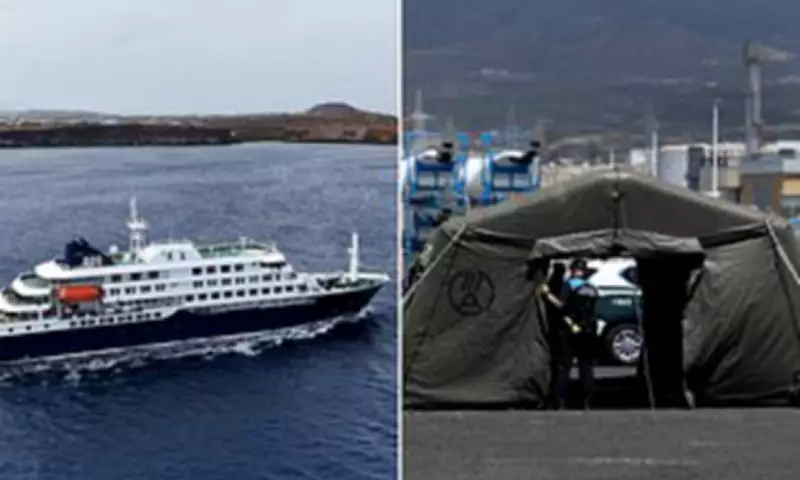
More than 20 British passengers and crew aboard a cruise ship affected by hantavirus could fly back to the UK this weekend after plans were made to dock the vessel in Tenerife. Officials from the UK Health Security Agency (UKHSA) and the Foreign Office will greet the MV Hondius when it arrives in the Canary Islands on Sunday. The Britons on board will be tested for hantavirus.
If those tested are negative and show no symptoms, they will be escorted to a dedicated repatriation flight, with hopes they will be flown back to Britain later that day. Spain says officials are in advanced talks with the British government to arrange the flight, which will have medical professionals on board along with medications and equipment in case anyone falls ill.
Depending on weather conditions, the ship is on course to dock in Tenerife as it sails from the coast off Cape Verde. The majority of Britons aboard are expected to self-isolate at home, but the UKHSA will make arrangements for those who cannot, providing alternative facilities. Details of this will be released later.

According to the Foreign Office, a total of 30 passengers and crew from the MV Hondius are British, with 22 still on the ship. Seven Britons disembarked in St Helena on April 23, and a British man with suspected hantavirus left the ship on the remote South Atlantic island of Tristan da Cunha. The two Britons who left at St Helena flew back to the UK and are self-isolating, but they do not have symptoms. Currently, four Britons remain in St Helena, while others have been tracked in an undisclosed country outside the UK.
Two British men are being treated for hantavirus in the Netherlands and Johannesburg, South Africa. Martin Anstee, a 56-year-old retired police officer and expedition guide on the MV Hondius, has been confirmed as one of the cases in the Netherlands. He was evacuated from the ship on Wednesday and remains in stable condition.
The UKHSA is tracing and contacting all those who previously left the ship but had contact with British nationals, though the exact number is unknown. The Foreign Office is in daily contact with the 22 British passengers and crew still aboard. At present, they show no symptoms, but anyone developing symptoms before disembarking will be treated in the Canary Islands.
Those returning to the UK will not be allowed to use public transport to reach their homes for self-isolation. They must remain in isolation for 45 days and will self-test. Further testing will occur after the isolation period ends.
Countries worldwide are scrambling to trace the 29 passengers of 12 nationalities who disembarked at St Helena after the first leg on April 24, as they may have unwittingly spread the virus. A total of nine confirmed hantavirus cases have been linked to the cruise ship, including the two British men, with one additional suspected case. Five of the nine are confirmed, while four remain suspected.
Around 30 people left the ship when it docked in St Helena in late April, including a Dutch woman who became unwell during onward travel and died. The outbreak is believed to have originated at a seagull-plagued rubbish tip in an Argentine town known as 'the end of the world'. The Argentine government's leading hypothesis is that a Dutch couple contracted the virus in Ushuaia during a bird-watching outing at a garbage dump before boarding.
WHO Director General Tedros Ghebreyesus said the first two cases 'travelled through Argentina, Chile and Uruguay on a birdwatching trip which included visits to sites where the species of rat known to carry the virus was present.' Three people have died in connection with the outbreak: a 69-year-old Dutch woman, her husband, and a German woman. Their cases are under investigation.
In a statement on Friday, the UKHSA said: 'UK Government staff will be on the ground ready to support the British nationals disembarking. British passengers and ship crew not displaying any symptoms of hantavirus will be escorted by UK Government staff to an airport and given free passage back to the UK.' The Foreign Office and UKHSA teams will continue to support all passengers. The UKHSA added: 'We are working with partners to ensure the flight operates under strict infection control measures. Public health and infectious disease specialists will be on board to monitor British nationals and provide care if needed.'

The World Health Organisation (WHO) said Thursday that morale has improved on the ship since it began its journey to Tenerife. Two doctors are on board, along with infectious disease experts from the WHO and the European Centre for Disease Prevention and Control (ECDC), conducting medical assessments. While the risk to the public is low, Dr. Ghebreyesus noted that more cases could emerge due to the incubation period of the Andes virus, a variant of hantavirus, which can extend to six weeks.
Hantavirus is a rare respiratory disease usually transmitted by infected rodents, causing respiratory and cardiac distress as well as hemorrhagic fevers. There are no vaccines or known cures. Professor Sir Peter Horby, director of the pandemic sciences institute at the University of Oxford, said: 'I believe the UKHSA, Foreign Office and NHS are taking all the right and necessary measures to protect the UK citizens involved in this challenging incident and to protect the broader UK population. Repatriation and isolation is the right thing to do, morally and scientifically.'