

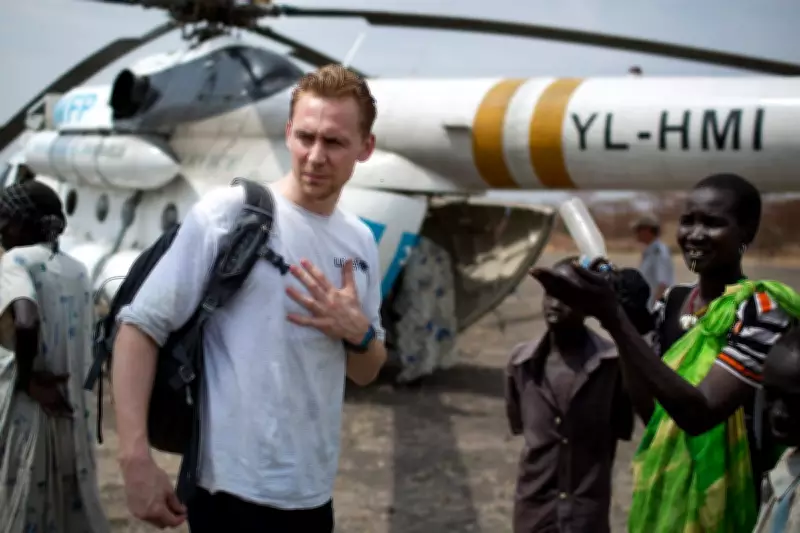
Tom Hiddleston, reflecting on a decade-long involvement with Unicef, has issued a stark warning about the consequences of international aid cuts. The actor, who will participate in Soccer Aid for Unicef on 31 May, describes how reduced funding from the UK and US is endangering children in conflict zones like South Sudan.
A Decade of Change
Ten years ago, Hiddleston witnessed a family reunite after years of separation due to war. Now, he questions whether such a reunion would be possible in 2026. During his second trip to South Sudan in November 2016, he met Nyalim, a twelve-year-old girl separated from her mother and aunt during a gunfight. After three years, Unicef's tracing programme reunited her with her parents—a moment Hiddleston describes as unforgettable.
On the same visit, he encountered Regina at an emergency feeding centre. She had fled fighting with her severely malnourished fifteen-month-old daughter, Emmanuela. Thanks to treatment, Emmanuela's survival became likely. Hiddleston emphasises that international aid cannot claim credit for the courage of families but ensures that when people arrive at feeding centres or health facilities, there is someone to meet them—the result of years of investment in nutrition, health systems, and childhood infrastructure.

Compounding Crises
South Sudan now faces multiple crises. Since early 2026, renewed fighting has displaced 330,000 people, and the country is experiencing its largest cholera outbreak on record, with nearly 100,000 cases hitting children hardest. Over two million children under five suffer acute malnutrition. The withdrawal of USAID has closed 186 nutrition sites, worsening an already desperate situation. Unicef's Country Representative Noala Skinner warned that a malnourished child without treatment is twelve times more likely to die. For the first time this century, deaths among children under five are expected to rise in 2025 due to global political decisions.
Aid budgets are being cut precisely when conflicts, climate disasters, and disease outbreaks accelerate. The UK's bilateral aid to African countries—where most child deaths occur—has collapsed by 56 per cent. With the overall aid budget set to fall to 0.3 per cent of Gross National Income by 2027, the human cost is visible. In 2016, the UK allocated 0.7 per cent of GNI to aid, more than double the current level.
Consequences for Vulnerable Nations
Countries like Malawi, where over 57,000 children live with HIV, and Sierra Leone, with one of the highest maternal and neonatal mortality rates, are losing support entirely. The UK government claims to prioritise conflict-affected states like South Sudan, but this comes at a cost to children elsewhere. Funding cuts force impossible choices about which children deserve life-saving treatment, pitting vulnerable children against each other in a calculus no government should make.
Soccer Aid and Public Generosity
Hiddleston will play in Soccer Aid for Unicef on 31 May, marking the twentieth anniversary of a match that has raised £121 million for children since 2006. He notes that while governments step back from commitments, the British public has consistently chosen to invest in children's futures. However, public generosity cannot replace political will. No child chooses where they are born, and the lottery of birth should not determine survival, literacy, or a chance at a happy childhood.
Unicef UK is urging the UK government to spend at least a quarter of its aid budget on child-focused healthcare, nutrition, and education programmes. Hiddleston recalls that when he met Nyalim, she was about to see her parents again, and Emmanuela's life-saving treatment was working. Those outcomes were not inevitable—they happened because the international community decided those children were worth investing in. That commitment is now faltering, and children will pay the highest price.
The UK government can choose to build on the success of its aid legacy or decide that the world's most vulnerable children are no longer worth helping. *Names changed to protect identities. Tom Hiddleston is an ambassador for Unicef UK and will play for England in Soccer Aid for Unicef on 31 May. This article is part of The Independent's Rethinking Global Aid project.






