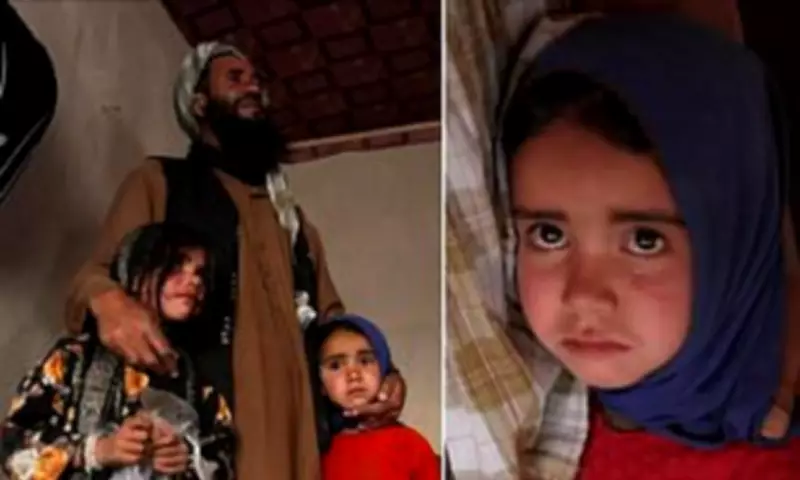
A desperate Afghan father has admitted he is planning to sell his seven-year-old daughter into marriage, a decision that will feed his family for four years. Abdul Rashid Azimi, from the Ghor province of Afghanistan, told the BBC that the economic situation in his home country, now governed by the Taliban, has become so dire that he has been forced to make this heartbreaking choice.
A Father's Anguish
Azimi described his daily struggle: 'I come home from work with parched lips, hungry, thirsty, distressed and confused. My children come to me saying "Baba, give us some bread". But what can I give? Where is the work?' He explained that he is so desperate for money that he must sell one of his two seven-year-old twin daughters, Roqia or Rohila. 'If I sell one daughter, I could feed the rest of my children for at least four years. It breaks my heart, but it's the only way.'
Widespread Desperation
Azimi is not alone in taking such drastic measures. Saeed Ahmad said he had already sold his five-year-old daughter, Shaiqua, after she developed appendicitis and a cyst on her liver. 'I had no money to pay the medical expenses. So I sold my daughter to a relative.' He arranged a deal: 'If I had taken the whole sum at that time, he would have taken her away. So I told him just give me enough for her treatment now, and in the next five years you can give me the rest after which you can take her. She will become his daughter-in-law.'

Ahmad added: 'Giving away your child at such a young age carries a lot of anxiety. Underage marriages have their problems; however, because I couldn't pay for her treatment, I was thinking, at least she will be alive.'
Afghanistan's Worsening Crisis
Since the Taliban seized power in 2021, Afghanistan has become increasingly hostile to women and girls. The regime has imposed severe restrictions on women's education and employment, compounding existing cultural norms that prioritize boys as breadwinners. Underage marriage remains widespread, and the economic collapse has made it even harder for families to stay together. A staggering three out of four Afghans cannot meet their basic daily needs. Unemployment is rampant, healthcare systems are struggling, and international aid has dwindled.
The United States, once the largest donor to Afghanistan, has slashed nearly all aid. Other nations, such as the United Kingdom, have followed suit. According to the UN, Afghanistan now receives less than 70% of the aid it did last year. The Taliban, however, blames the previous administration. Hamdullah Fitrat, deputy spokesman for the Taliban government, told the BBC: 'During the 20 years of invasion, an artificial economy was created due to the influx of US dollars. After the end of the invasion, we inherited poverty, hardship, unemployment and other problems.'
Return of Refugees
Despite the dire conditions, the UN reported on Tuesday that nearly three million Afghans are expected to return to the country by the end of the year, more than half of whom will be women and children. Since September 2023, 5.9 million Afghans have returned, mainly from Iran and Pakistan, accounting for about 10 to 12 percent of the population. In the first four months of 2026, approximately 600,000 Afghans returned from Iran and Pakistan, the UN report said, with an estimated 1.7 million more from Iran and 1.1 million from Pakistan expected in the coming eight months.
Most returnees are skilled labourers who were born and raised abroad or have been away from their communities for years. 'They either have weak or no ties to their communities of origin,' said Tajudeen Oyewale, UN Humanitarian Coordinator for Afghanistan. He added that 'over half of those returning are women and children' who are the most vulnerable in the country.

The UN and NGOs are calling for over $100 million (£75 million) for immediate border response to provide lifesaving assistance at key official crossing points with Iran and Pakistan. 'This figure only covers 40 per cent of the most vulnerable returnees, even though 70 per cent meet our vulnerability criteria,' said Thamindri De Silva, Country Director of World Vision International. However, the reintegration response for returnees requires $428.5 million. Another report this week warned that humanitarian assistance had declined from $1.62 billion in 2024 to $0.91 billion in 2025, a 43.82 percent reduction.