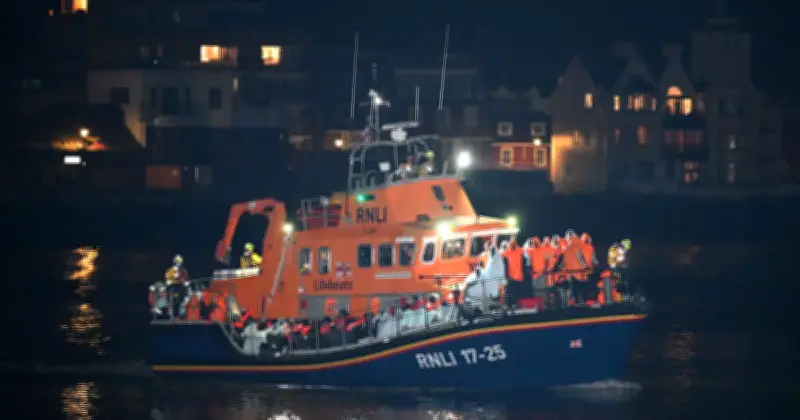
Nearly 4,000 migrants are waiting in camps in northern France to cross the Channel, according to border security commander Duncan Capps. The number of asylum seekers in the Dunkirk-Calais area is roughly double the typical size of the cohorts in two tent cities.
Speaking about the situation, Mr Capps said: "I think the French estimate at the moment is that there are almost 3,800 people between those two camps. Previously it was broadly about 2,000 between them. So, our understanding now from our French partners we work with closely is almost double what we would normally expect."
Prices for Crossings Fall to Record Low
Despite the higher numbers, the cost for those hoping to reach Britain has fallen to as low as £840, believed to be one of the lowest prices on record. Mr Capps noted that the large camp populations indicate the French are making it very difficult to cross, particularly in the Dunkirk-Calais area.
He added: "There is a moment with this from a criminal perspective where it stops being particularly viable. And part of our strategy is to drive it to a point where it is not worth them doing this because the cost of getting the boat, the engine, the risk of them being interdicted and jailed, is so much that actually they stop being in this business."
Smugglers' Business Model Under Pressure
Rob Jones, director-general of operations at the National Crime Agency, told the Home Affairs Select Committee: "The fact that there are more migrants in northern France is not a good thing – it shows the intent is high but it shows they are struggling to make the crossing."
Mr Jones stressed that the people smugglers' "business model is starting to shake", saying: "It's more likely than ever that you're going to get arrested. It's more likely than ever that your equipment is going to be seized," adding that trying to cross the Channel was getting "riskier and riskier for everybody that's involved".
The NCA chief said the unsafe dinghies used by traffickers typically cost them about £14,000. He also said ministers ramping up removals would help them defeat people smugglers, noting that the vast majority of removals had stuck despite attempts by organised crime to traverse the Channel.
Concerns Over Mass Casualty Event
Mr Capps admitted he had doubts about the one-in, one-out deal with France being a deterrent, but said: "I wasn't convinced it would be. But I think it has been. I would say it has been a success. We managed to return 1,631 illegal entrants, all of which were from countries we would have had difficulties returning otherwise. Did it scale to the level I would have liked it to? No, it didn't."
Asked about the biggest challenge he was facing, the interim head of the Home Office unit said: "I think the things that worry me most this year have been the increasing size of the boat and the increasing occupancy. You'll have seen this year we had a boat with 230 people in it. Extraordinary. And it ought to be put on record that it is only a matter of time until we have a mass casualty event in the Channel. It is extraordinary that has not happened so far."
He also mentioned a rescue operation where his officers were involved with the French in French waters, rescuing 168 people, none of whom drowned.
Many people fear smugglers' attempts to launch dinghies from Normandy could lead to an "invasion" of other coastal towns, such as Brighton, Southampton or Weymouth, as criminal gangs change their tactics to exploit weak points in the border.
Prime Minister Andy Burnham vowed to change tactics to tackle gangs bringing migrants across the Channel after a record 230 people made the journey in a single boat in August. At the time, French authorities warned the dinghy was "buckling" in the water and could have led to tragedy. Labour's one-in, one-out migrant deal with France collapsed after talks between London and Paris broke down, with officials admitting that too few people were removed under the scheme.
The Home Secretary insisted Labour, alongside other EU nations, wants to set up "return hubs" for failed asylum seekers, where European nations would deport migrants to a third country to be held until they can be returned to their home nations.