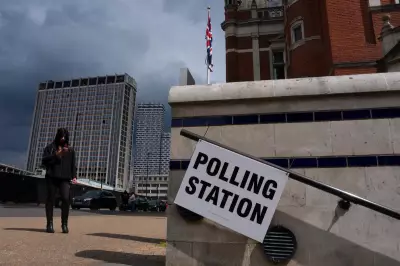
By any standard, Reform UK has done well in this set of elections. It has won about a third of the seats that were up for grabs in English councils, and has performed especially well in Wales. Reform UK polls higher than any other party, in a range of about 25 to 30 per cent. So the question is, will Reform be Britain's next government?
Are local elections an accurate predictor of general elections?
The short answer is "no" – at least, not this far out. Unless something cataclysmic happens, or the prime minister chooses, the next election probably won't be until 2029 – largely because Labour would lose an election held any sooner and its landslide working majority, currently 165, makes it immune from the usual by-election losses, defections or Commons rebellions that have brought down other governments.
Some governments have staged remarkable comebacks in less time, even if they didn't go on to win. The mountain might be higher this time, but voters are also more volatile. It's also important to bear in mind that some parties, traditionally the Liberal Democrats, do better when standing for town halls than at Westminster, and the two old parties do worse. Like by-elections, local elections tend to be used to register a protest – a phenomenon that tends to subside by the general election.

Would Reform UK win if there was a general election now?
The most sophisticated polling, which focuses on specific conditions across all British constituencies, suggests Reform would be the largest single party in the Commons but fall a long way short of the overall majority required to easily form a one-party administration. The latest such poll published by Electoral Calculus suggests that if a general election were held now, Reform would win 188 seats – a stunning result, but probably not enough even to form a short-lived minority administration. The Conservatives, for all their troubles, would secure 159 seats and thus the arithmetic would point to some kind of Reform-Conservative arrangement (though the 347 seats they'd jointly command, even adding a few more from the DUP), would yield only a slim majority. In any outcome, Farage and his colleagues would be pinned back and unable to implement all of his agenda, even if he had a claim to the premiership itself – something the Conservatives would be mad to concede, even if it provoked a constitutional crisis. (For the record, the Electoral Calculus study puts Labour on 86, Greens at 71, Lib Dems on 61 and the SNP and Plaid Cymru on a combined 61).
Is there a ceiling to Reform support?
Farage would say the sky's the limit, but Reform does seem to find it quite hard to break through the 30 per cent support reflected in opinion polls. In the 2025 local elections it achieved about a 30 per cent equivalent national vote share and the question is whether this represents the maximum extent of their backing. If Reform managed to hit say 35 per cent or 40 per cent, they'd be in for more of a landslide result, with only the Liberal Democrat seats holding out with much success.
What does history tell us?
That support for Farage's various political vehicles can spook the other parties, but hasn't so far yielded that mould-breaking achievement in the House of Commons. At the 2014 European elections, Farage's UKIP won with 26.6 per cent of the vote, and had a similar showing in that year's local contests. In 2019, the Tories under Theresa May collapsed and Farage's Brexit Party scored 30.5 per cent of the vote. Yet shortly after these amazing results, Farage himself couldn't get into the Commons; UKIP won one Westminster seat in 2015 and the Brexit Party none in 2019.
Reform will surely do better than that in 2029, but that also depends on whether Labour and/or the Conservatives continue to be historically weak, as well as whether the Greens subside and the Liberal Democrats retain their stable 10 to 15 per cent popularity. That's not certain either.