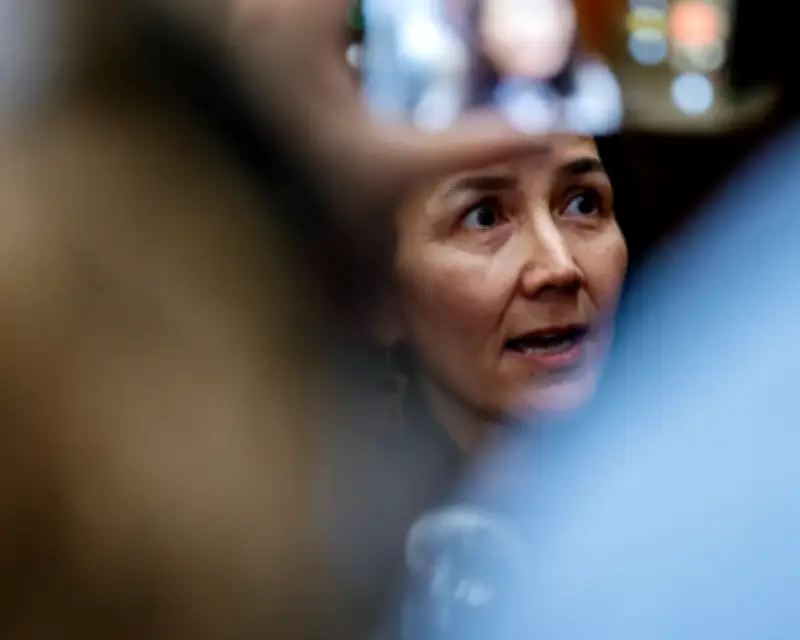
The US Justice Department, at Donald Trump's request, has sued to block certification of Alaska's US Senate race if the Republican incumbent narrowly loses, a judge dismissed that suit on Sunday, though the administration said it planned to appeal.
On Wednesday, Trump demanded that Mary Peltola, the Alaska Native Democrat whom polls favor to win, be removed from the ballot and prosecuted. Alaska's Republican governor has since ordered an investigation into Peltola's campaign.
Background of the Ballot Dispute
A New York Times investigation reported that operatives working with Peltola's campaign helped recruit another Sullivan, a retired teacher from Petersburg, to split the incumbent's vote. Peltola and her campaign have denied this.
The tactic is generally legal in Alaska, where the state supreme court refused to remove the other Sullivan from the ballot.
In 2020, Trump's allies pushed Kanye West on to ballots in states including Vermont, Arkansas and Wisconsin to take away votes from Democrats. In 2024, Trump allies worked to get Jill Stein and Cornel West on ballots in swing states, and Trump praised both from a rally stage because each "takes 100%" from Democrats.
Federal Intervention in One Race
Not one federal lawyer intervened in those cases. What's different in Alaska is not the tactic but that the federal government has decided to police it in one race, before a single vote is counted.
In Ohio, the Libertarian candidate Bill Redpath is being promoted by Democrat-affiliated groups, as Republicans have spent more than $1.58m boosting Gregory Levy, a progressive candidate. In Iowa, Democratic-aligned PACs have deployed hundreds of thousands of dollars to promote a Libertarian candidate, Thomas Raymond Laehn, whose presence on the ballot could eat into the Republican candidate Ashley Hinson's already slim polling lead.
The justice department hasn't touched these cases. It has sued in only one state, the one where an Alaska Native woman is favored to win.
Scrutiny of Native American Candidates
The Democratic candidate Peggy Flanagan in Minnesota, a member of the White Earth Band of Ojibwe, is experiencing similarly heightened scrutiny in her US Senate campaign.
On 21 October, the Wall Street Journal reported that Flanagan had inflated her credentials by claiming Phi Beta Kappa membership. Phi Beta Kappa's associate secretary and chief operating officer, Amber Fox, confirmed to CBS News that Flanagan was inducted in 2002, and WSJ eventually corrected the story.
Political scientists have shown how doubts about electability follow women of color. Primary voters may personally agree with their positions, yet withhold support because they fear other voters, especially general-election swing voters, won't back the candidates. Local party chairs share these doubts too.
Researchers at Rutgers' Center for American Women and Politics have also found that Native American women in politics, among other women of color, carry heightened stress and perform additional emotional labor because of their intersecting identities, though Native women remain among the least studied groups in the field.
Peltola and Flanagan are testing these entrenched doubts in majority-white statewide races, and the scrutiny lands right as they do. Peltola has also weathered two major New York Times investigations in five weeks, one into her treatment of staff and one into the ballot scheme, and her lead has held.
Why Alaska Matters
No Native American woman has ever served in the US Senate. This year, two are within reach of it, and both have spent the final weeks of their campaigns fending off scrutiny, one from a major newspaper that appears to have gotten the story wrong, the other from a federal government that has singled out her race alone.
Republicans hold the Senate 53-47, and Alaska is one of only a small handful of toss-ups that will decide if Trump can keep his majority for the last two years of his presidency. It's a state he has carried three times, but a majority of likely voters now disapprove of him.
Alaska Native voters complicate the picture even more deeply. In 2024, the North Slope and North-west Arctic district, where Alaska Native voters are a majority, gave Trump half its vote in the presidential race and Peltola 55% in that year's House race. Many of the voters Washington now claims to be protecting chose both.
But the method matters more than the motive. A justice department that will sue to pre-empt a state's certification, on behalf of one candidate, before a single ballot is counted, is testing the limits of a power the constitution leaves to states.