Donald Trump has issued a stark one-word warning to his potential successor amid growing speculation about who might replace him as the Republican presidential candidate in 2028.
Trump's Warning on Succession
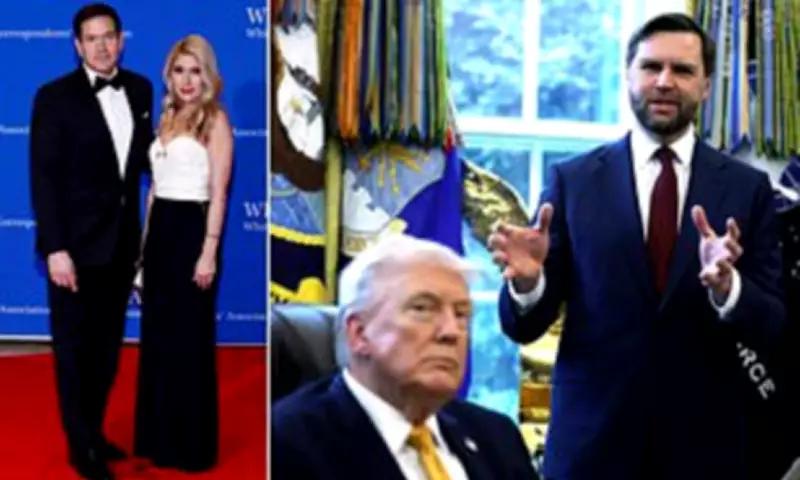
During an interview with Fortune Editor-in-Chief Alyson Shontell, Trump was asked who he believed was best suited to carry forward his legacy of aggressive dealmaking. The discussion touched on several potential candidates, including his son Don Jr., Secretary of State Marco Rubio, and Vice President JD Vance.
As Shontell posed the question in the Oval Office, she noted that Vice President Vance had quietly entered the room and would hear Trump's response firsthand.

"Whoever gets this job is going to be very important," the President replied. "And if you get the wrong person: disaster."
When pressed on who could replicate his distinctive brand of top-down economic power plays, Trump dismissed the possibility entirely. "Can't answer that question," he told Shontell. "I don't know. I mean, it's not going to happen again."
Context of the Interview
The hour-long conversation took place at the Resolute Desk, just hours before Trump departed for a high-stakes state visit to Beijing. He traveled with top officials including Rubio and Defense Secretary Pete Hegseth, as well as his son Eric and daughter-in-law Lara. Trump even made last-minute arrangements for Nvidia CEO Jensen Huang to accompany the delegation on Air Force One alongside Elon Musk.
Vice President Vance remained in the United States as a precautionary measure in case of any emergency.
Trump's Deal-Making Legacy
Trump proudly told Fortune that Boeing CEO Kelly Ortberg had dubbed him the "Salesman of the Year" ahead of the Beijing trip, where the US and China struck a deal for the sale of 200 Boeing jets. "I want to help American companies. There's nothing in it for me other than I want companies to do well," Trump said.
The President also used the interview to criticize the Supreme Court over its recent ruling that quashed around half of his Liberation Day tariffs. "It really pisses me off," Trump said. "Can you imagine, to people who hate us, to countries that ripped us off for years, I've got to give them back $149 billion."
He insisted that he would find another path to implement his tariffs and defended his rapid-fire economic approach. "I make one of those deals every day that no normal person would make," Trump said. "Some people actually think it's un-American, what I do. They say, 'You're taking their company away.'"
The Intel Deal and Trade Policy
Trump pointed to the lucrative deal to acquire a 10 percent government stake in Intel. An aide handed over a printout showing that the government's Intel position had exploded to a value of more than $50 billion in just eight months. "Do I get credit for it? Does anybody even know I did that?" Trump asked.
He argued that the deal corrected decades of poor trade policy, claiming that his protectionist stance would have saved the US tech giant from being bested by foreign rivals. "Intel should be the biggest company in the world right now," Trump said. "If I had been president when all these companies started sending their chips in from China, I would have put a tariff on that would have protected Intel. Intel would have all that business now, and there would be no Taiwan."
Beijing Visit and Iran Negotiations
The high-stakes visit yielded a package of economic and geopolitical agreements but has largely been viewed as a tentative first step to normalize US-China relations after years of tensions marked by trade wars. Beyond the Boeing jets, China's first commitment to purchase US-made aircraft since 2017, the White House confirmed a multi-billion dollar windfall for American farmers. Under the terms of the historic deal, Beijing has committed to purchasing $17 billion worth of agricultural products per year through 2028.

On the geopolitical front, Trump and Xi Jinping agreed that Iran cannot obtain a nuclear bomb and should reopen the Strait of Hormuz. Turning to the negotiations with Iran, Trump expressed frustration with Tehran's tactics as the ceasefire entered its sixth week. "They scream all the time," he told Fortune. "I can tell you one thing, they're dying to sign a deal. But they make a deal, and then they send you a paper that has no relationship to the deal you made. I say, 'Are you people crazy?'"