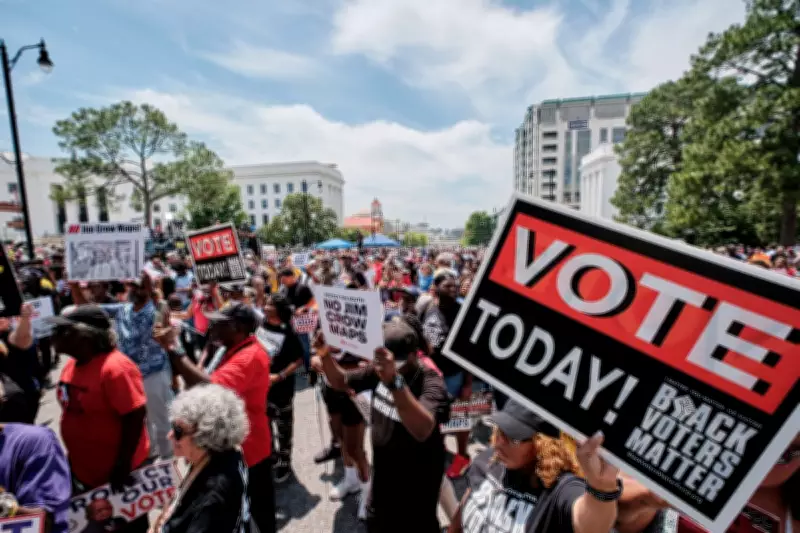
Thousands of people from across the United States converged on Montgomery, the capital of Alabama, on Saturday for the All Roads Lead to the South rally. They arrived by bus, car, and plane to protest the recent Supreme Court decision in Louisiana v Callais, which effectively weakened the Voting Rights Act and limited protections against voting discrimination. The event was organized by a coalition of national and local civic engagement groups and took place outside the Alabama state capitol building, in the same plaza where the historic 1965 Selma to Montgomery voting rights marches occurred.
Mayor Steven Reed Addresses the Crowd
Montgomery Mayor Steven L. Reed, the first Black person to hold the position, addressed the gathering. “We’re here, Montgomery, not at a stopping point, but at a starting point,” he said. “We’re here in this city because of the spirit, because of the courage and because of the commitment of our forefathers and foremothers who got us to this point.”
Republican-Led Redistricting Efforts
Following the Supreme Court decision, Republican-led states have moved to redraw voting maps in ways that diminish Black political power. Tennessee and Florida have already enacted new maps, while Alabama, Louisiana, and Georgia are expected to follow. Mississippi temporarily paused redistricting, with the governor pledging to revisit the issue soon. Voting activists from these states, along with local and national elected officials including Senators Cory Booker and Raphael Warnock, and Representatives Terri Sewell, Shomari Figures, and Alexandria Ocasio-Cortez, took the stage to mobilize attendees.

“We need to fight with all we got,” said Tennessee State Senator Charlane Oliver, who protested her state’s redistricting by standing on her desk last week. “They may draw some racist maps, but we are the south, this is our south. The south belongs to us. The south got something to say, and we gon’ speak real loud and clear in November.”
A Rally Rooted in Faith and History
Throughout the event, spontaneous chants of “vote, vote, vote” erupted from the audience. The rally had a worship-like atmosphere, reminiscent of the Black church’s crucial role in the civil rights movement. It began with a prayer, and when an attendee experienced a medical emergency, an emcee asked the crowd to “put their praying hands together.” Multiple gospel songs were performed during the day.
Personal Connections to the Struggle
For many attendees, the rally was deeply personal. Their family members had fought for voting rights, and they felt a responsibility to continue that legacy. “My grandmama, my momma, my mother-in-law – our ancestors did not cross that bridge, walk during the bus boycott, my cousins got locked in the First Baptist Church [in Montgomery], across from the police station in the 60s, my other cousin got beat up by a horse up on Jackson Street – we didn’t do all that for this,” said Carole Burton, a Montgomery resident.
From Selma to Montgomery
The day’s events began in Selma with a prayer service at the historic Tabernacle Baptist Church, followed by a silent walk across the Edmund Pettus Bridge, the site of the brutal “Bloody Sunday” violence against civil rights marchers in 1965. Participants then traveled by bus to Montgomery, where they were joined by thousands more.
Nationwide Solidarity
All Roads Lead to the South was not an isolated event – more than 50 satellite gatherings were held across the country for those unable to travel to Alabama. Speakers emphasized that the fight would continue elsewhere. “Our task is bigger than defending the past,” said Rukia Lumumba, director of the Mississippi VRA Rapid Response Coalition and M4BL Action Fund. “Our task is to build a democracy worthy of the people who bled to create it in the first place.”