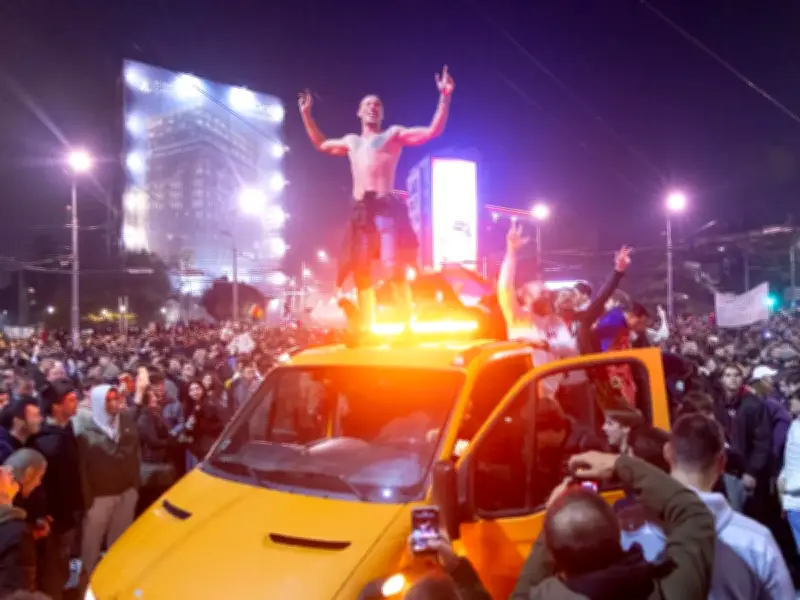
Serbia's parliamentary election on October 25 ended with a student-backed movement, the "Student List," securing a commanding victory and bringing an end to Aleksandar Vučić's 14 years in power. Vučić formally conceded defeat after independent polling groups CeSID and Ipsos projected the movement would win 139 to 140 seats in the 250-seat parliament, enough for a clear majority.
The win has come with a historic twist: Serbia still does not have a single named Prime Minister. The Student List deliberately ran without naming a preferred head of government, and because the movement chose to stay decentralised and opaque, the exact shape of the new cabinet is expected to be decided over the coming weeks.
Transition at the Top of the State
At the very top of the state there is also a stop-gap situation. Vučić resigned under pressure in September, and Parliament Speaker Ana Brnabić is currently filling the role of President in a caretaker capacity until a formal presidential election takes place in December.
The uprising that powered the students to victory began with tragedy. On November 1, 2024, a concrete canopy outside the newly renovated railway station in Novi Sad collapsed, killing 16 people. The disaster was widely blamed on negligence, shoddy building standards and corruptly managed state contracts, and anger exploded when critics said the government failed to properly investigate or hold senior figures accountable.
From Campus Blockades to a Nationwide Rebellion
Students responded with spontaneous campus blockades and daily 16-minute silences, which over nearly two years grew into a nationwide rebellion against censorship, political violence and authoritarian control.
Analysts say the result is globally remarkable because turnout surged to nearly 70 per cent, the highest level of participation since the violent breakup of Yugoslavia in 1992. Traditional opposition parties stood aside as student plenums created the Student List, then pulled off a risky tactic that appears to have worked: not a single student was placed on the ballot.
A Clean Slate of Candidates
Instead, organisers selected a full roster of 250 respected non-political figures, including doctors, judges, academics and artists, aiming to win over older and more conservative voters who distrusted the usual political class. Minutes after the result became public, celebrating crowds in Belgrade tore down the metal fences of "Ćaciland", a pro-Vučić tent camp that had stood outside parliament for 18 months, in a moment many saw as the symbol of a new era.
The Student List's new MPs are now tasked with a strict 11-point anti-corruption manifesto, including purging compromised officials and freeing public broadcast media from state control, while keeping divisive topics like EU accession and Kosovo on the back burner for now. The UK is watching closely because Serbia has been seen as a key pro-Russian proxy on Europe's doorstep.
Shifting Foreign Policy and Regional Impact
Under Vučić, Belgrade refused to join UK and EU sanctions on Russia after the Ukraine invasion, kept flights running to Moscow and maintained deep ties with the Kremlin. British strategists also have security interests in the region through NATO's KFOR mission in Kosovo and a UK special envoy, and they will be looking for signs the new leaders will lower tensions around Kosovo and Bosnia.
Serbia's position on the "Balkan Route" also makes it central to migration and organised crime, while a cleaner government could affect European energy projects and provide a blueprint for beating "illiberal democracies" that control media and courts.
Supporters say the students changed the country by turning private grief into relentless national mobilisation, bypassing state-controlled media with grassroots networks, avoiding unpopular opposition politicians by offering a clean slate of respected public figures, uniting a split society by focusing on domestic "survival", and driving a turnout so high it broke a 14-year monopoly.
Serbia is not alone. In Bangladesh, a 2024 Gen‑Z uprising that started over a civil service quota system forced Prime Minister Sheikh Hasina to resign and flee after 15 years, with students pushing for an interim government led by Nobel laureate Muhammad Yunus. Nepal saw youth-led protests in 2025-2026 that helped drive change through elections, bringing the Rastriya Swatantra Party to power under Prime Minister Balendra Shah. Albania's 2026 "Flamingo Revolution" has seen students besiege parliament and clash with police as they demand Prime Minister Edi Rama's resignation. In France, school blockades and walkouts this year have brought huge crowds onto the streets against President Emmanuel Macron's austerity and education cuts.