

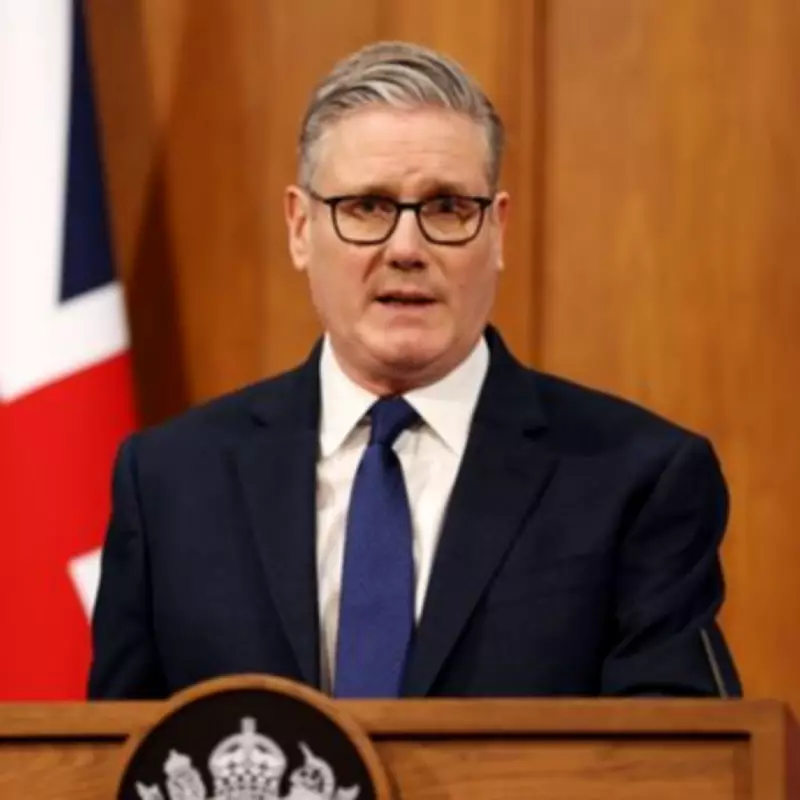
Starmer's Political Resurgence Meets Daunting Election Projections
Prime Minister Keir Starmer has initiated Labour's local election campaign with renewed vigour, buoyed by what commentators describe as his 'Love Actually' diplomatic moments. However, the electoral landscape presents formidable challenges as the nation approaches crucial voting in May.
Navigating International Crises and Domestic Politics
Starmer has recently garnered public approval through his handling of delicate international situations, particularly his firm stance regarding the escalating conflict in Iran. His refusal to align with unpredictable US President Donald Trump's positions has resonated positively with voters, contrasting sharply with the approaches of political rivals Nigel Farage and Kemi Badenoch.
This strategic positioning has allowed Starmer to adopt a more proactive political stance, reassuring citizens that he would not repeat the controversial alignment decisions made by former Prime Minister Tony Blair in 2003. Labour MPs have noted this shift, with one observing that for the first time in months, Number 10 no longer appears to be in what they termed a "defensive crouch".

Reform Party's Troubles and Electoral Implications
Meanwhile, Nigel Farage's Reform Party faces mounting difficulties following a series of damaging incidents. The party's housing spokesman, Simon Dudley, was dismissed after making insensitive remarks about the Grenfell Tower tragedy, creating significant reputational harm.
Furthermore, Farage's repeated visits to the United States to court favour with the increasingly unpopular President Trump may now be backfiring politically. These developments have sparked cautious optimism within Labour circles that Reform's prolonged poll dominance might be waning, though this remains speculative at this early stage.
Alarming Election Predictions for Labour
Despite these positive developments, electoral forecasts paint a bleak picture for Labour's immediate future. Professor Stephen Fisher, an elections specialist at Oxford University, has projected that Labour could lose approximately 1,900 council seats in the upcoming local elections.
Conversely, Reform might gain over 2,200 seats according to these predictions. Local Government Chronicle experts Colin Rallings and Michael Thrasher have similarly warned that Labour's losses could exceed 1,000 seats, indicating substantial electoral challenges ahead.
Unprecedented Electoral Uncertainty
Polling analyst and Conservative peer Lord Hayward has described the forthcoming May elections as "probably the most important and challenging I have ever seen." He highlighted widespread voter apathy and confusion, noting that many citizens remain undecided about whether they will participate and which party they might support.
This political volatility stems from what Hayward identifies as weak party allegiances and inadequate political messaging in recent years, creating an exceptionally unpredictable electoral environment.
Internal Labour Perspectives and Future Scenarios
Within Labour ranks, MPs acknowledge the difficult polling situation but report more positive experiences during constituency engagements. One backbencher from the 2024 intake noted that while the overall outlook remains challenging, Starmer's handling of the Iran crisis has positioned the party favourably compared to Conservative and Reform approaches to Trump.
Another Labour MP suggested that Reform's relatively low profile might be a deliberate strategy to prevent candidate missteps, and expressed confidence that Starmer would weather the electoral storm regardless of outcomes due to his competent crisis management.
Potential Consequences and Historical Parallels
Should the election results align with the pessimistic predictions, questions will inevitably arise regarding Starmer's leadership longevity, with potential challengers likely to emerge. However, the Prime Minister's aides have been quick to downplay suggestions that poor local election performance would necessarily foreshadow defeat in the 2029 general election.

A Labour source emphasised that "mid-term local elections tend to be difficult for incumbent governments" and rarely serve as accurate predictors of subsequent general election outcomes. The party remains committed to campaigning vigorously on key issues including NHS reform, cost of living support, and national pride restoration.
Historical precedents offer some consolation for Labour strategists. The Conservative Party under David Cameron experienced significant local election setbacks during his first term before securing victory in the 2015 general election. Similarly, Labour under Tony Blair suffered substantial local election losses in 2004 following the Iraq War controversy, yet managed to win the 2005 general election.
Addressing Voter Discontent and Policy Challenges
Nevertheless, convincing disgruntled Labour MPs and disillusioned voters will require substantial effort if electoral outcomes prove particularly unfavourable. One MP highlighted the electorate's search for clarity regarding Labour's solutions to socioeconomic inequality, particularly as living costs escalate while wealth extraction continues unabated.
The perception that government is not employing all available measures to assist ordinary citizens, including potential wealth taxation, risks reducing politics to mere transactional technocracy rather than a source of genuine solutions and hope. Voters increasingly seek political relevance and leadership that embodies values resonating with their daily experiences and aspirations.





