
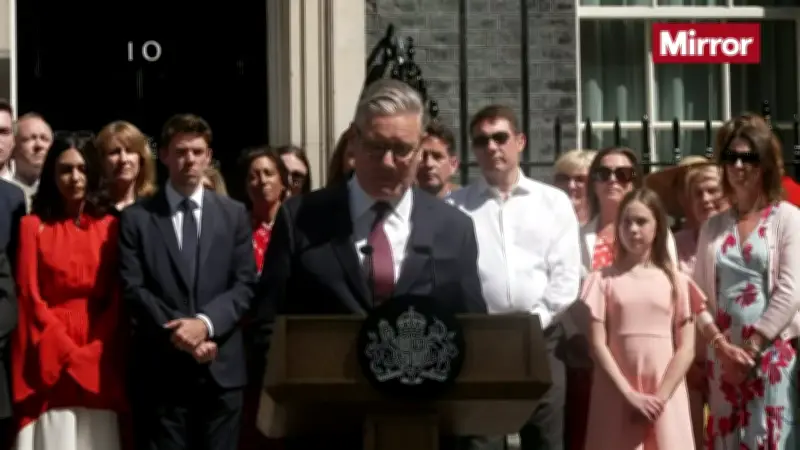
Standing at the lectern on Downing Street, surrounded by a large crowd of family, friends and colleagues - many of whom are now contemplating unemployment - Keir Starmer declared that “my work is done” and that “I go with a smile” in his final speech as prime minister.
If the smile didn't quite convince, it's because the manner and speed of his departure were not entirely of his own choosing. There was dignity in the choreography of the farewell, but very little disguising the political reality behind it.
The departing premier, joined by his wife Lady Victoria Starmer, insisted the country was "stronger and fairer" than when Labour took office. Judging by the mood within his own party, and among an increasingly sceptical electorate, that message hasn’t landed.
Political Arithmetic Forces Starmer Out
He didn't look entirely convinced of it himself. For all the ceremony, there was a sense that this was less a triumphant valedictory and more an acknowledgement that events had overtaken him. Prime Ministers rarely get to decide the terms on which they leave office, and Starmer is no exception. His resignation may have been delivered with grace, but it came because the political arithmetic had become impossible to ignore.
The May local elections were the final blow, but the rot had set in long before then. The initial mishandling of the Gaza war, the wildly unpopular decision to cut winter fuel payments, together with a succession of unforced errors, policy reversals and hesitant messaging, steadily eroded the trust that had carried Labour into government with such authority.
Trust Eroded by Policy Reversals and Hesitant Messaging
Rather than projecting competence and purpose, Downing Street increasingly appeared reactive and uncertain. Each individual setback might have been survivable, but together they created an impression of an administration that had lost control of its own narrative. And, by the way, the narrative wasn’t entirely clear. Voters had chosen Labour to change the country, despite Labour not being entirely clear about what that change would look like. In the run up to the General Election, the party had sought to manage and lower expectations. Somehow they under-promised and still undelivered.
By the time voters headed to the polls in May, many had already made up their minds. The local election results merely confirmed what opinion polls had been suggesting for months. Sir Keir's approval ratings had collapsed to extraordinary levels for a Prime Minister so early in a parliamentary term. He had become comfortably the least popular party leader across a range of surveys, while Labour MPs privately fretted about the absence of a compelling vision and the government's inability to communicate what it had actually achieved in office. Add to that the rise of the right wing insurgent Reform and the parliamentary party was increasingly unsettled.
Local Election Earthquake Strips Confidence
The loss of more than 1,400 councillors was not simply another bad night for Labour. It was a political earthquake that stripped away any remaining confidence in Starmer's leadership. Nervous MPs who had once urged patience were suddenly looking elsewhere for answers. Increasingly, those answers appeared to lie 200 miles north of Westminster, where Greater Manchester Mayor Andy Burnham's popularity and political instincts have made him the obvious focus for a party searching for renewal.
"In six and a half years, I took our party from a historic defeat in 2019, changed it so it was fit to face the country and won a landslide general election victory in 2024," Starmer said in his farewell remarks. On paper, that is an impressive political record. In practice, it may not be quite the boast he imagines. Winning elections matters, but so does what follows. The scale of Labour's victory only serves to underline how extraordinary its loss of public goodwill has been.
Landslide Majority Squandered at Remarkable Speed
It is little short of staggering how quickly a Labour leader who delivered one of the party's biggest ever election victories transformed from electoral asset into electoral liability. Landslides are supposed to buy governments time and political capital. Starmer somehow managed to exhaust both at remarkable speed. The overwhelming parliamentary majority that once looked like a platform for lasting reform instead became a reminder of just how much political ground had been squandered.
Despite his smiles today, and his insistence that he leaves office in good grace, it is difficult to imagine that his removal does not sting. After all, this was a politician who spent years rebuilding Labour after its worst defeat in generations, only to discover that winning power is often easier than holding on to it. His premiership will inevitably prompt questions about whether Labour misunderstood the nature of its 2024 victory. Was it an enthusiastic endorsement of Starmer's vision, or simply a rejection of a tired Conservative government? Events since then suggest the latter.
Political Lesson for Burnham: Deliver Change or Face Same Fate
It is often said that all political careers end in failure, and given enough time they usually do. Yet some collapse with startling speed. Starmer's premiership will ultimately be remembered less for the landslide that brought him into office than for the astonishing pace at which he squandered it. A leader who inherited not only a commanding Commons majority but also the goodwill and patience of a country managed, in little over two years, to convince many of the very people who had placed their trust in him that he was not equal to the task.
Politics is unforgiving, particularly in an age when voters expect immediate results and have little appetite for promises of long-term rewards. Governments no longer enjoy lengthy political honeymoons; they are judged almost from the moment they walk through the door of Number 10. Starmer discovered that harsh reality sooner than most. For Andy Burnham, the lesson is an obvious one. Get on and deliver change. Or it’ll be you saying farewell at the lectern next.




