
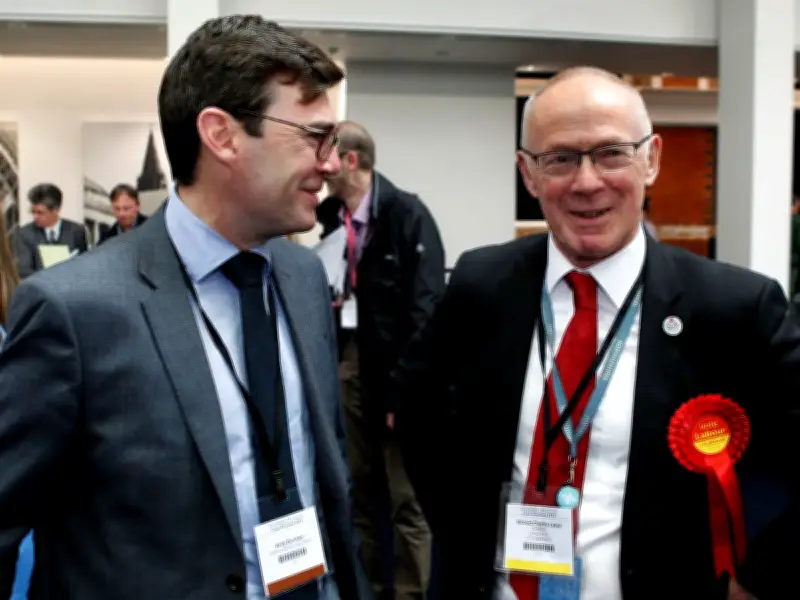
Sir Richard Leese, the former leader of Manchester City Council for 25 years, has come to the defence of Andy Burnham against critics who accuse him of 'flip-flopping' and wrongly taking credit for the city's economic success. Burnham's statements and policies have faced increased scrutiny since winning the Makerfield by-election on June 18.
Criticism from Political Figures
Reform UK leader Nigel Farage labelled Burnham a 'flip-flopper' on Sky News Australia, stating: “I have no idea what his policies are, I have no idea what he believes in. This is a historic flip-flopper. This guy is the epitome of the career politician who blows with the wind.” Shadow Chancellor Mel Stride also described Burnham as a man who 'flip flops'.
Sir Richard's Defence
However, Sir Richard challenges these views in an exclusive op-ed for the Manchester Evening News (MEN), engaging in what he calls 'myth busting'. He writes: “Andy is often credited for what others have done, but he doesn't claim credit for what others have done. For example, when talking about economic growth in Manchester, Andy has always credited Howard Bernstein and myself. I've seen him very regularly publicly praise others for their contribution.”
He further questions the term 'flip-flopping': “And why is changing your mind described as flip-flopping? I've often argued with Andy, not always successfully, for him to change his mind, and for an intelligent, learning politician, as understanding and circumstances change, so should their mind.”
Earlier Radio 4 Comments
Sir Richard’s op-ed follows his comments on Radio 4’s Today programme earlier this week, where he was asked about Burnham being 'a bit flakey'. He told the presenter: “I think Andy, apart from anything else, is a very people person. He empathises with people that have got high levels of need. He wants to help them. He responds very positively to those people.”
Burnham's Record and Adaptability
Sir Richard, a former teacher and youth worker, was one of the longest-serving council leaders in the country. He and Howard Bernstein – chief executive of Manchester City Council from 1998 to 2017 – oversaw the city's transformation and were knighted for their efforts. Burnham appointed Sir Richard as deputy mayor of Greater Manchester in May 2017.
In the MEN, Sir Richard acknowledges that Burnham is not perfect and that working with him was not always easy. He notes that Burnham initially “brought some Westminster ways with him, not least the habit of Government Ministers to announce policy first and think about the details and delivery afterwards,” but adapted to Greater Manchester's 'collaborative' and 'consensus' style of politics.
He cites Burnham's role in developing the Good Employment Charter, championing bus re-regulation, and taking on the region’s health portfolio as examples of embracing devolution and partnership working. He adds: “Westminster would be a whole lot better if it worked in this way.”
Honest Criticism
While praising Burnham, Sir Richard does not shy away from criticism. He writes that Burnham’s commitment to eradicate homelessness “though laudable was undeliverable.” Nonetheless, his 'A bed every night' emergency shelter scheme demonstrates “he has Manchester's can-do attitude.”
He also highlights Burnham’s role in delivering bus re-regulation, describing the process as lengthy and complex due to legal challenges. “It was not easy with hostile bus companies scrutinising every step,” he writes.
People Person and Covid-19 Response
Above all, Sir Richard describes Burnham as a “people-person, with a natural empathy for people's needs and aspirations” – something he noticed during the Covid-19 pandemic. Burnham’s disputes with central government were driven by a desire to protect local residents from “remote and often irrational” decisions.
Writing on Burnham’s election as Makerfield’s MP, Sir Richard concludes: “The Makerfield test will be real. How will a particular policy make the lives of people in the many different communities of Makerfield better, and consequently better in all the ‘Makerfields’ all over the country?”




