
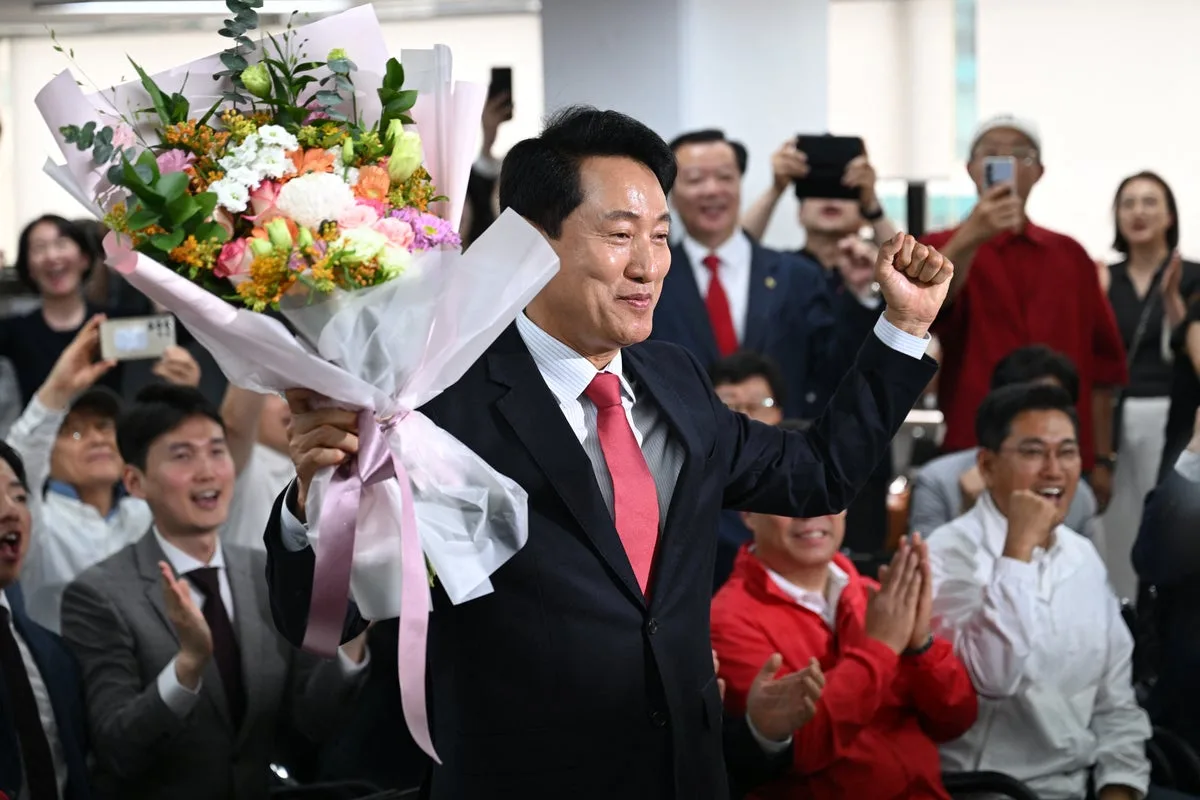
South Korea's ruling Democratic Party secured a majority of victories in Wednesday's local elections but suffered a significant setback with the loss of the crucial Seoul mayoral contest. The outcome complicates efforts to solidify President Lee Jae Myung's political mandate, despite his party's broader success.
The Democratic Party won 12 of the 16 mayoral and provincial gubernatorial posts, while the conservative People Power Party (PPP) secured four, including the Seoul mayoral race. Democratic Party leader Jung Chung Rae described the defeat in Seoul as 'painful', though he expressed gratitude for support elsewhere.
The elections coincided with Mr Lee's one-year anniversary in office, following a snap election triggered by the removal of former President Yoon Suk Yeol. Mr Lee's approval ratings remain above 60 per cent, buoyed by his 'pragmatic diplomacy' and a booming stock market. However, analysts noted that the Democratic Party should have clinched Seoul given the PPP's disarray after Mr Yoon's impeachment.
In the Seoul mayoral race, incumbent Oh Se Hoon overtook Democratic candidate Chong Won O as votes were counted. Mr Oh declared that 'Seoul's future has become brighter' and that citizens 'preserved Seoul as democracy's last safeguard'. Mr Chong conceded defeat, saying he 'heavily and humbly' accepted the result.
The election was marred by controversy after a shortage of ballot papers at some polling stations led to a temporary suspension of voting. PPP leader Jang Dong Hyeuk demanded a new election, but the Democratic Party rejected the demand as 'not even worth considering'.
Meanwhile, PPP continues to grapple with internal feuding between reformists and loyalists. In Busan, independent candidate Han Dong Hoon, a reformist expelled from the PPP, defeated the Democratic Party's Ha Jung Woo. Analysts suggested Mr Han's victory could either help reformists regroup or deepen the conservative divide.




