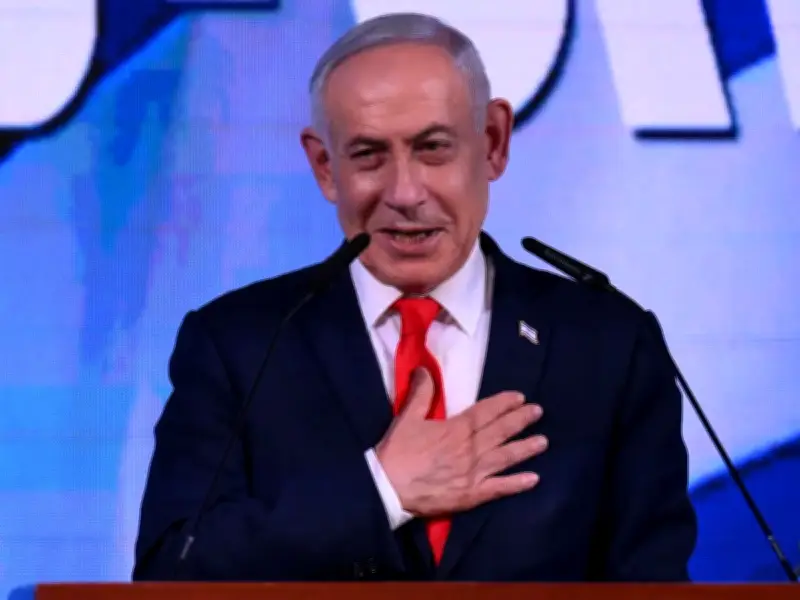
Israeli Prime Minister Benjamin Netanyahu has declared victory in the country's election, telling supporters that official results will show Likud is the largest party in parliament. Speaking at his party's election night celebrations in Jerusalem shortly after 3am local time, Netanyahu said: “We are waiting for the official results, which will show that the Likud is the largest party in Israel.” He added: "Israel faces a once-in-a-lifetime historic opportunity, together with our partner President Trump, to eliminate the existential threat from Iran once and for all."
Exit Polls Suggest Narrow Opposition Edge
The Prime Minister's declaration came despite exit polls indicating that voters had delivered a sharp rebuke, giving his opponents a slight edge. Initial exit polls from major Israeli TV stations suggested Netanyahu's bloc won 50 seats, the opposition won 52-53, and Arab parties won 17-18. Revised polls suggested a slight increase in support for Netanyahu but still left him short of a governing majority, with Likud projected as the largest party with about 27 seats.
The broader blocs led by Netanyahu and his main rival, former military chief Gadi Eisenkot, each captured about 51 seats, according to the polls, which initially gave Eisenkot's bloc a slight edge. Arab-led parties won the remaining 18 seats. A candidate needs 61 parliamentary seats to form a majority coalition government.
Coalition Talks Ahead
During his speech, Netanyahu called for a "strong, right-wing" government and slammed the country's Arab-led parties, urging Jewish parties to line up behind him. A riled-up crowd chanted, sang, and cheered as votes were tallied, with Netanyahu joining in one of the songs.
The opposition may still find it difficult to form a government. The easiest path would involve Eisenkot partnering with Arab-led parties, but that could prove politically difficult and potentially alienate other opposition factions. Eisenkot said the exit polls show a "lack of confidence" in the current prime minister.
High Turnout and Political Limbo
An inconclusive result would leave Israel in political limbo after its first national election since the October 7 2023 attack by Hamas. The race is widely seen as a referendum on Netanyahu, whose 17-year rule has left Israelis bitterly divided. The resulting wars in Gaza, Lebanon, and Iran, along with settler violence in the occupied West Bank, have strained ties with Israel's closest allies and fuelled a rise in antisemitism.
More than 74% of eligible voters had cast ballots by 8pm, the highest turnout at that time in decades and eight percentage points higher than in the last elections in 2022, according to the Central Elections Committee. More than 7.0 million people are eligible to vote, with tens of thousands reportedly arriving from overseas.
Israel's president will task the party leader with the best prospect of forming a government, usually one with the most seats, to cobble together a coalition. If Likud emerges as the largest party, Netanyahu could claim that right. No single party has ever won an outright majority in the 120-seat parliament, forcing political leaders to forge coalitions. If no one can form a majority coalition, new elections could be held early next year.